Origin:
Probably resulting from a mutation of Aeonium ‘Plum Purdy‘. However, this origin should still be considered a hypothesis rather than a definitively established lineage.
Known names: ‘Lina‘ (the most widespread name), ‘Plum Purdy Super White Variegata‘, ‘Cornish Rose Variegata 3‘.
Date of creation / creator:
Appearance on the market around 2022 (China).
Botanical description
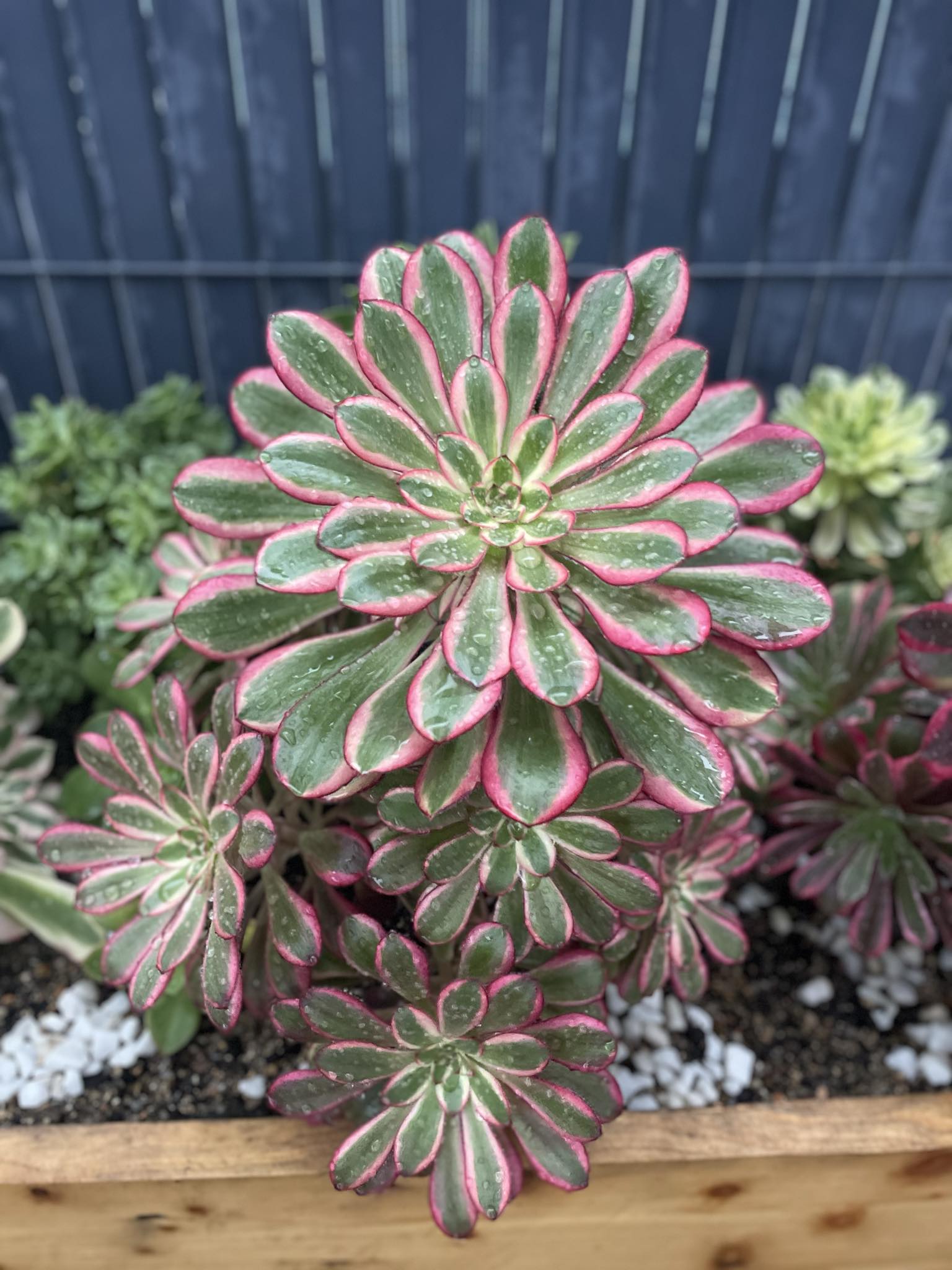
Aeonium ‘Lina‘ is a variegated shrubby Aeonium characterized by particularly bright variegation and a strong contrast between the green center of the leaves and their pale margins.
In winter, when light levels are relatively low, the leaves generally show a broad central green band, surrounded by two wide cream-white areas.
A fine pink to red edging can already appear along the leaf margin, even when light conditions remain moderate.
One of the most interesting features of ‘Lina‘ is precisely the significant width of its central green zone. This is generally more developed than in Aeonium ‘Chanel‘, which is one of the most useful visual criteria for distinguishing the two plants.
However, the variegation can vary from one rosette to another and change with the age of the leaves. It is therefore preferable not to identify a plant based solely on a single photograph.
Spectacular coloration under strong light
The aesthetic appeal of Aeonium ‘Lina‘ truly becomes apparent as light intensity increases.
Under strong light, the cream-white margins gradually accumulate red pigments and can shift towards dark red, burgundy, or even purple tones.
At the same time, the green central part of the leaves gradually darkens. On plants grown in very bright conditions, it can take on very dark shades, giving an almost black appearance.
This evolution creates a particularly spectacular contrast:
deep green → cream → red → purple
Coloration can be particularly intense when the plant benefits from strong light combined with cool temperatures and slight water stress, conditions that generally favor the expression of red pigments in many Aeonium.
Specialized growers also observe, in forms close to ‘Chanel‘, a very strong intensification of reds and greens under high light exposure.
‘Lina‘ and ‘Chanel‘: two very similar Aeonium
The comparison between ‘Lina‘ and ‘Chanel‘ is particularly interesting.
The two plants are now often placed within the same genetic line and show very similar morphology and coloration. Some growers even consider that they may be extremely close variants.
However, in the collections monitored by Variegated Aeonium, one fairly consistent visual difference appears:
Aeonium ‘Lina‘
The central green zone is generally wider, while the cream-colored parts are proportionally less extensive.
Aeonium ‘Chanel‘
The zone lacking chlorophyll is generally larger and the central green part narrower. This difference is also noted by certain specialized sources.
This distinction is not absolute, however. The amount of chlorophyll can vary depending on the age of the leaf, growing conditions, and especially the stability of the mutation.
Rather vigorous growth
Available observations indicate that ‘Lina‘ has good overall vigor for a variegated Aeonium.
Its ability to produce offsets is considered good and its growth rather fast. This feature is of interest to collectors, as it makes it relatively easy to obtain several rosettes from a single plant.
However, the vigor of a variegated Aeonium remains directly linked to the amount of chlorophyll present in its tissues. A rosette with extremely extensive variegation may naturally grow more slowly than a more chlorophyll-rich rosette.
Good resistance to sun and heat
‘Lina‘ also appears to show noteworthy resistance to summer conditions for a variegated Aeonium.
Very dark forms in this line generally tend to tolerate strong light relatively well, while developing their best coloration when they benefit from high light conditions.
It is nevertheless important to avoid extreme situations: during heatwaves, scorching sun behind glass or very hot exposure can cause leaf burn, even in a cultivar considered relatively resistant.
Good ventilation and protection from the harshest sun during the hottest hours can be particularly useful in Mediterranean climates or during heatwave events.
As with all aeoniums, frost is, by contrast, a real danger and must be strictly avoided.
WINTER PHOTOS


SUMMER PHOTOS


REVERSION OF A LINA OFFSET

Differences between Chanel, Lina, and Ice Cream

CONTINUE EXPLORING


