Origin:
Most likely derived from a mutation of Aeonium ‘haworthii‘. This origin, long presented as a mutation of Aeonium ‘leucoblepharum‘, deserves serious reconsideration today. The plant’s morphology, its behavior in cultivation, and particularly the color of its flowers are more compatible with a ‘haworthii‘ origin. A connection to Aeonium ‘Floresens‘, itself linked to this lineage, is also possible.
Known names:
‘Macaroon’ — the primary international name — ‘Macaron’, ‘Macaroon Variegated’, ‘Macaroon Variegata’, ‘Leucoblepharum Middle’, ‘Leucoblepharum Middle Variegated’, and ‘Leucoblepharum Variegated Hybrid’. The names referencing leucoblepharum stem from its initially assumed commercial lineage, which is now being questioned. No original Chinese name has been identified.
Date of creation / creator:
Commercial introduction around 2021 (China).
History and Origin of Aeonium ‘Macaroon‘
Aeonium ‘Macaroon‘ is a variegated aeonium that is particularly interesting from a botanical perspective, because its commonly accepted origin now appears to warrant serious reconsideration.
It was long presented as a « middle » form of Aeonium ‘leucoblepharum‘. This designation explains the continued commercial use of the name ‘Leucoblepharum Middle‘ encountered today.
Yet several factors make this lineage difficult to defend.
Aeonium ‘leucoblepharum‘ is a species native to East Africa and Yemen, with a natural range extending from Eritrea through northern Tanzania and Yemen. Its most important characteristic for this comparison is its yellow flowers. The flowers are typically composed of 7 to 10 yellow petals.
Yet Aeonium ‘Macaroon‘ displays a white to cream-white flower.
This difference is not trivial among aeoniums: flower morphology is actually one of the most useful characteristics for determining the affinity of a cultivar when its historical origin is uncertain.
Conversely, Aeonium ‘haworthii‘ also possesses white to cream-white flowers. Botanical descriptions indicate cream flowers, sometimes whitish, and may show slight pinkish tones.
The comparison does not stop at flowering. ‘Macaroon‘ also displays a general morphology very similar to that of ‘haworthii‘: small size, numerous branches, relatively compact rosettes, and thick leaves.
These various indicators thus make the hypothesis of a ‘haworthii‘ origin particularly credible.
Botanical Description
Aeonium ‘Macaroon‘ is a small, variegated, shrubby aeonium that progressively forms a bush composed of numerous branches.
Unlike certain variegated aeoniums that can rapidly form tall stems and imposing rosettes, ‘Macaroon‘ remains relatively compact. This trait, combined with its natural tendency to produce numerous offshoots, makes it a particularly interesting cultivar for potted cultivation and collections.
Its foliage consists of thick, fleshy, smooth, and glossy leaves arranged in a relatively compact form.
The similarity to Aeonium ‘haworthii‘ is particularly striking since the botanical species likewise possesses firm, obovate leaves, arranged in relatively small rosettes and often edged in red.
Variegation That Can Virtually Disappear
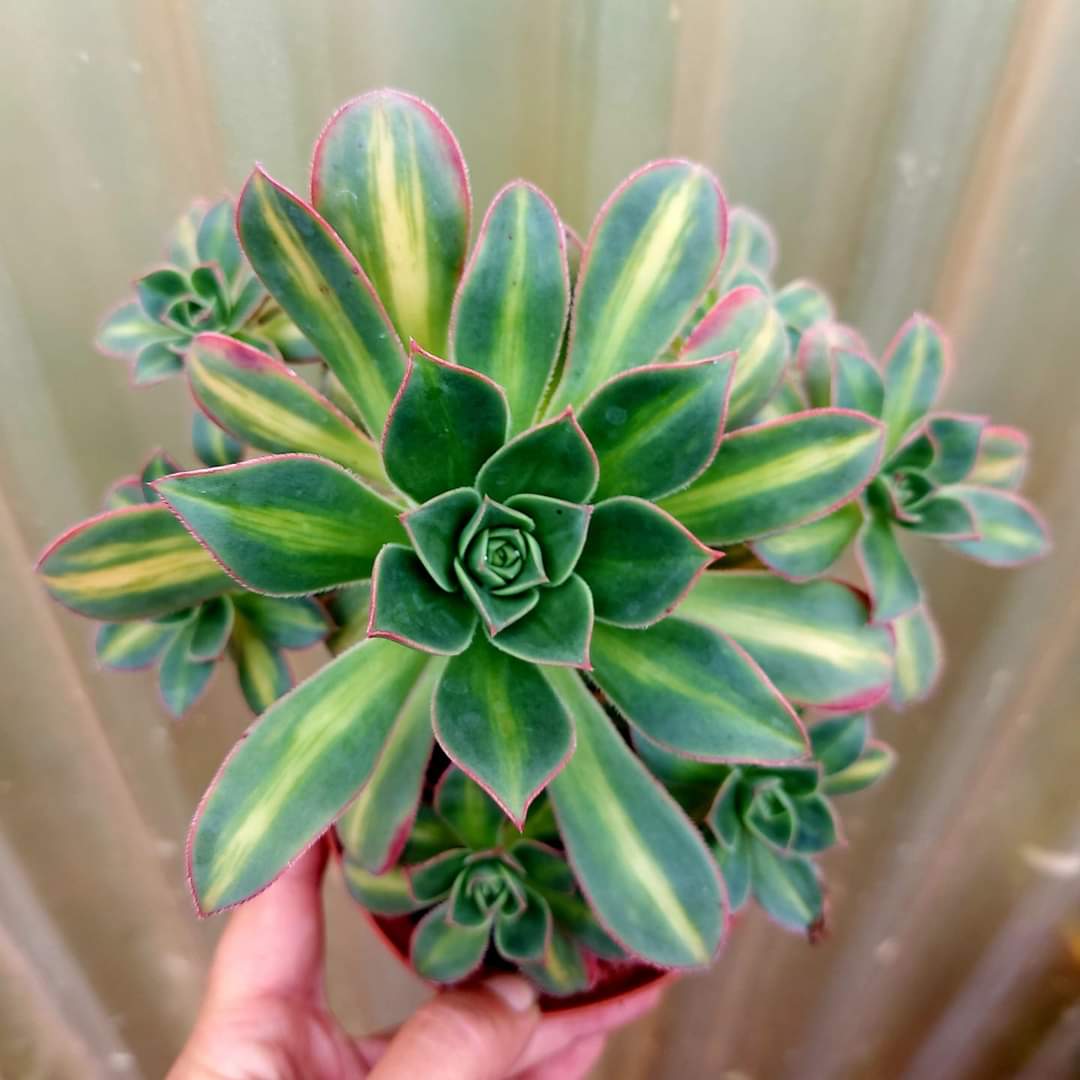
During winter, when light is lower, ‘Macaroon‘s foliage typically displays:
- a fine yellow to cream central stripe ;
- two broad green lateral zones ;
- a peripheral rim that may take on pink or red tones.
One of the most bewildering characteristics of this aeonium is its tendency to temporarily lose much or all of its variegation.
A rosette can thus become almost entirely green for several months before gradually regaining its variegated appearance.
This apparent reversion does not necessarily mean the plant has permanently lost its mutation. In ‘Macaroon‘, this frequently appears to be a temporary modification of variegation expression.
For the collector, this behavior can nonetheless be quite frustrating: a spectacular plant at the time of purchase may display much greener foliage for several months.
Coloration That Intensifies in Sunlight
As light intensity increases, the leaf margins gradually become more colorful.
The peripheral green rim gradually shifts to pink, red, or deep red hues, depending on light intensity and growing conditions.
Under strong exposure, the red coloration can sometimes extend beyond the margin and spread into the blade.
This phenomenon is consistent with the behavior of the botanical Aeonium ‘haworthii‘, whose gray-green to green leaves are also frequently edged in red when strongly exposed to light.
In ‘Macaroon‘, the combination of yellow-cream variegation, green, and red pigments produces a particularly elegant contrast.
A Morphology Strongly Reminiscent of ‘haworthii‘


The Characteristic That Changes Everything: The Flower
The characteristic that changes everything: the flower
Flowering is likely the most interesting element in the debate concerning ‘Macaroon‘s origin.
Aeonium ‘leucoblepharum‘ possesses yellow flowers, a trait well documented in botanical literature.
Conversely, Aeonium ‘haworthii‘ produces white to cream-white flowers, sometimes slightly tinged pink. This characteristic is confirmed by several botanical and horticultural references.
Now, the flowers observed in ‘Macaroon‘ are white.
This does not constitute absolute genetic proof on its own, but it is a particularly strong indicator favoring kinship with ‘haworthii‘ rather than with ‘leucoblepharum‘.
It would therefore be particularly valuable to thoroughly document the flowers of several ‘Macaroon‘ clones to verify whether this trait is consistent.


What Connection to Aeonium ‘Floresens‘?
Another line of inquiry also merits consideration.
Aeonium ‘Floresens‘ belongs to the lineage of variegated aeoniums linked to ‘haworthii‘ and is sometimes grouped with ‘Macaroon‘ by collectors.
Both plants share several general characteristics associated with this lineage, but it currently remains difficult to assert a direct relationship between them.
Growth and Branching Capacity
Aeonium ‘Macaroon‘ displays rather slow growth, but this relative slowness is more than compensated by its excellent capacity to produce branches.
It tends to branch readily and can quickly form a small bush composed of numerous rosettes.
This trait is particularly valuable for vegetative propagation and likely explains why it is possible to observe significant differences in variegation among the different rosettes of a single specimen.
A Rather Easy-to-Cultivate Aeonium
Despite its variegation and sometimes bewildering behavior, no particular fragility is currently clearly established in ‘Macaroon‘.
Substrate: a very well-draining mix is preferable to prevent water from pooling at the roots ;
Heat: good tolerance for heat, dryness, and strong sun ;
Frost: sensitive to frost like all aeoniums.
A Recurring Challenge: Loss of Variegation
One point must be emphasized before choosing this aeonium for a collection.
‘Macaroon‘ can lose its variegation for several months.
This phenomenon appears particularly frequent during certain growth phases.
Therefore, one should not automatically regard a rosette that has reverted to green as a loss of variegation.
Winter Period Photos


Summer Period Photos


CONTINUE EXPLORING


