
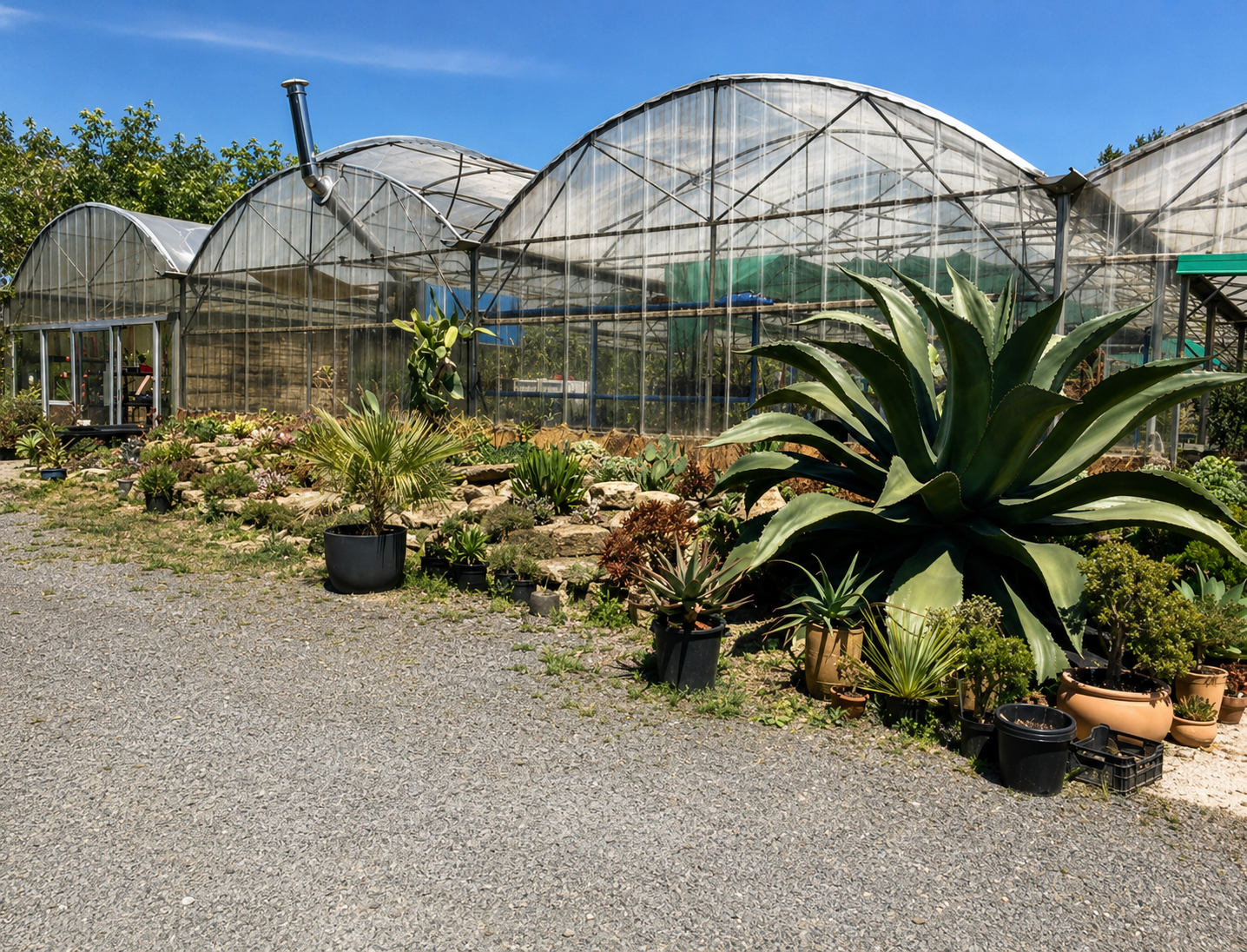
Landeda, Kerno, Langazel, Pentrez… To anyone familiar with Finistère, these names have a familiar ring. They evoke Breton villages, winding lanes and stretches of land reaching out towards the sea. Yet in Aeonium collections, they are also the names of plants. Behind each lies a story that begins in Ploudaniel, at the Serres de Pen Ar Ru.
Far from the major international centres of Aeonium breeding, this nursery has gradually given rise to a collection of distinctive selections well worth exploring. Before they became names on our plant labels, these Aeoniums were the result of passion, encounters and, above all, patience.
It all began with a passion worth sharing
The story begins with Robert Vincot, known to succulent enthusiasts as Bob, and his wife Geneviève. Together, they assembled a collection of succulent and exotic plants in Ploudaniel. Their passion grew to occupy such an important place in their lives that it eventually became their livelihood.
In the early 2010s, the greenhouses opened to visitors. Among the many Crassulaceae, exotic plants and even Proteaceae, Aeoniums found their own place. For anyone who loves these plants, the appeal of such a collection is easy to understand: the diversity of their rosettes, their changing seasonal colours and their remarkable ability to surprise us.
From Bob to Geneviève, who formally took over the business in 2015, the same horticultural adventure continued. Plants grew, the collection expanded and successive generations of seedlings appeared.
Virginie Broc’h and the next chapter
In January 2018, when Robert and Geneviève retired, Virginie Broc’h took over the Serres de Pen Ar Ru. A new chapter began without closing the previous ones. The photograph of Virginie and Bob together during a visit in 2020 captures that continuity rather beautifully.

In the following years, new Aeoniums began appearing in collections. But who should be credited with each one? For enthusiasts, this is as intriguing as it is fascinating. Some plants introduced after 2018 may have originated from much earlier sowings, while others may reflect more recent selections. Without precise first-hand accounts, it would be a pity to lose this part of their history by attributing them all to a single breeder.
The collector’s impatience and the breeder’s patience
There is something fascinating about raising Aeoniums from seed. A single flowering can produce dozens of young plants, each different from the next. A rounder rosette, darker foliage, an unexpected silhouette: an unassuming seedling may one day become the cultivar we seek out for our own collections.
But it takes time for its qualities to emerge. A plant must be observed through the seasons, allowed to mature and propagated to see whether its distinctive features are retained in its cuttings. This quiet work, often invisible to the person buying the plant, is what makes the selections of a production nursery such as Pen Ar Ru so interesting.
The parentage of many cultivars remains unknown. Some may come from deliberate crosses, others from open pollination. The dates found in collections usually mark their earliest documented introductions rather than the moment a seed germinated. There is a world of difference between a plant’s birth and the moment its story becomes visible.
When Brittany lends its names to Aeoniums
This is perhaps one of the most endearing aspects of the collection. As Aeoniums travel from continent to continent, bearing names inspired by places around the world, many of the Pen Ar Ru selections bring us back to the westernmost reaches of France.
Landeda evokes Landéda in the Abers region; Langazel recalls the heathlands and peat bogs of Ploudaniel. Crozon, Camaret and Roscanvel bring to mind the peninsula between the roadstead of Brest and the Iroise Sea. Pentrez takes us towards the Bay of Douarnenez. Other names, such as Kerno, Kerjoly, Languilly and Roudous, carry the same unmistakable Breton cadence.
Of course, the precise reason behind every name is not always known. Taken together, however, they give the collection a remarkably distinctive identity. For enthusiasts, growing an Aeonium from Pen Ar Ru is also a way of keeping a little piece of this Breton story alive.
Through the years: the Aeoniums of Pen Ar Ru
From ‘Sediblack’ to more recent selections, I invite you to explore this collection year by year. Each card leads you to the plant’s Encyclopedia profile, where you can discover its history, characteristics and seasonal variations.
Some of these plants have revealed the year they first appeared; others remain more mysterious. Each tells, in its own way, part of this Breton adventure that lives on in our collections.
2020

2021

2022

2023


2024


2025


2026
Date still to be established


A story we can still write together
What I find particularly appealing about the Aeoniums of Pen Ar Ru is that their history is still within reach. The people who grew these plants, the collectors who watched them appear and those who preserve them today can help us recover the earliest chapters.
An old label forgotten in a pot, a dated photograph, the memory of a purchase or a conversation directly with the Serres de Pen Ar Ru can sometimes provide the missing piece of a story. If you have information about breeding or introduction dates, origins, parentage or the people behind these Aeoniums, please share it on the forum, even if it still needs confirmation. Every contribution matters: together, we can preserve this Breton horticultural heritage and give it its rightful place in the history of the genus.
Join the forum discussion — Origins, history & documentation →


