The substrate, the invisible foundation of a collection of Aeoniums
This is probably one of the questions that comes up most often among collectors:
“What is the best substrate for my Aeoniums? »
The question seems simple. The answer is much less so.
Today there are a multitude of recipes for succulent plants: cactus soil, pozzolan, perlite, sand, pumice, zeolite, coconut fiber, bark, garden soil… Each material has its own properties and each collector generally ends up developing their own recipe.
However, one thing is certain: there is not a universal substrate for all Aeoniums and all growing conditions.
The ideal mixture depends on climate, temperature, exposure, container, watering frequency, the size of the pot and especially the speed at which the substrate dries.
An Aeonium grown in the ground in a Mediterranean climate will not have the same needs as a variegata cultivar grown in a pot in a humid oceanic region. In the same way, a subject installed in terracotta pottery will not behave like an Aeonium placed in a plastic container.
The real objective is therefore not to seek “the best recipe”, but to understand what we ask of a substrate.
What is a substrate?
The substrate is the environment in which the roots develop.
It performs several essential functions:
- maintain the plant;
- allow roots to anchor;
- retain part of the water;
- allow the absorption of mineral elements;
- maintain good air circulation;
- drain excess water;
- provide the roots with a stable physico-chemical environment.
For an Aeonium, the balance between water and oxygen at the roots is particularly important.
A substrate that retains a lot of water may seem interesting at first glance. It allows you to reduce the frequency of watering. But if this humidity persists for too long, the space available for air around the roots decreases and conditions become much less favorable.
Conversely, a mixture composed exclusively of very coarse materials can dry out so quickly that it becomes difficult to maintain regular growth.
The right substrate therefore lies somewhere between these two extremes.
An Aeonium is not a cactus
This distinction is worth remembering.
Aeonium belongs to the family of Crassulaceae and has a different physiology than many other succulents.
During its active period, it can enjoy relatively regular watering, even every 2 to 3 days!
This particularity is fundamental to understanding the role of the substrate.
It’s not about creating a mixture that prevents water from staying in the pot at all costs.
You need to create a mixture capable of:
absorb water → make it temporarily available to the roots → allow air to circulate → evacuate the excess → dry sufficiently quickly.
How to create a draining substrate for Aeoniums?
When talking about substrate for succulents, the term “draining” is often used.
But be careful: draining doesn’t just mean “lots of rocks.”
Good drainage depends on the overall structure of the mixture.
The particle size, porosity, proportion of fine particles, organic matter, shape of the container and even the height of the pot influence the speed of circulation and storage of water.
These recommendations have one essential thing in common:
The substrate must be draining without being poor.
The two main families of components
To simplify, we can distinguish two main categories.
Organic components
They generally constitute the fraction that retains the most water and nutrients.
On retrouve notamment :
- horticultural potting soil;
- garden soil;
- coconut fiber;
- tourbe ;
- compost or composted bark.
They also provide structure allowing roots to develop.
But their proportion must be adapted to the growing conditions.
Mineral components
They mainly make it possible to modify the structure of the substrate, its porosity, its drainage and its retention capacity.
Among the most interesting:
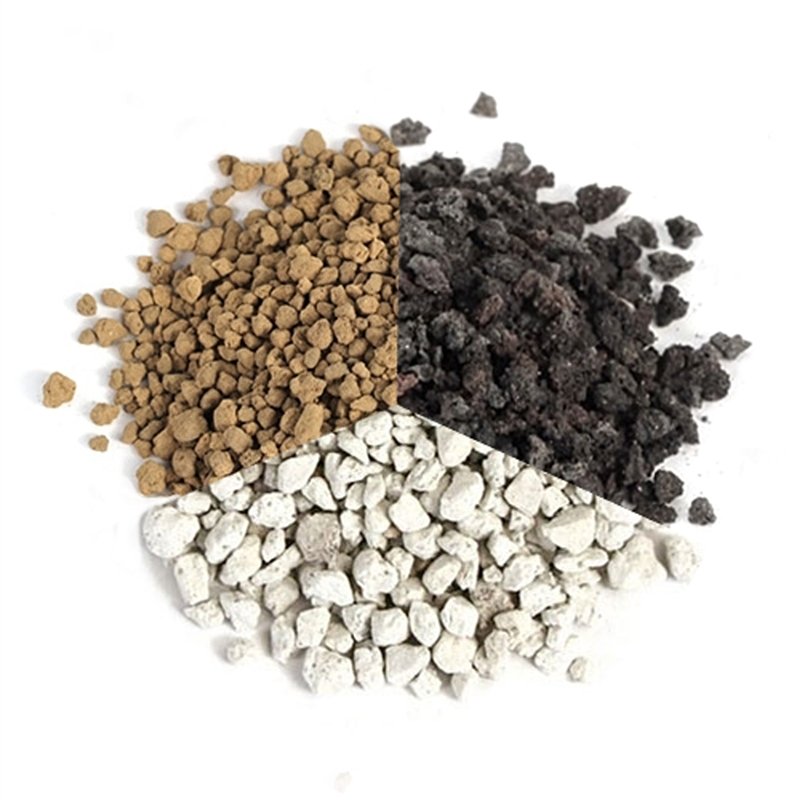
- pumice or pumice stone;
- pouzzolane ;
- perlite ;
- sable grossier ;
- gravier ;
- zeolite;
- chabasite.
However, not all of them have the same properties.
It is therefore useless to accumulate them simply because they are “mineral”.
Pumice, pozzolan, perlite: what are the differences?
Pumice: probably one of the best materials for an Aeonium collection
Pumice, or pumice, is a very porous volcanic rock.
It is of particular interest in substrates for succulents because it allows a durable structure to be obtained while maintaining air-filled spaces.
It also has a certain water retention capacity without transforming the mixture into a heavy and compact substrate.
For a collection of rare or fragile cultivars, it is a particularly interesting material.
Its main advantages:
- excellent porosity;
- good stability over time;
- improved ventilation;
- drainage efficace ;
- low tendency to compaction;
- good particle size when correctly selected.
Its main disadvantage remains its price, generally higher than that of materials such as pozzolan or sand.
For a valuable collection, it is nevertheless one of the materials that I favor. It is useful to compare the different particle sizes of pumice in order to choose grains adapted to the size of the pots.
Pozzolan: the versatile mineral
Pozzolan is a volcanic rock widely used in horticulture.
It is particularly interesting for:
- increase the mineral proportion of a mixture;
- improve its structure;
- limit compaction;
- promote the evacuation of excess water.
It is also very durable.
However, its particle size is important: a pozzolan that is too fine will not provide the same benefits as a suitable particle size.
For Aeoniums, I generally favor grains large enough to maintain good air circulation around the roots. You can here compare pozzolan particle sizes.
Sand: excellent… as long as you choose the right one
Sand is probably one of the most misused components in succulent mixes.
The “add lots of sand to drain” principle is not always true.
Very fine sand can, on the contrary, fill the spaces between other particles and cause a more compact mixture.
For Aeoniums, you must therefore favor:
coarse sand of homogeneous particle size without fine particles (washing it can help remove them).
Coarse sand can:
- improve the structure;
- add weight to the pot;
- promote drainage;
- limit the excessive lightness of certain mixtures.
Very fine masonry sand is not the equivalent of coarse horticultural sand.
It is an excellent economical alternative which can work perfectly but which can also be counterproductive if the quality of the sand is not suitable.
Perlite: light and effective
Perlite is an extremely lightweight expanded volcanic material.
It has a porous structure and makes it possible to improve the aeration of the substrate while retaining a certain reserve of humidity.
It is particularly interesting for:
- young plants;
- cuttings;
- mixtures intended for small pots;
- the substrates that we wish to lighten.
Its main drawback is its lightness.
During handling and watering, particles may move or rise to the surface.
It is also less durable than some volcanic aggregates.
For a permanent collection, I therefore generally prefer pumice or pozzolan to constitute the main mineral structure. The horticultural perlite nevertheless remains interesting for easily lightening a mixture.
Vermiculite: use sparingly
Vermiculite has a high water retention capacity.
This is precisely what limits its interest for a substrate intended for adult Aeonium.
It can be useful in certain propagation mixtures or for young plants, but I do not recommend making it an important component of a substrate intended for adult plants.
In a humid climate or during a cool winter, too high a proportion of vermiculite can unnecessarily prolong the humidity period.
La horticultural vermiculite must therefore be used sparingly and according to your climate.
Blonde peat: effective, but not essential
Peat has excellent horticultural properties: it is light, retains water and has a good nutrient storage capacity.
But its use today poses an important environmental question.
Peatlands constitute major ecosystems for carbon storage and their exploitation is not trivial.
For an Aeonium collection, peat is therefore absolutely not essential.
Coconut fiber or certain renewable organic substrates can constitute interesting alternatives when an additional organic component is sought.
And the Seramis?
Seramis is made up of particularly porous cooked clay granules.
It has good absorption capacity and can be used as a complementary component in a technical substrate.
Its main drawback is its cost.
For a large collection, it is therefore possible to prefer materials such as pumice or pozzolan, which often make it possible to work on large volumes at a lower cost.
Le Seramis can especially be suitable for small collections or mixtures in which its regularity is sought.
What proportion of organic matter?
This is probably where the recipes get the most interesting.
There is no magic percentage.
An Aeonium installed in a very humid region with low winter temperatures will benefit from having a more mineral substrate than an Aeonium grown in a hot and dry Mediterranean climate.
Blends I recommend
Rather than presenting a recipe as universal, today I prefer to offer several bases.
1. The balanced mix — for the majority of collectors
50% organic matter
50% mineral materials
For example:
- 50% quality horticultural soil;
- 25 % pumice ;
- 25% pozzolan or coarse sand.
Pumice and pozzolan can be replaced by coarse sand for economic reasons. A completely correct alternative but necessarily a little less secure.
It is an excellent base for growing in pots in a temperate climate.
It offers enough organic matter to support growth while maintaining a largely aerated structure.
2. The highly draining mixture — humid climates
30% organic matter
70% mineral
Exemple :
- 30 % terreau ;
- 30 % pumice ;
- 25 % pouzzolane ;
- 15 % sable grossier.
Pumice and pozzolan can be replaced by coarse sand for economic reasons. A completely correct alternative but necessarily a little less secure.
This mixture is particularly interesting for:
- Bretagne ;
- Normandie ;
- Belgique ;
- oceanic regions;
- cold greenhouse crops;
- collectors who tend to water a lot.
It significantly reduces the time the substrate remains wet.
3. The mixture for hot and dry climates
60% organic matter
40% mineral
In a very hot and dry Mediterranean region, a slightly higher proportion of organic matter can keep a water reserve available for longer.
Exemple :
- 60 % terreau ;
- 20 % pumice ;
- 20 % pouzzolane.
Pumice and pozzolan can be replaced by coarse sand for economic reasons. A completely correct alternative but necessarily a little less secure.
But this recipe must be adapted if the plants are placed in a greenhouse: the heat can change the drying speed very quickly.
4. The ultra-mineral mixture for sensitive plant collections
For certain rare plants, cristae, particularly fragile variegata or plants whose root system is regularly subjected to difficult conditions, a much more mineral mixture may be interesting.
20 to 30% organic
70 to 80% mineral
This type of substrate offers excellent security against water stagnation.
On the other hand, it requires more precise management of watering and fertilization because an Aeonium requires water and organic matter to develop well.
More mineral therefore does not automatically mean better.
This simply means that the collector takes more control over water and nutrient availability.
Which substrate according to your situation?
| Situation | Recommended guidance |
|---|---|
| Humid oceanic climate | 60–70% mineral |
| Temperate climate | 40–50% mineral |
| Mediterranean climate | 30–40% mineral |
| Serre froide | 50–70% mineral |
| Warm and ventilated greenhouse | 40–60% mineral |
| Pot plastique | More mineral |
| Terracotta pot | Possibility of a little more organic |
| Jeunes boutures | Light and airy blend |
| Collection of rare cultivars | Reinforced mineral structure |
These proportions are deliberately indicative.
They must be adjusted to your installation.
The pot is part of the substrate
This is a point often forgotten.
You can’t really choose a substrate without taking the container into account.
Plastic pot
The plastic limits evaporation through the walls.
The substrate therefore generally dries more slowly.
→ A more mineral mixture may be interesting.
Terracotta pot
Terracotta is porous and allows more exchange with the outside world.
The substrate may dry more quickly.
→ A slightly higher proportion of organic matter may be possible.
But the most important thing always remains the presence of effective drainage holes.
The size of the pot also influences the substrate
A small Aeonium in a huge pot is rarely a good combination.
The greater the volume of substrate relative to the root system, the more moist a quantity of mixture can remain around the roots.
The container must therefore remain proportionate to the plant.
For a collection of rare cultivars, I often prefer:
a relatively fitted pot + a perfectly structured substrate
rather than a large container filled with a very organic mixture.
Should you put a layer of gravel at the bottom of the pot?
This is an extremely widespread practice.
However, a layer of gravel simply placed at the bottom of a pot does not transform a bad substrate into a draining substrate.
Water circulation mainly depends on the structure of the entire substrate and the drainage of the container.
It is therefore preferable to work directly on the composition of the mixture.
A good substrate in a properly drilled pot is better than a bad substrate placed on a layer of gravel.
pH: should we worry about it?
Aeoniums are relatively pH tolerant.
Should a substrate for Aeonium be poor?
Non.
This is another preconceived idea.
A very mineral mixture can be excellent, but it then requires suitable fertilization.
Conversely, a substrate containing a reasonable organic fraction can provide part of the elements necessary for growth, knowing that Aeonium remains a succulent that requires relatively little organic matter to develop into large, well-branched plants.
The objective is therefore not to deprive the Aeonium of nutrients.
You simply need to avoid turning the pot into a reservoir of wet organic matter.
How do you know if your substrate is good?
Forget the recipes for a few moments and observe your plant.
A suitable substrate must allow:
After watering
Water penetrates quickly.
A few minutes later
The excess drains through the drainage holes.
In the following days
The substrate dries gradually.
Between two waterings
The roots once again have a sufficiently ventilated environment.
During growth
The plant produces new leaves and maintains a vigorous rosette.
Ultimately it is your Aeonium that will give the best answer.
The ideal substrate is therefore not necessarily the most mineral
This is probably the most important conclusion of this article.
In communities of succulent enthusiasts, we often encounter a race for “always more mineral” substrate.
Pourtant, an Aeonium does not need to live in pure stone to be healthy.
It needs a balanced root environment.
A substrate composed of 80% mineral may be excellent in some conditions and completely unsuitable in others.
Conversely, a mixture containing 70% organic matter can work perfectly if the climate, pot, temperature and watering are suitable.
The right question is therefore not:
“What is the best substrate for Aeoniums? »
But rather:
“What substrate allows my Aeoniums to dry quickly enough while retaining enough water to support their growth? »
My choice for Variegated Aeonium
After several years of cultivation and the observation of many cultivars, I favor a simple approach.
For a large majority of collections in temperate climates, I would start on a basis of approximately:
50% organic + 50% mineral
with, ideally, a combination of:
quality horticultural soil + pumice + pozzolan + coarse sand.
OR
quality horticultural soil + coarse sand (if you have a very large collection and have limited financial means)
This recipe is nothing spectacular.
And this is precisely what makes it strong.
It is easy to prepare, relatively economical, adaptable and versatile enough to suit a large proportion of Aeoniums grown in pots.
Ensuite, j’adapte.
Wetter?
→ I increase the mineral fraction.
Warmer and drier?
→ I can slightly increase the organic fraction.
Pot plastique ?
→ I reinforce the drainage.
Terre cuite ?
→ I can preserve more organic matter.
Collection of rare or fragile cultivars?
→ I favor a very stable and very airy structure.
The best substrate is the one that matches your culture
Ultimately, there is no magic recipe.
The best recipe for a collector living in Brittany will probably not be that of an enthusiast based in the Canaries.
And that’s great news.
This means that everyone can build its own collection substrate, provided you understand the properties of each component.
The Aeonium then gives us all the necessary information.
A plant that grows regularly, develops a healthy root system, maintains compact rosettes and dries properly between two waterings is generally installed in a suitable environment.
Conversely, a substrate that remains wet for a week, compacts, becomes asphyxiating or causes root problems must be questioned, even if its recipe seemed perfect on paper.
For Aeonium, the best substrate is therefore not the one that contains the most different materials.
It is the one that offers the roots the best balance between water, air, stability and nutrition.
And for a collection of variegata cultivars, where each plant can represent several years of selection and multiplication, this balance is not a detail.
It is the basis of all culture.
The essentials for preparing a good Aeonium substrate
1. Create a balanced base
- Organic matter: a quality horticultural soil, non-compact and without excess coarse fibers.
- Mineral structure: of the pumice and/or the pouzzolane, supplemented if necessary with coarse sand.
2. Prepare a regular mixture
- A game of garden sieve : it allows you to eliminate dust and very fine particles which can clog the mixture, then to select a particle size consistent with the size of the pots.
- A graduated container: it helps to easily reproduce the same proportions from one repotting to the next.
3. Protect yourself from dust
Lightly moisten very dusty components and work outdoors if possible. A FFP2 dust mask is useful when sifting and mixing dry materials.
4. Check the result
After watering, water should penetrate quickly, drain through the drainage holes and allow the substrate to dry gradually. If the mixture remains compact or wet for too long, increase the mineral fraction rather than adding new components randomly.
Starting point recommended by HOLDWIG: approximately 50% organic matter and 50% mineral matter, then adaptation to the climate, the type of pot and your watering rate.
The links in this article
The links provided throughout this article are to products available on Amazon. In case of purchase, Variegated Aeonium receives a small commission to help finance the hosting of the site and the creation of free content. The price remains strictly the same for you.
Cet article vous a plu ?

CONTINUE EXPLORING


