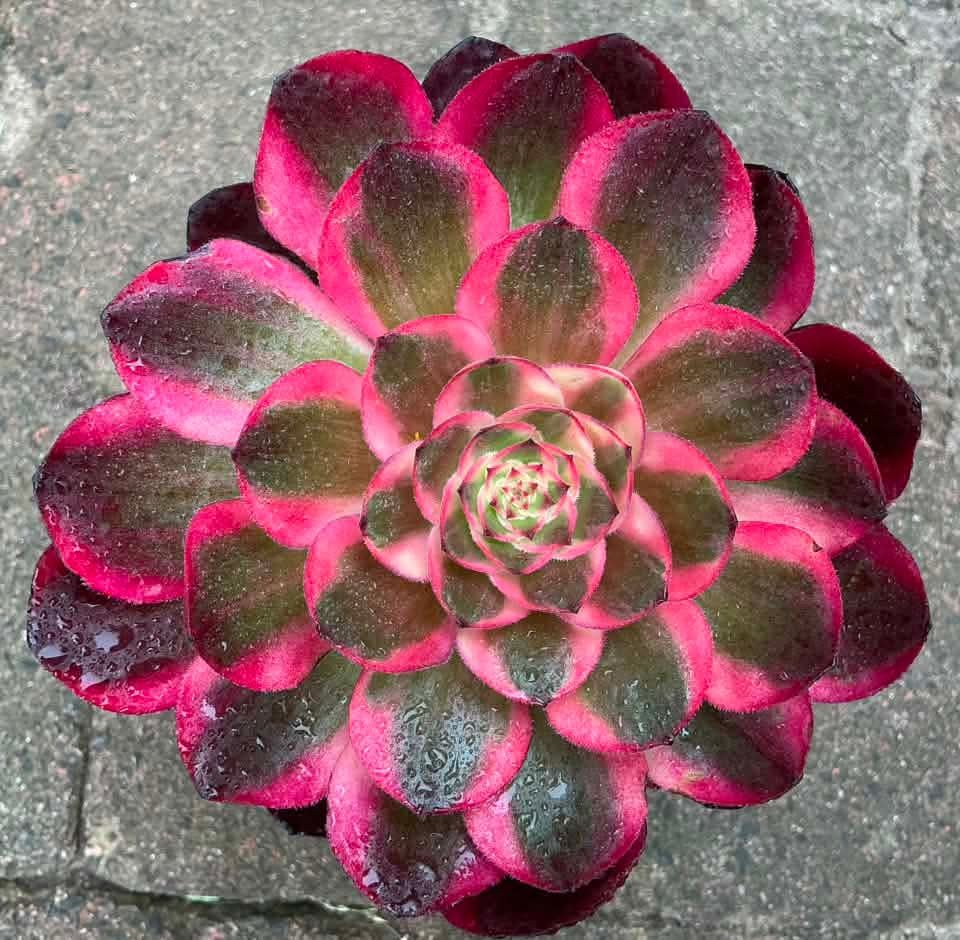
Origin: a mutation derived from Aeonium ‘Madeira Rose’, also distributed under the name ‘Halloween’.
Known names: ‘Yunhe’, 云荷 (Yún Hé). The spellings ‘Yun He’ and ‘Yun-He’ may also appear in the international trade.
Creation / commercialization date: breeder and exact date of origin unknown. The cultivar was documented in the Chinese trade by 2024 at the latest.
Origin and history
Aeonium ‘Yunhe’ is a variegated mutation derived from Aeonium ‘Madeira Rose’, also known as ‘Halloween’.
The cultivar appears to have first circulated in the Chinese horticultural market. However, its breeder, the exact circumstances in which the mutation arose, and its date of origin remain unknown.
Its Chinese name is 云荷, transcribed as Yún Hé. The character 云 (yún) means “cloud,” while 荷 (hé) can refer to the lotus. One possible literal translation is therefore “cloud lotus.” This is a translation of the Chinese name, not an official synonym for the cultivar.
Botanical description
General description
Aeonium ‘Yunhe’ is a variegated Aeonium that forms dense rosettes of fairly broad, fleshy leaves. The leaves are spatulate to slightly obovate and end in a small point.
Its variegation mainly combines green, cream to pale yellow, pink, and red. The proportion of these colors changes considerably with the season, light levels, and growing conditions.
Seasonal changes
During active growth, when temperatures remain cool and light is less intense, the foliage generally retains more green and cream. The center of the rosettes often remains distinctly green, while the palest areas may begin to take on pink tones.
As light levels and temperatures rise, the cream areas may become more colorful, developing shades of deep pink, raspberry red, or carmine red. Older leaves and the most exposed areas may become much darker, with burgundy to reddish-brown tones.
A single plant may therefore display a green or cream center, pink intermediate leaves, and much darker outer leaves at the same time. This seasonal change explains the sometimes striking differences between winter and summer photographs of ‘Yunhe’.
Growth and branching
‘Yunhe’ branches readily. Established plants can develop several branches, each ending in a rosette, and gradually form compact, many-headed specimens.
Cultivation experience in Europe remains too limited to determine its precise growth rate and long-term dimensions under different growing conditions.
Stability and reversions
The long-term stability of its variegation remains insufficiently documented.
Particular sensitivities
No sensitivity specific to Aeonium ‘Yunhe’ is currently documented well enough to be stated with confidence.
Flowering
No flowering characteristic specific to Aeonium ‘Yunhe’ has yet been documented with sufficient reliability.
As with other aeoniums, each rosette is monocarpic: it gradually dies after flowering, while the plant’s other branches normally continue to grow.
Growing conditions
☀️ Light
Bright light promotes compact rosettes and the development of the pink and red tones characteristic of ‘Yunhe’.
💧 Watering
During the growing season, water when the growing medium has dried sufficiently between waterings. When summer temperatures become high and growth slows, reduce watering and adjust it to the plant’s actual activity rather than following a fixed schedule.
🪨 Substrate
Use a very free-draining, well-aerated growing medium that allows excess water to drain away quickly. Growing the plant in a pot makes it easier to control moisture during periods when growth slows.
🌡️ Temperatures
Protect ‘Yunhe’ from frost. In the absence of specific hardiness data, keeping it above 32 °F (0 °C) is preferable. During periods of intense summer heat, provide good ventilation and adjust both exposure and watering to the plant’s slowdown.
WINTER PHOTOGRAPHS
SUMMER PHOTOGRAPHS


CONTINUE EXPLORING


