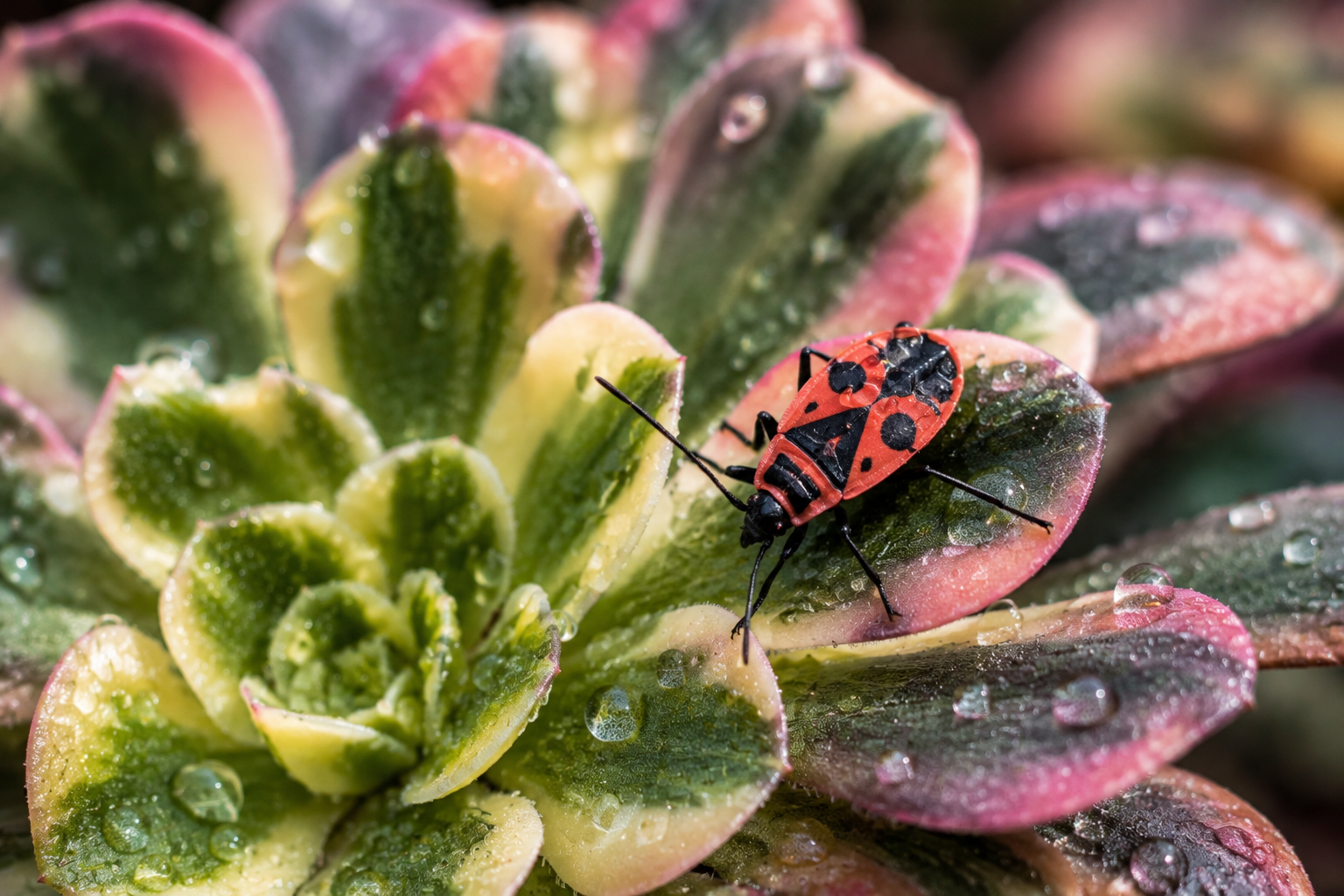
They are red and black, often gather in impressive groups, and sometimes seem to have made themselves at home right in the heart of our Aeoniums. As soon as the warmer weather arrives, it is not unusual to discover dozens of these small insects, commonly known as “firebugs,” around pots, on the substrate, or even inside the rosettes.
But should we really be worried?
The answer is rather reassuring: in the vast majority of cases, the firebug is not a serious pest of Aeoniums. Its presence on a plant does not necessarily mean that it is feeding on it, much less that it is responsible for any damage.
So why do we sometimes find so many Pyrrhocoris apterus around our succulents?
The Firebug: A Regular Visitor to Warm, Sunny Places
The firebug, whose scientific name is Pyrrhocoris apterus, is a true bug that is easily recognized by its distinctive red-and-black coloration. It generally measures around one centimetre in length and belongs to the family Pyrrhocoridae.
Its common French name, “gendarme,” comes from its appearance, which was thought to resemble certain military uniforms.
Widely distributed throughout Europe and other temperate regions, it particularly favours warm, sunny places: the bases of trees, walls, stones, low walls, leaf litter, and areas around buildings.
And this is precisely what may explain some of the observations made by Aeonium growers.
Are Aeoniums a “firebug magnet”?
Not really.
Aeoniums are often grown in conditions that perfectly match the thermal preferences of many insects: pots exposed to the sun, terraces, rock gardens, greenhouses, warm walls, and relatively sheltered areas.
The pot itself can also provide an attractive microhabitat.
As the sun warms the substrate and containers, firebugs may gather there to take advantage of the heat.
This behaviour is particularly noticeable in spring. Adults emerging from their overwintering period actively seek sunny areas. Scientific studies have shown that basking in groups enables firebugs to raise their body temperature considerably and accelerate reproductive activity.
In other words: if your Aeoniums are growing in a particularly warm and sunny spot, they may simply happen to be sitting in an excellent holiday resort for firebugs!
Why Are There Always So Many of Them?
This is probably one of the characteristics that surprises Aeonium growers the most.
You rarely find just one firebug.
You find ten.
Then twenty.
And sometimes several dozen gathered in the same place.
This behaviour is completely natural.
Pyrrhocoris apterus is a gregarious species. Individuals can form large aggregations, particularly in warm, sunny locations.
These gatherings are especially noticeable at certain times of the year and may be associated with thermoregulation, reproduction, or the search for food.
This is therefore very different from a colony of aphids.
When you see large numbers of firebugs around the base of an Aeonium, you should not immediately conclude that the plant is under attack.
But Do Firebugs Feed on Plants?
This is where things become more interesting.
The firebug has a rostrum, a piercing-sucking mouthpart adapted for feeding on fluids. Its diet is relatively varied.
It mainly feeds on seeds, particularly those of certain members of the mallow family (Malvaceae) and lime trees (Tilia), but it can also consume plant material and dead insects. It is also known to feed on certain insect eggs and, occasionally, aphids or scale insects.
The firebug should therefore not be described as an exclusively herbivorous insect.
And on an Aeonium?
This is where field observation becomes important.
The presence of a firebug on an Aeonium does not mean that it is attacking the plant.
It may simply be:
- looking for a warm place;
- moving from one area to another;
- searching for small prey;
- taking advantage of organic matter around the pot;
- searching for seeds or plant debris;
- gathering with other individuals;
- using the Aeonium simply as a resting place.
Firebugs are particularly known to frequent areas where seeds, decomposing plant material, and various food sources are available.
Firebugs May Even Play a Useful Role in Your Collection
This is probably one of the least-known aspects of this insect.
Despite the “pest” image that its piercing mouthparts might suggest, the firebug can contribute to the biological balance of a garden.
INRAE notes that its diet includes insect eggs as well as aphids and scale insects. The species also contributes to the decomposition of organic matter and the dispersal of seeds.
It would therefore be a mistake to automatically regard this insect as an enemy.
A potentially useful insect — but with some perspective
We should not go too far in the opposite direction either.
The firebug is not a specialist beneficial insect for controlling aphids or scale insects in the way that some much more specialized predators are.
Its diet is opportunistic and varied.
It is therefore best regarded as one component of garden biodiversity, rather than as a biological control solution capable of managing an infestation on its own.
Can Firebugs Damage Aeoniums?
In the vast majority of situations observed in gardens, even a large presence of firebugs does not cause significant damage to Aeoniums.
This is an important point.
If you discover dozens of firebugs around a perfectly healthy Aeonium with firm leaves, normal growth, and no suspicious lesions, there is generally no reason to apply any treatment.
Be more watchful around young growth and tender tissues
As with many piercing-sucking insects, however, it is sensible to remain observant when populations become extremely large.
An insect may occasionally probe or pierce plant tissues without causing visible or lasting damage.
The situation only becomes genuinely concerning if you simultaneously observe:
- repeated lesions on plant tissues;
- unusual discoloration;
- areas of necrotic tissue;
- unexplained slowing of growth;
- or large concentrations of insects directly on young, tender tissues.
In such cases, the most important step is to identify the insect accurately before taking action.
In an Aeonium collection, the real problem is far more likely to involve aphids, scale insects, thrips, or other piercing-sucking pests than firebugs.
🔎 Don’t Confuse Them!
Have you spotted a small red-and-black bug sitting on your Aeonium? Don’t assume too quickly that it is a firebug!
Several species found in our gardens display this distinctive coloration. Some look remarkably similar, yet their diets and behaviour can be quite different.

The Firebug — Pyrrhocoris apterus
Risk to Aeoniums: 🟢 Very low to none
This is the best-known of the group. Its black markings against a red background resemble a mask, and it is often seen gathering in sometimes impressive numbers.
The firebug mainly feeds on seeds, particularly those of Malvaceae such as mallows, hollyhocks, and hibiscus, as well as those of lime trees. It may also feed on dead insects or their eggs.
➡️ On an Aeonium: its presence is far more likely to be incidental than evidence of an actual attack. It is not considered a pest of Aeoniums.
The Saxatile Seed Bug — Spilostethus saxatilis
Risk to Aeoniums: 🟢 Low
This is one of the species that can easily be mistaken for a firebug.
Its red-and-black markings are more complex and irregular, creating a mosaic or chequered appearance. Unlike the firebug, which is often found in large colonies, this species is more commonly seen alone or in small numbers.
It is a phytophagous, polyphagous bug that feeds in particular on seeds and plant fluids from various species.
➡️ On an Aeonium: its presence simply warrants observation, but Aeoniums are not currently known to be regular host plants for this species.
The Black-and-Red Seed Bug — Lygaeus equestris
Risk to Aeoniums: 🟢 Low
Another master of disguise!
Also red and black, it can be distinguished in particular by the small white markings visible on the dark membranous section of its wings.
It primarily feeds on seeds. However, the species can use a wide range of plants and has been recorded on dozens of species belonging to many different plant families.
➡️ On an Aeonium: there is no reason to regard it as a specific Aeonium pest. A single observation does not justify treatment.
The Ornate Cabbage Bug — Eurydema ornata
Risk to Aeoniums: 🟡 Worth distinguishing, although Aeonium is not its usual target
Here, the situation is somewhat different.
This attractive red-and-black bug is a genuinely phytophagous insect capable of damaging the plants on which it feeds. It pierces leaves and extracts their cellular contents. When infestations are heavy, leaves may turn yellow and severely affected young plants can suffer considerable damage.
However, its diet is primarily associated with Brassicaceae: cabbages, oilseed rape, turnips, and wild crucifers.
➡️ On an Aeonium: it is not known as a regular pest of the genus. However, if several individuals remain on the plant for long periods and appear to be piercing its leaves, careful monitoring is advisable.
🌱 What Should You Do If You Find Them on Your Aeoniums?
A single insect passing through? Do nothing.
The presence of a bug on a plant does not necessarily mean that it is feeding on it. Insects may also use Aeoniums simply as a resting place, shelter, or observation point.
However, if several individuals remain on the same plant for an extended period, look for three clues:
✓ insects with their rostrum inserted into Aeonium tissue;
✓ repeated small discoloured or necrotic areas around feeding sites;
✓ the presence of nymphs, which may indicate that the insect is doing more than simply passing through your collection.
If this happens, photograph the insect before taking any action: correct identification is always preferable to unnecessary insecticide treatment.
🕵️ The Rule to Remember
Red + black ≠ necessarily a firebug.
And above all:
A bug sitting on an Aeonium ≠ a bug attacking an Aeonium.
Observing before treating will often reveal that the supposed “pest” was simply a visitor passing through.
Why Are They Particularly Numerous Around Aeoniums in Summer?
The answer mainly lies in their environment.
Aeoniums are often grown in places that combine several factors particularly attractive to firebugs:
☀️ Sunshine
Highly exposed terraces and balconies provide warm surfaces where insects can thermoregulate.
🪴 Pots and substrates
Pots create small sheltered areas, particularly beneath dead leaves and around the base of plants.
🌿 Surrounding vegetation
A planted garden or terrace provides a range of food resources and shelters.
🌡️ Microclimate
Heat stored by pots, stones, and walls can create conditions very different from the surrounding air temperature.
Research on Pyrrhocoris apterus has demonstrated the importance of microclimates in its behaviour and survival.
Should Firebugs Be Treated?
In most cases: no.
This is probably the most important advice to remember.
If firebugs are simply present around your Aeoniums and the plants show no signs of damage, there is no need to use an insecticide.
Automatically treating an insect simply because it is abundant may even be counterproductive.
Insecticide treatments can affect other organisms living in your collection or garden, including beneficial species.
Before reaching for the sprayer, take a few moments to observe.
Ask yourself three questions:
1. What insect is actually present?
A firebug? Another true bug? An aphid? A scale insect?
2. Is the plant actually showing signs of damage?
The presence of insects does not necessarily mean there is a problem.
3. Can the observed damage really be attributed to this insect?
This is a step that is often overlooked.
What Can You Do If Their Presence Becomes a Nuisance?
If you simply do not like having large numbers of firebugs around your Aeoniums, the first solution is… to do nothing.
Large aggregations may only be temporary.
Individuals move according to temperature, food availability, and their biological cycle. Their abundance can therefore vary considerably from one week to the next.
You can also:
- remove dead leaves accumulated around the base of plants;
- avoid allowing plant debris to build up in pots;
- temporarily move plants that attract particularly large numbers;
- manually remove groups of insects if necessary;
- monitor the plants for the appearance of genuine pests.
The aim is not to turn your collection into a sterile environment.
An Aeonium grown in a living garden will inevitably be surrounded by insects.
And that is generally a good thing.
A Positive Presence for Biodiversity
The firebug is one of those insects that immediately catches the eye, yet its ecological role is often poorly understood.
Its presence contributes to the biological diversity of the garden. It is itself a food resource for various predators, including birds, spiders, certain wasps, and hornets.
Its gregarious behaviour and striking red-and-black coloration also make it one of the most easily recognizable insects in our gardens.
And contrary to some misconceptions, the firebug is not an insect that should automatically be eliminated whenever it appears.
So, Should You Be Worried?
No, not in the vast majority of cases.
Seeing a few firebugs on an Aeonium is perfectly normal.
Seeing several dozen may look alarming, but the number of insects alone is not enough to determine whether there is a problem.
What really matters is the condition of the plant.
An Aeonium that continues to produce healthy leaves, maintains normal growth, and shows no suspicious lesions does not require treatment simply because firebugs are walking over it.
The right reflex: observe before treating
Ultimately, this is one of the essential rules of Aeonium cultivation.
An insect is not necessarily a pest.
And the firebug is an excellent example.
Before considering these small red-and-black insects enemies, take the time to observe them.
They may simply have come to enjoy the sunshine with you.
Key Points to Remember
🐞 The firebug (Pyrrhocoris apterus) is a very common red-and-black true bug.
☀️ It favours warm, sunny places, which explains why it can be particularly noticeable around Aeoniums grown outdoors.
👥 It is gregarious and may form very large aggregations.
🌱 It has a varied diet, mainly consisting of seeds and certain plant materials, but it may also consume dead insects as well as some insect eggs, aphids, and scale insects.
🪴 Its presence on an Aeonium does not necessarily mean that it is attacking the plant.
🚫 Treatment is generally unnecessary.
🔎 If visible damage occurs, the first step should always be to identify the actual culprit accurately.
Above all, when growing Aeoniums, it is worth learning to distinguish between an insect that is simply present and one that is genuinely harmful.
That distinction can make all the difference between a collection treated unnecessarily… and one grown in a naturally balanced environment.


