
Origin:
It would come from a mutation of the Aeonium ‘Velour‘. Chinese sources describe 赤霞飞 as a variegated form from 紫羊绒, the “Purple Cashmere”. The precision 欧版紫羊绒, “European Purple Cashmere”, allows this plant to be linked to Aeonium ‘Velour‘.
Known names:
Aeonium ‘Eden‘(most common name), ‘Chixiafei‘, ‘Chi Xia Fei‘, 赤霞飞, 赤霞飛, ‘Flame Rose and ‘Cabernet Sauvignon‘. The translationsFlying Red Clouds‘ and ‘Red Clouds Flying‘ corresponds to an interpretation of the Chinese name.
Creation date / creator:
The mutation was reportedly discovered in 2017 in Kunming, China, by a collector or producer known under the pseudonym Tan Hua — 探花. It is documented under the name 赤霞飞 as of April 16, 2018. The western name ‘Edenappears to have been circulating since 2019, but its author remains unknown.
Botanical description
The Aeonium ‘Eden‘is a Shrubby Aeonium variegata which develops branched stems bearing terminal rosettes.
Its appearance can be extremely different depending on the season.
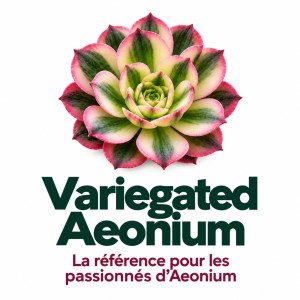
During its growth period, the foliage generally combines three big tones :
- green;
- cream to pale yellow;
- pink to purplish red.
The heart of the rosette generally retains more green and cream, while older leaves develop much more dramatic bands of color.
Leaves often have a wide central green strip, accompanied by cream areas then pink or reddish shades on the lateral parts.
A particularly scalable variegation
This is undoubtedly where the whole point of the Aeonium lies.Eden‘.
When the plant enters its active phase, colors gradually appear. Younger leaves generally remain more green and cream, while older leaves develop pink shades.
With increasing brightness, the pink gradually becomes more intense. It can evolve into red, purple, or even purplish tones.
In the brightest conditions, the central green part can also darken considerably, to the point of taking on shades very dark purple to burgundy.
The result can be spectacular: the same rosette can then simultaneously present green, cream, pink and purple.
This development is well documented at ‘Eden‘: the leaves change color with the seasons and the plant can lose its variegation during its rest period before regaining it when growth resumes.
‘Eden‘ in dormant period
The summer period can completely change the appearance of the Aeonium’Eden‘.
When temperatures become high and the plant significantly slows down its growth, the variegation may disappear partially, or even almost completely.
The heart of the rosette usually retains green and cream areas, while the older leaves gradually become dark purple, burgundy or purple brown.
This phenomenon should not necessarily be interpreted as a permanent loss of variegation.
At ‘Eden‘, this is generally a phenomenon reversible linked to the vegetative cycle : when temperatures decrease and the plant resumes growth, the new leaves gradually regain their variegated coloring.
A coloring strongly dependent on light
Light plays a major role in the appearance of ‘Eden‘.
High light generally favors the expression of red and purplish pigments, while lower light tends to produce more green and cream foliage.
This alternation between a very colorful growth period and a much darker rest period constitutes precisely one of the most fascinating characteristics of this cultivar.
Vigorous growth and excellent ability to reject
The Aeonium ‘Eden‘ also stands out for its good capacity to produce rejects.
When conditions are favorable, it can quickly form a tuft of several rosettes and take on a particularly bushy appearance.
Its growth can be considered as rather fast for an Aeonium variegata.
Be careful with reversions
As with many Aeonium variegata, mutations and reversions constitute a phenomenon to be monitored.
At ‘Eden‘, complete reversion can give rise to a plant known as Aeonium’Olimpo‘.
This plant strongly resembles Aeonium ‘Velour‘, but it should not be considered as a real ‘Velour‘.
Culture and resistance
The Aeonium ‘Edendoes not seem to present any particular fragility apart from the usual difficulties encountered with Aeoniums variegata.
Like all Aeoniums, it must however be protected from gel, to which it is particularly sensitive.
PHOTOS PERIOD WINTER


SUMMER PHOTOS


TOTAL REVERSION OF EDEN : AEONIUM OLIMPO
The Reversion of Eden: Aeonium ‘Olimpo‘
The discovery of this reversion is particularly interesting for understanding the genetic behavior of ‘Eden‘.
The Aeonium ‘Olimpohas green rosettes which can take on different shades burgundy to very dark purple when the brightness increases. It generally retains a green heart and has a morphology that is strongly reminiscent ofVelour‘.
However, despite this resemblance, the two plants are considered distinct.
We can therefore summarize this relationship as follows:
Aeonium ‘Velour‘ → mutation/variegation → Aeonium ‘Eden‘ → reversion → Aeonium ‘Olimpo‘
This particularity makes ‘Eden‘a particularly interesting cultivar for the study of mutations and reversions in Aeoniums.

CONTINUE EXPLORING


