Origin:
A mutation of Aeonium ‘Medusa’, itself derived from a mutation of Aeonium ‘Velour’.
The original lineage can therefore be presented as follows:
Aeonium ‘Velour’ → Aeonium ‘Medusa’ → Aeonium ‘Canary’
Known names:
Aeonium ‘Canary‘, 金丝雀, 金丝雀法师, 金丝雀锦 and 金丝雀锦法师 — Jīnsīquè, meaning “canary”. The names ‘Canary Variegata‘ and ‘Canary Variegated‘ are simply commercial variants.
Creation date / Breeder:
The mutation is believed to have been discovered in spring 2021 and marketed during the same year, probably through a Chinese production network. The breeder or person who discovered the mutation is not documented.
Botanical description
Aeonium ‘Canary’ is a shrubby variegated cultivar resulting from a mutation of Aeonium ‘Medusa’.
In winter, when light levels are lower, the leaves display a broad green central band surrounded by cream-yellow margins. This variegation pattern is particularly bright and makes ‘Canary’ easy to distinguish from non-variegated forms.
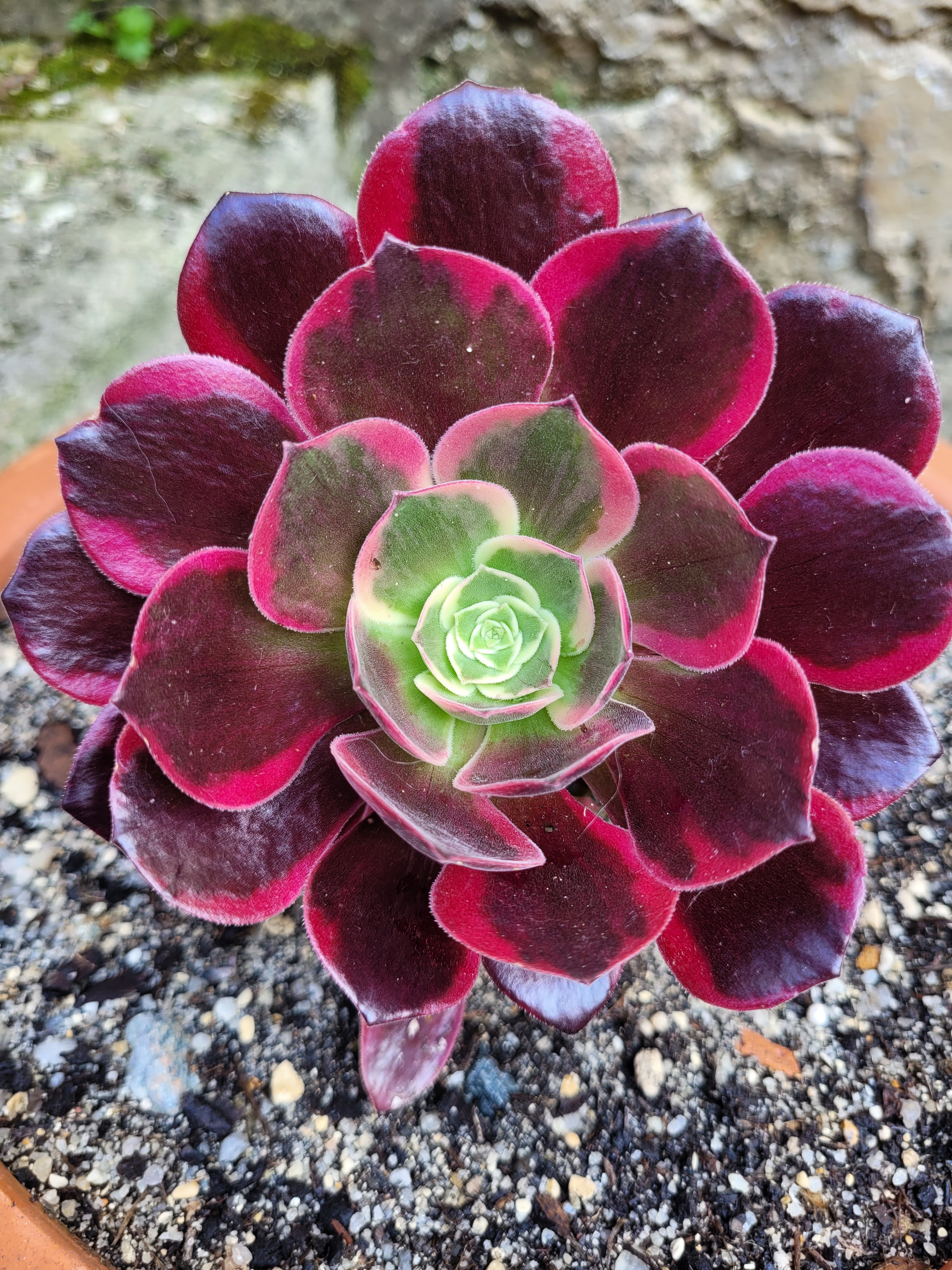
As light levels rise, the margins gradually begin to turn red. This coloration generally appears first on the upper part of the leaves before progressively extending toward their base.
Spectacular coloration in sunlight
Color development is one of the principal characteristics of Aeonium ‘Canary’.
As light levels and temperatures increase, the red pigments gradually become more prominent. The coloration may then spread over much of the leaf blade, profoundly changing the plant’s appearance during the season.
At the same time, the green central band gradually darkens. Under strong light and conditions that encourage pigmentation, the green can become extremely dark, developing almost black shades.
The plant can thus change from winter foliage dominated by green and cream yellow to much more contrasted summer foliage combining red, purple, deep green and black.
This development makes ‘Canary’ a particularly interesting cultivar to observe through the seasons.
Cultivation and behavior
Aeonium ‘Canary’ grows fairly quickly and has a good natural ability to produce offsets.
This branching ability facilitates propagation and makes it possible to obtain a well-developed plant relatively quickly.
It does not appear to have any particular weakness in cultivation. Initial observations even indicate good tolerance of sun and high temperatures, an interesting advantage for a variegated Aeonium.
As with all Aeoniums, however, this tolerance should not be confused with frost resistance. Sub-zero temperatures, and especially prolonged frost, can cause significant damage to the foliage and plant tissue.
During summer, good ventilation and a highly draining substrate remain essential, particularly during periods of intense heat.
A spectacular descendant of the ‘Velour’ lineage
With ‘Canary’, ‘Medusa’ and ‘Velour’, we can observe a true succession of mutations within the same horticultural lineage.
The interest of ‘Canary’ lies particularly in the intensity of its seasonal development: its winter cream-yellow variegation gradually changes under light until the foliage becomes strongly marked with red and black.
Its vigorous growth, good branching ability and relative tolerance of bright, warm conditions also make it particularly appealing to collectors seeking a spectacular yet relatively easy-to-grow variegated Aeonium.
CANARY / WEDDING DRESS COMPARISON


CANARY / MEDUSA COMPARISON

WINTER PHOTOS


SUMMER PHOTOS


CONTINUE EXPLORING


