Origin:
Resulting from a mutation of Aeonium ‘Mardi Gras’.
Known names:
‘Ink Painting’ (most common name), ‘Ecstasy’, 水墨画 ; ‘Ecstacy’ is a common misspelling. ‘Beyoncé Painting’ is sometimes given as a synonym, but it could refer to a distinct selection or mutation.
NOTE: ‘Ink Painting’ is now the most widely used international name, while ‘Ecstasy’ seems to have been an old commercial name, possibly even earlier.
Creation date / Creator:
Name given by Chongqing Muko in 2018 (China). The earliest public record currently found is a photo dated August 26, 2018, but the original listing is no longer accessible. The plant appears in Asian commercial publications no later than August 2019.
Botanical description
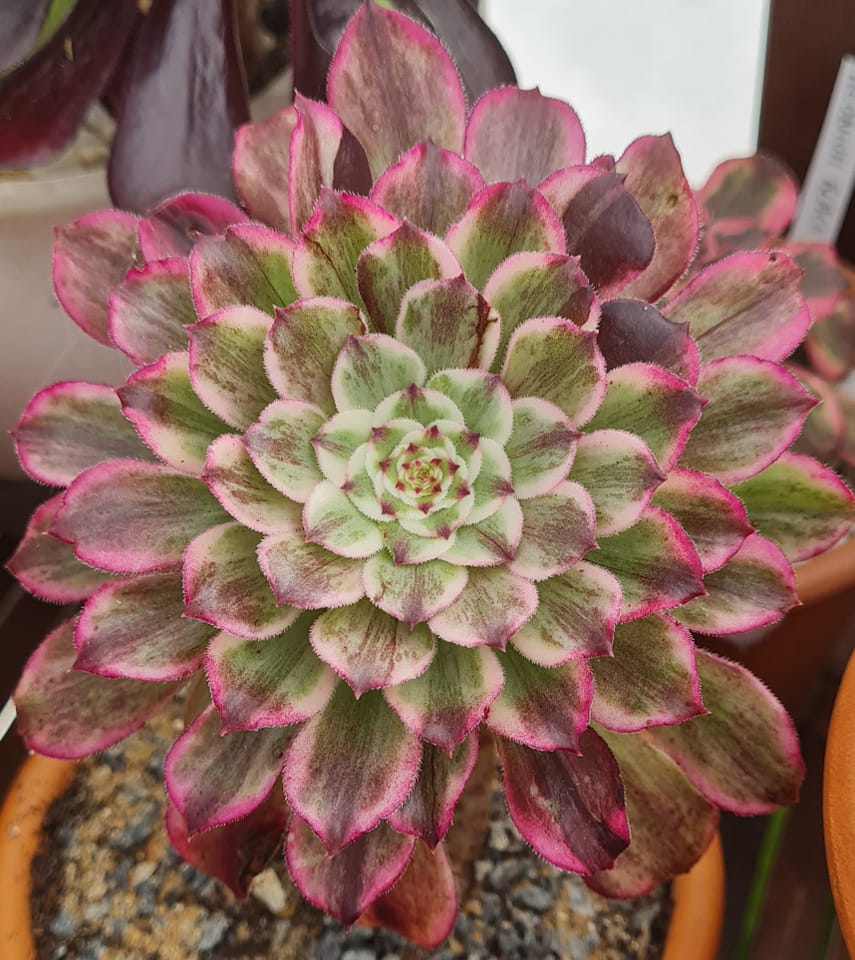
The Aeonium ‘Ink Painting’ is a variegated shrubby Aeonium from the famous lineage of Aeonium ‘Mardi Gras’. Today, it is considered one of the most original cultivars in this family thanks to a unique feature: the appearance of fine black streaks that resemble brush strokes in traditional Chinese painting.
It is this distinctive trait that earned it the name « Ink Painting », literally « ink painting ».
Foliage that looks like a work of art
During winter, when light is low and growth is active, the foliage shows the typical variegation of ‘Mardi Gras’ descendants:
- a wide central green stripe;
- two cream-colored side stripes.
The whole thing offers a particularly elegant light contrast, with a rosette center in soft shades blending tender green and cream.
The famous black streaks
With the increase in brightness, temperatures, and water stress, the Aeonium ‘Ink Painting’ gradually reveals its full personality.
The central green band gradually darkens until it takes on deep green, almost black shades.
It is also during this period that the famous irregular black streaks appear, randomly scattered across the leaf blade.

- deep green;
- black;
- cream;
- pink.
These markings, totally unpredictable from one leaf to another, give the impression that each leaf was painted with a brush using India ink. No other cultivar derived from ‘Mardi Gras’ shows this graphic signature as distinctly.
At the same time, the cream-colored side bands gradually shift to pink shades, which can become deep pink under strong light exposure.
The center of the rosette, meanwhile, keeps softer tones, dominated by light green and cream.
On some plants, the leaves can also curve slightly and develop a gentle wavy effect, further enhancing the plant’s elegance.
A spectacular seasonal change
Like many modern cultivars derived from ‘Mardi Gras’, ‘Ink Painting’ shows a particularly striking color change throughout the seasons.
In winter, the contrasts remain bright and are dominated by green and cream.
In spring and then in summer, the combination of anthocyanin pigments and dark streaks gradually turns the plant into a true color palette where the following merge:
This chromatic richness explains its popularity among collectors of Aeoniums variegata.
Cultivation and behavior
The Aeonium ‘Ink Painting’ behaves similarly to its relative ‘Mardi Gras’.
Its main horticultural features are:
- Growth: medium to good;
- Ability to produce shoots: normal;
- Vigor: satisfactory;
- Fragility: no particular sensitivity observed apart from its usual frost sensitivity.
However, it has two important peculiarities:
- a relatively early flowering, similar to that of ‘Mardi Gras’;
- a tendency to revert, capable of producing rosettes identical to the Aeonium ‘Morticia’, a well-known reverted form of ‘Mardi Gras’.
These reversions are a classic phenomenon in this lineage and show the genetic complexity of mutations derived from ‘Mardi Gras’.
Aeonium ‘Danqing’ and Aeonium ‘History’ are described as mutations of ‘Ink Painting’; their individual profiles explain their distinctive foliage.
WINTER PERIOD PHOTOS


SUMMER PERIOD PHOTOS


FLOWERING INK PAINTING


