Origin:
Derived from the mutation of Aeonium ‘Mardi Gras‘.
Common names:
‘Meiji’ (the most widely used name), ‘Miki’, ‘Maggie’, 美姬 and 美姬法师. Do not confuse with Aeonium ‘Meiya’ — 美娅.
Date of creation / Creator:
Selection appeared around 2018 in China. International distribution confirmed from 2020. Original discoverer and propagator unknown.
A Chinese publication dedicated to the main Aeonium variegata states that ‘Meiji’ was selected around the same time as ‘Hongyan’. The article places the development of these first cultivars around 2018, which clearly means that ‘Meiji‘ does not come from ‘Hongyan‘ as some sources have suggested.
BOTANICAL DESCRIPTION
The Aeonium ‘Meiji’ is a variegated shrubby Aeonium whose appearance can vary greatly depending on the season, light, temperature, and the plant’s water status.
When light is low, especially in the heart of winter, the foliage generally shows a relatively classic pattern for descendants of Mardi Gras:
- a green central stripe;
- a creamy yellow side areas;
- a still relatively subtle coloration when the plant is under low exposure.
At this stage, Meiji may look quite similar to several other cultivars from the same lineage.
It’s when the light increases that its true aesthetic potential appears.
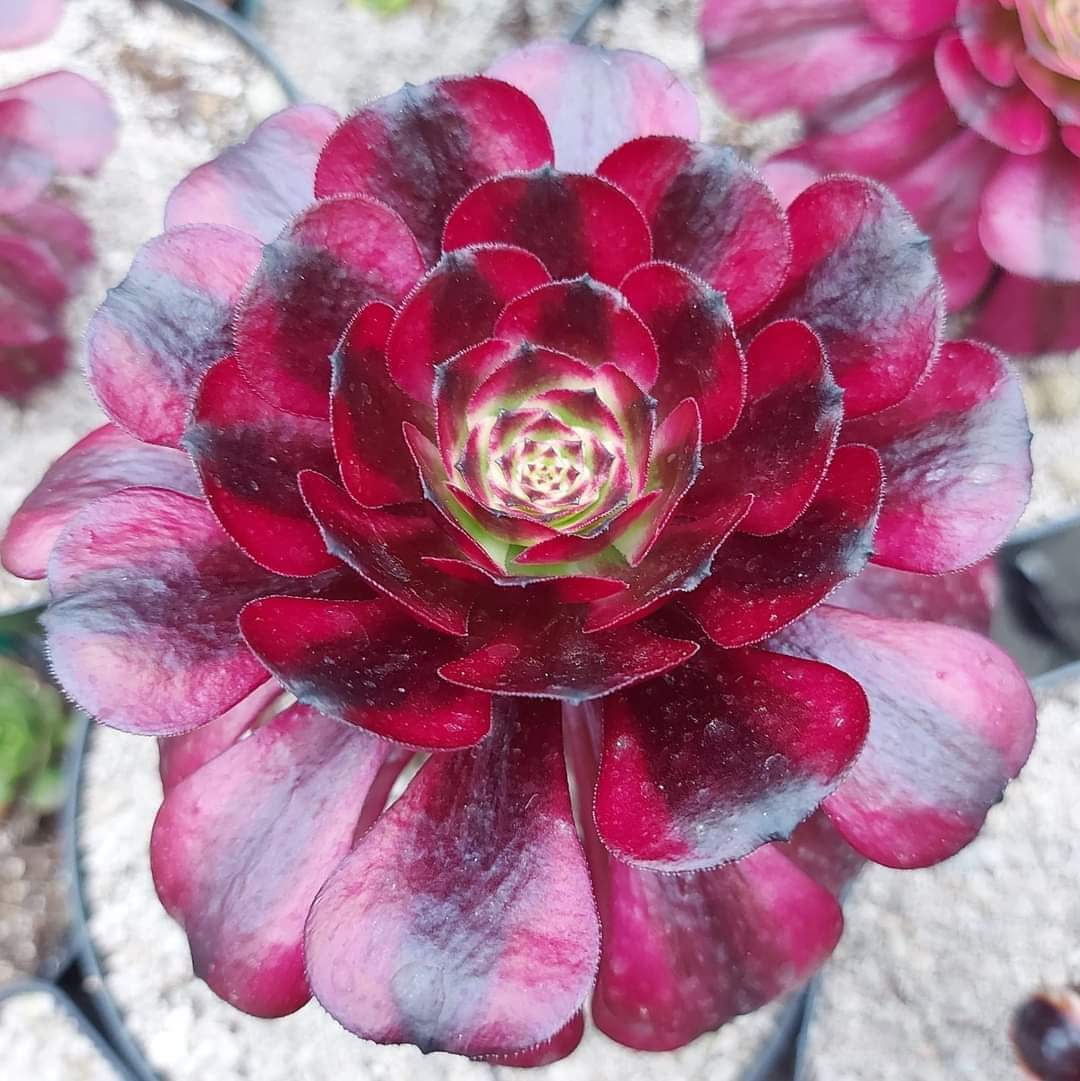
An exceptional red and black coloration
As brightness increases, the side areas of the leaves gradually start to turn pink then red, while the central green part darkens.
When conditions are particularly favorable, the green can shift to very dark green, purple-brown, and then almost black shades.
This combination gives Meiji a particularly deep palette.
It’s this color intensity that usually allows Meiji to stand out from many other red and black Aeoniums variegata.
The influence of light and water stress
The coloring of Meiji, however, shouldn’t be seen as a totally fixed feature.
As with many red- or black-pigmented Aeoniums, the expression of anthocyanins heavily depends on environmental conditions.
Strong brightness, combined with suitable temperatures and slight water restriction, can enhance color intensity.
Conversely, a very shaded growing area or significant watering can keep the plant greener and temporarily reduce the intensity of red and dark hues.
So, it’s best to avoid comparing two Meiji plants photographed at different times without considering their growing conditions.
The same plant can look very different between a period of active growth and a summer dormancy period.
This feature is important for identifying cultivars: a photograph taken at the peak color moment doesn’t necessarily show what the plant will look like all year round.
Good summer hardiness
Like many Aeoniums, Meiji can adopt a protective strategy when summer conditions get tough.
When temperatures rise sharply and sunlight becomes intense, the rosette tends to tighten up and reduce its exposed surface.
This summer closure is not necessarily a sign of a cultivation problem. It often corresponds to a physiological response that helps limit water loss and exposure of leaf tissues.
In this respect, Meiji seems to show good resistance to sun and heat compared to many other Aeoniums variegata.
An Aeonium variegata to grow with care.
Despite its apparent resistance to bright and warm conditions, Meiji has a characteristic that collectors should be aware of: its fragility during the early stages of development.
Observations made on recently received plants show significant sensitivity particularly in:
- recently taken cuttings;
- cuttings that have not yet developed roots;
- young plants;
- plants that have experienced transport or a period of stress.
Some plants may arrive in cultivation in a fairly degraded state and require a relatively long recovery period.
The exact reason for this sensitivity is still difficult to determine.
However, this fragility seems much less pronounced in adult plants that are properly rooted.
This is therefore an observation that would deserve to be confirmed by more feedback from collectors.
Growth and offsets
Meiji shows average growth and decent branching ability.
It generally produces offsets, gradually allowing for a bushier plant.
WINTER PERIOD PHOTOS


SUMMER PERIOD PHOTOS


MEIJI MUTATION

PINK MEIJI
A pinker mutation of Meiji
Creation date: 2025.
CONTINUE EXPLORING


