Origin
Traditionally presented as a mutation or variegated form of Aeonium haworthii. Its exact origin remains uncertain. A particularly interesting hypothesis treats it as an Aeonium haworthii × Aeonium decorum hybrid because of intermediate traits in the foliage, rosettes and flowers.
Known names
‘Dream Color’ (preferred name), ‘Kiwi’, ‘Kiwionium’, ‘Tricolor’, ‘Decorum Variegata’, ‘Kiwi Verde’, ‘Verde’ and ‘Keweonium’. ‘Kiwi’ is extremely widespread in cultivation, but the nomenclature is historically confused.
Creation date / Creator
Origin unknown. The cultivar is old in cultivation. A record under Aeonium haworthii ‘Variegata’ is reported from 1997, while the name ‘Dream Color’ was published by Harry Mak in 2003.
History and origin
For many years it was treated simply as a variegated form of Aeonium haworthii, and the Royal Horticultural Society still lists it as Aeonium haworthii ‘Dream Color’. Aevriel Scarlet proposed a possible haworthii × decorum origin based on its branching habit, thin stems, glossy leaves, pink colour and flower morphology. Experimental hybrids reported by growers in 2026 showed a similar habit, but this remains supporting observation rather than definitive botanical proof.
Botanical description
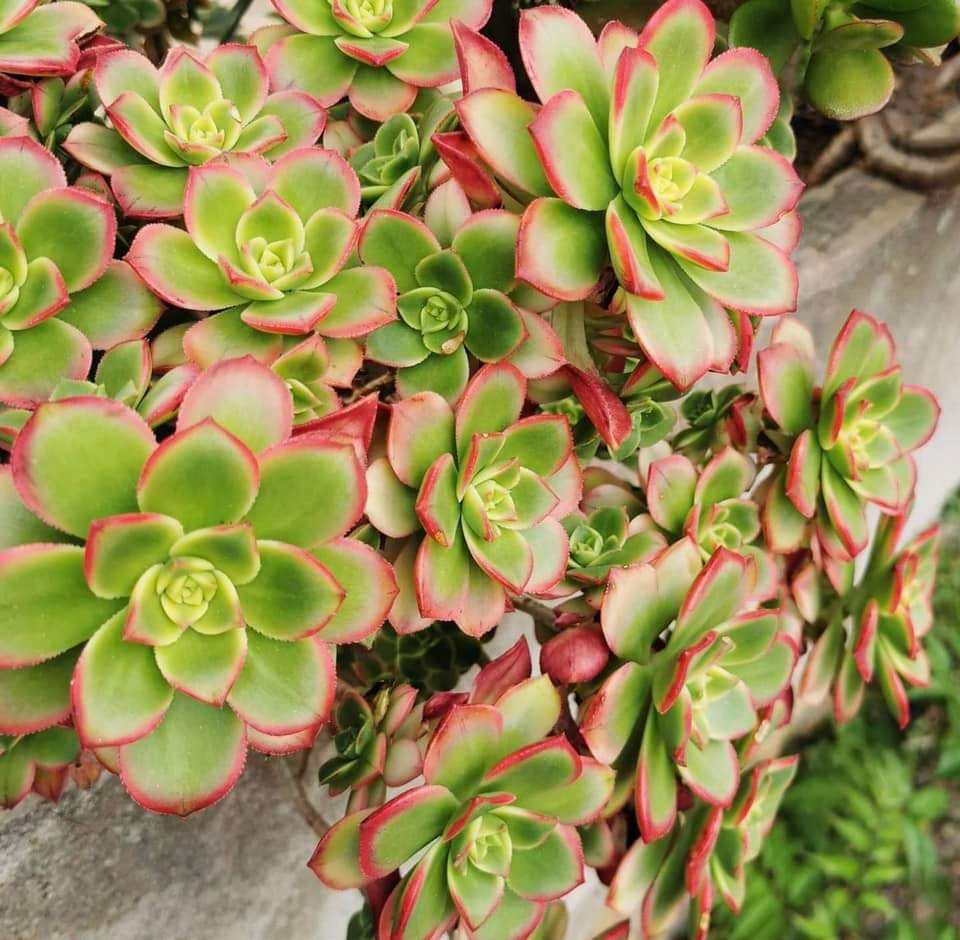
Aeonium ‘Dream Color’ is a small, highly branched shrub-form Aeonium, usually 20–30 cm tall, with numerous terminal rosettes around 8–12 cm wide. The fleshy, spatulate leaves combine green, cream-yellow and pink, explaining the trade name ‘Tricolor’.
Highly variable variegation
Its appearance changes greatly with light, temperature and hydration. In winter it may become mostly green, sometimes retaining only pink leaf margins, while some plants keep a luminous cream-yellow rosette centre. This seasonal change should not automatically be mistaken for reversion.
Spring and summer colours
As light increases in spring, cream and yellow areas return and pink margins intensify. In summer, the leaves may show a green centre, yellow-green or cream intermediate zones, a broad pink border and bright-red tips. Maximum colour should not be pursued through excessive drought stress.
Growth and cultivation
Growth is slow to moderate, but strong branching gradually creates a substantial clump. It is not considered especially fragile, although some growers report sensitivity to ambient humidity. Good ventilation, a free-draining substrate and frost protection are important.
Is ‘Dream Color’ really ‘Kiwi’?
‘Kiwi’ is now extremely widespread for this cultivar, but historical naming is more complex. VariegatedAeonium.fr therefore gives priority to ‘Dream Color’ while retaining ‘Kiwi’ as a known name.
Avoid confusion with ‘Kiwi Variegata’
Another cultivar marketed as ‘Kiwi Variegata’ appeared notably in American collections around 2018. It should not be treated as the same plant as ‘Dream Color’.
Flowering
The flowers are white to whitish, strongly recalling Aeonium haworthii, although their morphology has also contributed to the proposed relationship with Aeonium decorum. A flowering rosette is monocarpic and dies afterwards, while other branches continue growing.
Reversion and loss of variegation
A plant that becomes very green in winter or low light is not necessarily reverting. Improved light may restore the colours. However, a branch that remains completely green may represent a sectorial reversion; nearly white or yellow shoots should also be monitored because their photosynthetic capacity is low.
WINTER PHOTOS


SUMMER PHOTOS


FLOWERING DREAM COLOR

One-year development of a ‘Dream Color’ cutting

CONTINUE EXPLORING


