Origin
Exact origin unknown. Its general morphology and especially its branching pattern suggest a possible relationship with Aeonium undulatum. A mutation producing abnormal, monstruosa-like growth is another possibility, but neither hypothesis has been demonstrated.
Known names
‘Île du Levant’, the official name.
Creation date / Creator
Discovered in 2022 by Pierre Quillier in private gardens on Île du Levant in the Var, France. First marketed in 2025.
Botanical description
Aeonium ‘Île du Levant’ is an unusual shrub-form Aeonium with several features reminiscent of Aeonium undulatum. That Gran Canaria endemic normally forms large terminal rosettes and characteristically produces new growth mainly from the base.
Uniquely shaped leaves
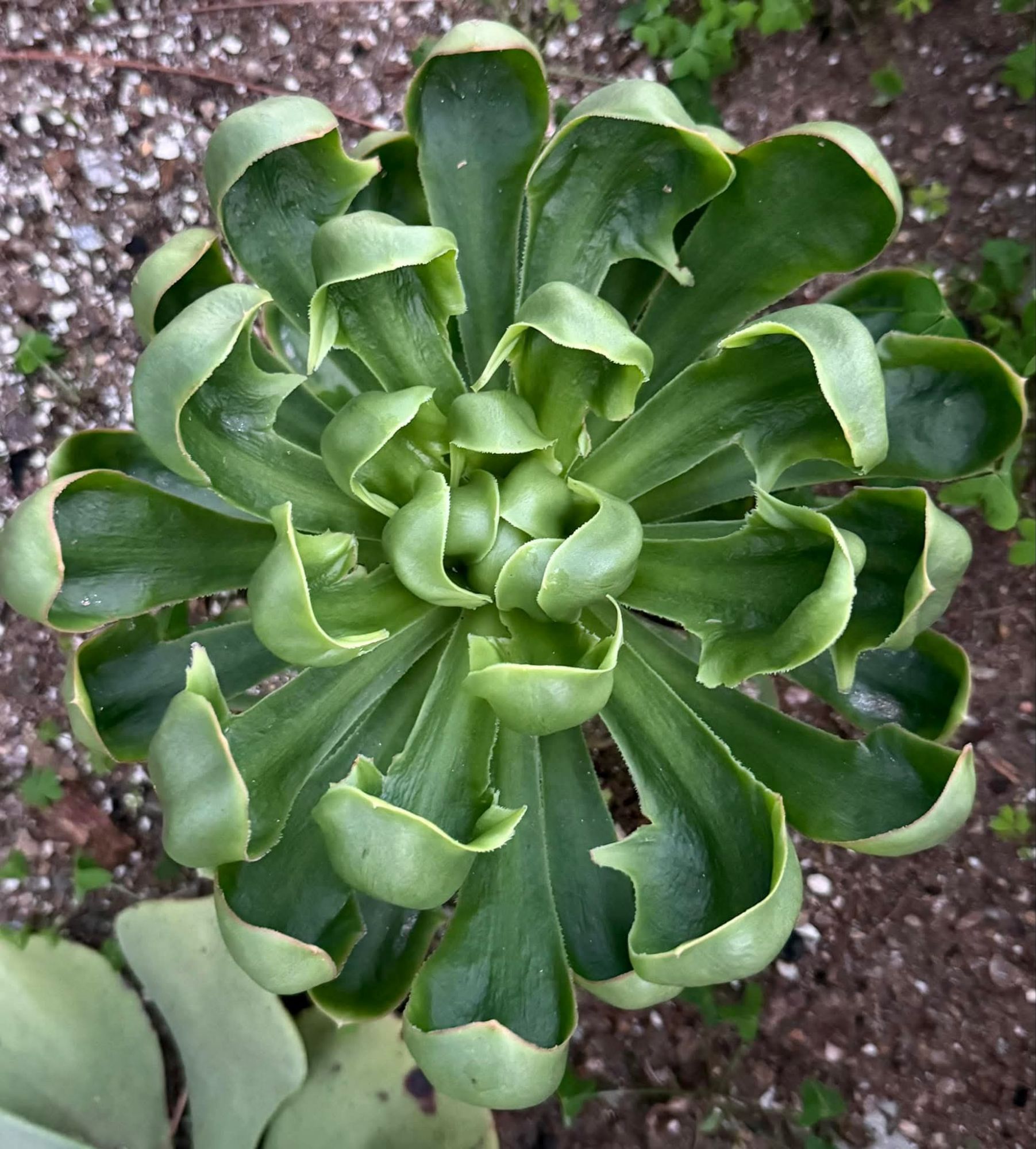
The leaves are strongly curved and irregular, sometimes wavy or more deeply deformed. Young leaves tend to stand upright and close around the central meristem, giving the rosette a distinctive, immediately recognisable architecture.
A closure apparently unrelated to summer dormancy
Unlike the temporary closing of many Aeonium rosettes during summer dormancy, this upright and deformed foliage persists during active growth and favourable conditions. It therefore appears to be an inherent morphological trait.
A possible monstruosa-type mutation
The altered leaf development may suggest a monstruosa-like morphological mutation. It is not a typical cristate form: no elongated crest-shaped meristem is present, and the anomaly seems to concern the geometry of the leaves themselves.
A possible undulatum relationship worth studying
Its broad wavy leaves, large terminal rosettes and especially basal offset production make an Aeonium undulatum relationship plausible, but morphology alone cannot prove genetic ancestry. The first documented flowering could provide useful comparative evidence.
Branching behaviour to monitor
Most offsets appear near the base, although shoots have also been observed close to or inside the rosette. Future propagation should document offset location, the stability of the deformed leaves and the persistence of these traits under different conditions.
A cultivar with a unique identity
Its origin remains unresolved, but the combination of strongly curved foliage, compact centre and unusual branching makes ‘Île du Levant’ unmistakable.
Photographs


