Origin:
A spontaneous mutation of Aeonium ‘Mardi Gras’.
Known names:
‘Auspicious Clouds’—the most widely used international name—, 祥云, ‘Xiangyun’, ‘Xiang Yun’, and 祥云法师. ‘Auspicious Cloud’ is an occasional grammatical variant.
Creation date / breeder:
The mutation appeared before November 2023. Its presence in the Chinese and international trade is documented from November 2023.
What does “Auspicious Clouds” mean?
The English name ‘Auspicious Clouds’ translates the Chinese designation 祥云 — Xiángyún, meaning “auspicious clouds,” “clouds of good omen,” or “lucky clouds.”
The term carries substantial meaning in Chinese culture.
Auspicious clouds are a traditional motif associated with luck and prosperity. A linguistic detail reinforces this symbolism: the Chinese word for cloud, yún (云), sounds similar to yùn (运), a word associated with luck or good fortune. Images of layered clouds have therefore traditionally evoked continuing good fortune.
The “auspicious clouds” motif has long appeared in Asian decorative arts. Museum collections notably preserve historic textiles combining these clouds with phoenixes or various flowers.
The name of this Aeonium can therefore reasonably be understood as:
Aeonium “Auspicious Clouds”
Botanical description
Aeonium ‘Auspicious Clouds’ is a shrubby variegated Aeonium that retains the general morphology of the ‘Mardi Gras’ lineage.
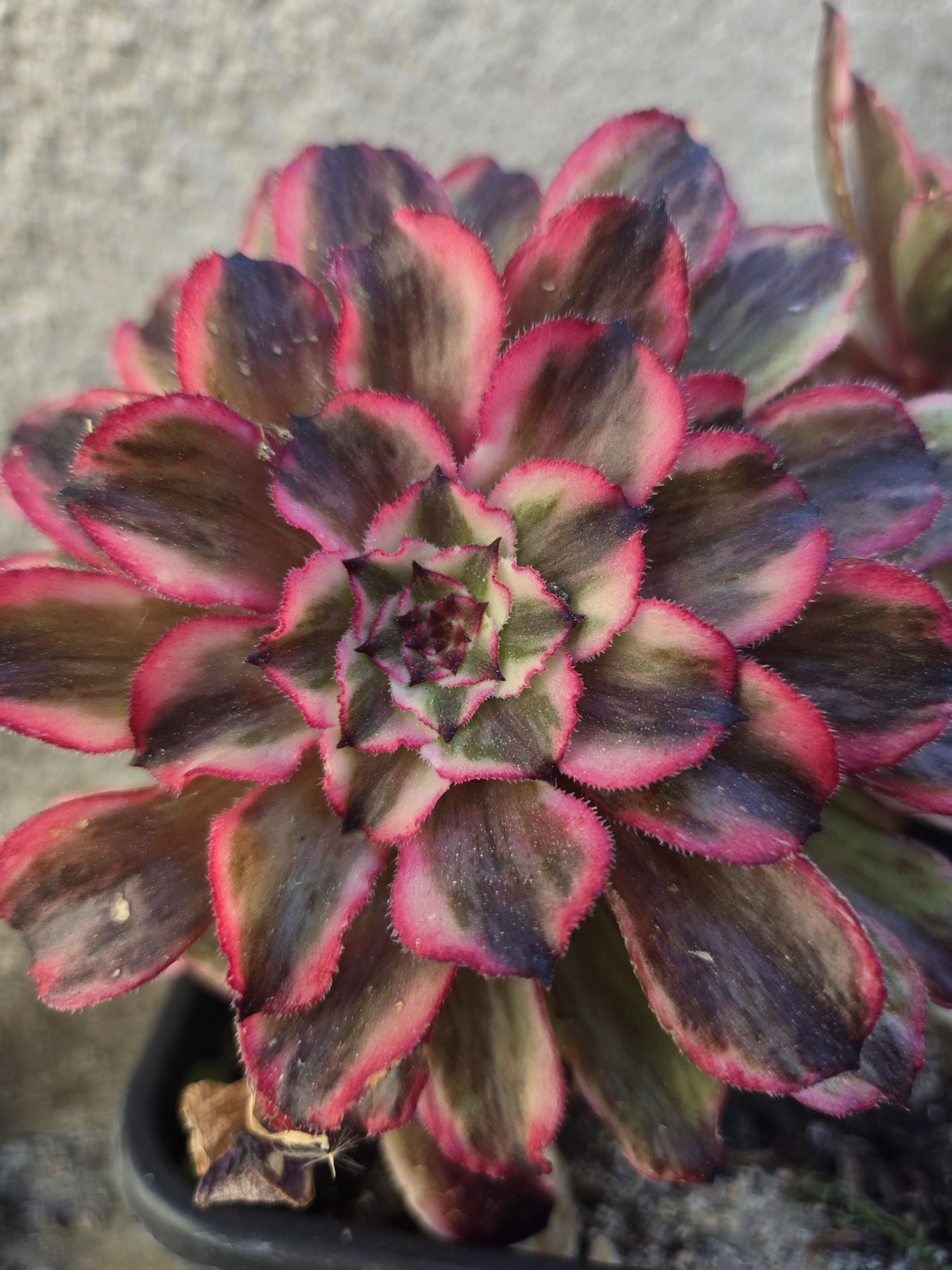
Its variegation is based mainly on three color groups: green, yellow or cream, and pink to purple, sometimes joined by grayish to nearly black tones.
In winter, when light levels are relatively low, the leaves generally display a green central band surrounded by broad pale-yellow to cream lateral areas.
This pattern is characteristic of many mutations derived from ‘Mardi Gras’.
‘Auspicious Clouds’ nevertheless stands out for its ability to develop purple pigments fairly quickly, even before light conditions become especially intense.
Particularly distinctive dark tones
This is probably one of the most interesting features of ‘Auspicious Clouds’.
As light levels rise, the leaf margins begin to develop pink and then purplish-red shades.
At the same time, the chlorophyll-bearing central portion does not necessarily remain a clear green. It may gradually darken through the following tones:
dark green → gray-green → slate gray → almost black.
This combination creates a particularly marked contrast between the dark center of the leaf and the outer variegated areas, which have turned pink or purple.
The oldest and most exposed leaves may consequently appear much darker than those at the center of the rosette.
The plant’s center generally retains more of the green and cream shades characteristic of recent growth.
Coloration strongly dependent on growing conditions
As with most variegated aeoniums, the colors of ‘Auspicious Clouds’ should not be regarded as perfectly fixed.
The amount of red and purple pigmentation expressed by the plant depends on several factors: light intensity, temperature, season, water availability, and leaf maturity.
The same plant may therefore look quite different during its winter growth period and in the months preceding summer dormancy.
This is also why identifying a recent cultivar from coloration alone can be difficult, especially within the ‘Mardi Gras’ family.
How can ‘Auspicious Clouds’ be recognized?
With the limited experience currently available, it would be premature to establish a true identification key. Several traits nevertheless appear useful when observed together:
- a fairly well-defined green central band under lower light;
- yellow-to-cream lateral areas;
- relatively rapid development of purple pigments along the margins;
- pronounced darkening of the central area;
- slate-gray to nearly black tones on strongly colored leaves;
- marked contrast between the brighter center and darker outer leaves.
The combination of these traits currently appears more useful for recognizing the cultivar than any single feature considered in isolation.
Growth and branching
Initial observations indicate average growth for variegated aeoniums derived from ‘Mardi Gras’.
Its ability to produce new branches also appears normal, gradually allowing the formation of a shrubby plant with several rosettes.
Caution remains necessary: because ‘Auspicious Clouds’ has been in the trade for only a few years, too few mature plants have been grown under different conditions to assess its vigor precisely.
Sensitivity and cultivation behavior
Initial observations reveal no particular sensitivity.
It therefore appears suitable for cultivation like most variegated Aeonium cultivars derived from ‘Mardi Gras’, using a very free-draining growing medium and bright light during the growing season.
Care is nevertheless required during intense summer heat, and especially to avoid the combination of high temperatures and a growing medium that remains wet, particularly when growth has slowed markedly.
Its dark coloration should not be interpreted as evidence of particular resistance to full sun. Gradual acclimatization remains essential, especially for the creamy-yellow parts of the foliage, which naturally contain less chlorophyll.
A cultivar still to be documented
‘Auspicious Clouds’ belongs to a new generation of Chinese ‘Mardi Gras’ mutations whose behavior over several years is only beginning to be understood.
Its main interest appears to lie in the unusual intensity of its dark tones, combining green, cream, purplish pink, and sometimes an almost black slate gray.
Its Chinese name 祥云 (Xiángyún), meaning “auspicious clouds,” also adds an interesting cultural dimension to a cultivar whose history remains largely undocumented.
The coming years should clarify its stability, true vigor, branching ability, and behavior during intense heat.
WINTER PHOTOGRAPHS


SUMMER PHOTOGRAPHS


CONTINUE EXPLORING


