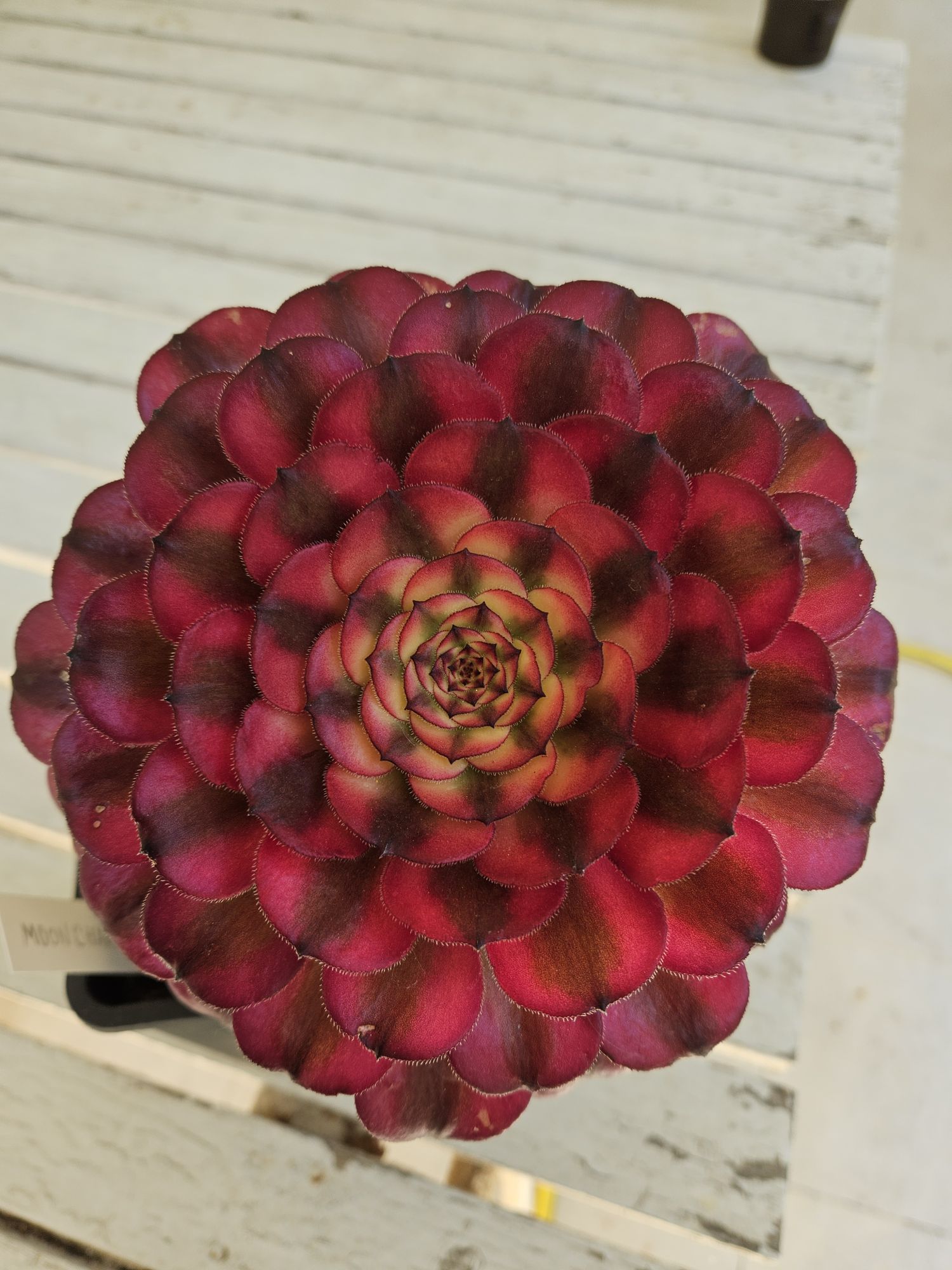
Origin:
A mutation of Aeonium ‘Hongyan’, which is itself a mutation of Aeonium ‘Mardi Gras’. Chinese horticultural sources describe it more specifically as an improved second-generation selection of ‘Hongyan’, retained and named separately to distinguish it from the original form.
Known names:
‘Moon Chan’ (the most widely used name), ‘Moonchan’, ‘Yuechan’, ‘Yue Chan’, ‘Moon Belle’, ‘Moon Goddess’, ‘Moonbell Yuechan’, 月婵, 月蝉, and sometimes 月禅.
The different Chinese spellings are probably explained by their very similar pronunciation, transliterated as “Yuechan.” The name ‘Moon Chan’ is an international commercial adaptation rather than an official botanical translation.
Creation / commercialization date:
First marketed in China in 2022.
Botanical description
Aeonium ‘Moon Chan’ is a shrubby variegated Aeonium belonging to the ‘Hongyan’ lineage. It forms regular, fairly broad and rounded rosettes made up of relatively thick, spatulate leaves. Their tips are generally rounded and end in a small point.
Seasonal changes
During the growing season, while light levels remain moderate, the foliage retains a large green central area. This is accompanied by paler lateral zones ranging from light green to creamy yellow and a narrow pink-to-red margin. The variegation may remain fairly subtle on young leaves at the center of the rosette.
As light levels and temperatures rise, the leaf margins develop increasingly intense pink, red, and then purplish-red tones. Older leaves may simultaneously take on brown, purple, or almost black shades, while the rosette center generally remains greener. This progression produces a characteristic contrast between a bright center and much darker outer leaves.
Growth and branching
Its growth appears moderate. The plant gradually develops a shrubby habit and may produce several branches beneath the main rosettes. Pinching or pruning the growing tips generally encourages a more highly branched plant.
Particular sensitivities
Aeonium ‘Moon Chan’ has no formally documented particular sensitivity.
Flowering
Flowering specific to this cultivar has not been documented. It is comparable to that of other aeoniums in the ‘Mardi Gras’ group, with an upright inflorescence bearing numerous small, star-shaped yellow flowers.
The flowering rosette is monocarpic: it dies after blooming, but non-flowering branches normally allow the plant to continue growing.
Growing conditions
☀️ Light
A very bright position is necessary to obtain compact rosettes and bring out the characteristic red and purple shades. Morning or late-afternoon sun is particularly suitable.
Full sun is possible after acclimatization, but light protection remains preferable during heat waves, especially in Mediterranean regions.
💧 Watering
Water regularly but moderately during the growing season, generally from fall through spring. Allow the growing medium to dry between waterings and never keep the roots in continuously wet soil.
In summer, when the plant enters dormancy and tightens its rosettes, reduce watering sharply. A light watering may be given when the growing medium is completely dry and the plant shows signs of dehydration.
❄️ Temperatures
Growth is optimal under mild temperatures, approximately 50 to 75°F (10 to 24°C). The plant can tolerate higher temperatures for short periods but slows or stops growing during intense heat.
Aeonium ‘Moon Chan’ must be protected from frost. A minimum winter temperature above 32°F (0°C) is recommended.
WINTER PHOTOGRAPHS


SUMMER PHOTOGRAPHS


CONTINUE EXPLORING


