Origin:
A horticultural mutation derived from Aeonium ‘Mardi Gras’, documented in China.
Known names:
‘QingYi’ (the most widely used name), ‘Tsing Yi’, 青衣.
Creation / commercialization date:
Documented in China by 2021 at the latest. The exact date of creation or first commercial release is unknown.
Origin and history
Aeonium ‘QingYi’ belongs to the important horticultural lineage of mutations derived from Aeonium ‘Mardi Gras’. A Chinese horticultural source published in 2021 already explicitly mentions 青衣 (QingYi) among the mutations of 红覆轮锦, a Chinese name associated with this lineage.
This source describes its mutation as retaining a blue-green to gray-green central zone, contrasting with marginal bands that can become deep red. The name 青衣 directly refers to this characteristic coloration in the center of the foliage.
However, no primary source has been found that can identify with certainty the breeder, the precise place where the mutation appeared, or its exact creation date. The year 2021 should therefore be regarded as a documented presence date, not as a confirmed creation date.
Botanical description
General description
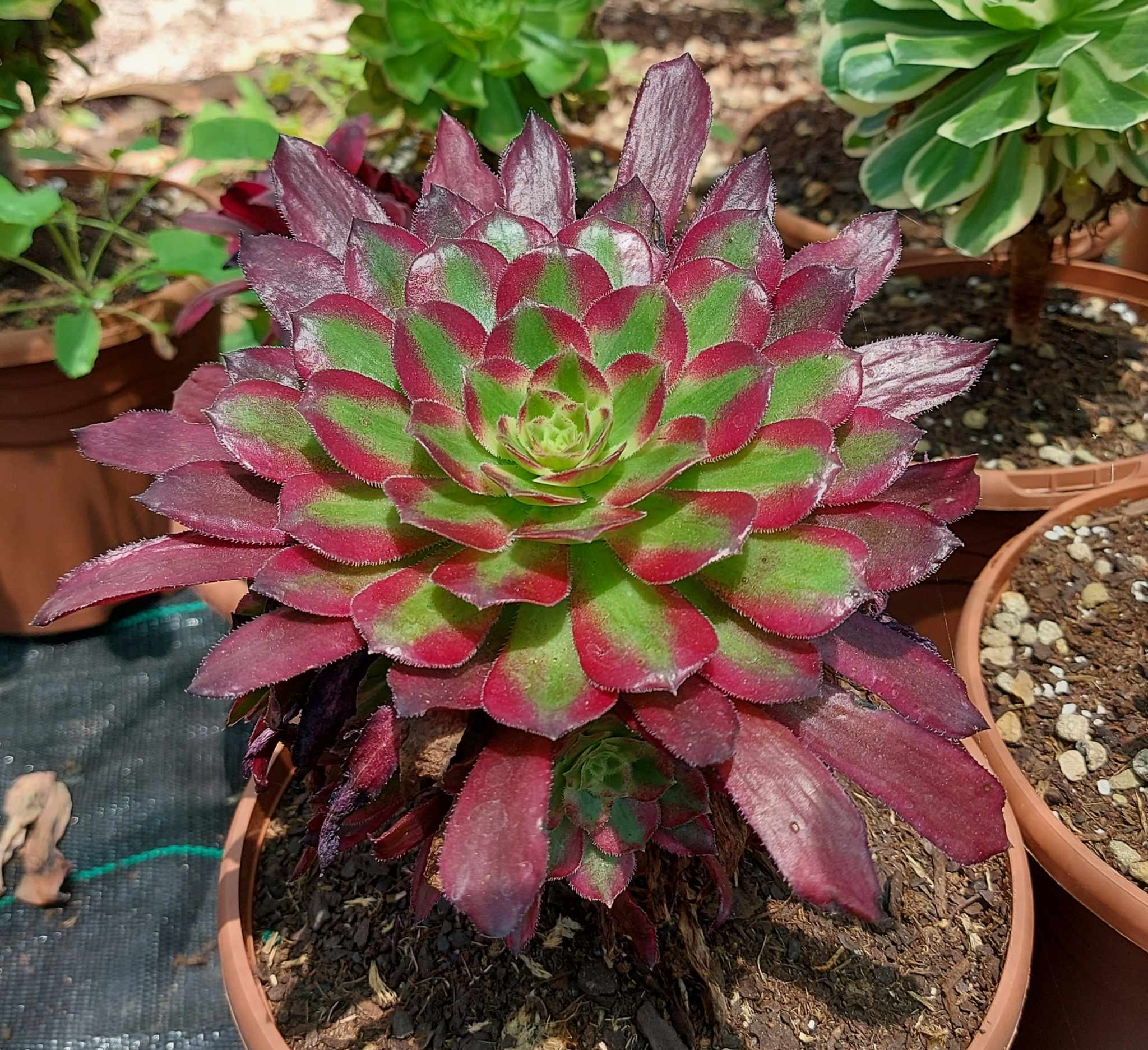
Aeonium ‘QingYi’ is a variegated cultivar forming regular rosettes. Its leaves are elongated to slightly spatulate and display particularly recognizable variegation when fully expressed: the central part remains green, blue-green, or gray-green, while the paler peripheral areas shift from cream and pale yellow to pink, red, and sometimes deep red.
The contrast between the blue-green center and the strongly colored margins is one of its most distinctive visual features. Its appearance nevertheless remains highly dependent on season, light levels, temperatures, and growing conditions.
Seasonal changes
During the winter growing period, the rosette generally displays softer colors. Green is more dominant and the variegated areas appear cream to pale yellow. Under limited light, the contrast can become relatively subtle.
In spring, increasing light gradually encourages pink and then red tones to develop in the peripheral areas, while the central portion generally retains its green coloration.
When the plant receives strong light and its variegation is fully expressed, the margins can take on rich red to deep red tones. Two genetically identical plants grown under different conditions can therefore look noticeably different.
Growth and branching
Growth follows the usual rhythm of Aeoniums in this lineage, with activity mainly concentrated during cooler periods. The plant can gradually branch and form several rosettes. Growing conditions, plant age, and any pruning strongly influence its habit.
Stability and reversions
As with other variegated cultivars originating from a mutation, vegetative propagation by cuttings is the preferred method for preserving the characteristics of ‘QingYi’. Watch for the possible appearance of fully green shoots or shoots with a markedly different distribution of variegation.
Particular sensitivities
The palest areas of the foliage, which contain less chlorophyll, are more sensitive to sunburn when exposure increases too abruptly. Gradual acclimation is therefore recommended, particularly after winter or after growing under cover.
Flowering
No flowering characteristic specific to ‘QingYi’ is currently documented. As in Aeoniums generally, a rosette that flowers is monocarpic: it dies after flowering, while the other branches can continue to grow.
Growing conditions
☀️ Light
Strong light encourages color development and the characteristic contrast of ‘QingYi’. Sun exposure should nevertheless be increased gradually to avoid burns, especially on the palest variegated areas. Protection from the most intense summer sun may be necessary depending on climate.
💧 Watering
During the growing period, generally from fall through spring in temperate climates, water when the growing medium has dried sufficiently between waterings. When intense summer heat clearly slows growth, reduce watering and adjust it to the plant’s actual condition.
🪨 Substrate
Use a very free-draining growing medium and a container that allows excess water to drain quickly. As with other Aeoniums, stagnant moisture around the roots should be avoided.
🌡️ Temperatures
‘QingYi’ favors the cool to mild periods corresponding to its active growth phase. It should be protected from frost. During intense summer heat, its activity can slow considerably and cultivation should be adjusted accordingly.
PHOTOGRAPHS


CONTINUE EXPLORING


