Origin:
Variegated form of the botanical species Aeonium castello-paivae.
Known names:
‘Suncup’ (the most widely used name), ‘Harry Mak’ (the name with nomenclatural priority), ‘Sun Cup’, Aeonium castello-paivae ‘Variegata’, ‘Castello-paivae Variegata’, 爱染锦.
Creation / appearance date:
Before 2006.
Bibliography / nomenclature:
The name ‘Harry Mak’ was published by Gordon D. Rowley in Teratopia in 2006. ‘Suncup’ was subsequently published by Robert Schulz in Aeonium in Habitat and Cultivation in 2007, p. 152. ‘Harry Mak’ therefore has publication priority.
History and nomenclature of Aeonium ‘Suncup’
Aeonium ‘Suncup’ holds a distinctive place in the history of variegated aeoniums.
Unlike many recent cultivars derived from mutations discovered and propagated in China, ‘Suncup’ has been cultivated for several decades and belongs to the historic variegated forms of Aeonium.
It is a variegated form of Aeonium castello-paivae, a species native to the Canary Islands.
Its naming history is particularly interesting.
The cultivar is now overwhelmingly known as ‘Suncup’, but this is not the name with publication priority. Gordon D. Rowley published ‘Harry Mak’ in 2006 in Teratopia. The name ‘Suncup’ appeared in the literature in 2007 in Robert Schulz’s book on Aeonium.
From a nomenclatural standpoint, ‘Harry Mak’ is therefore the prior name, while ‘Suncup’ is now the most widely used horticultural name.
This explains why both names may be found in collections and nurseries for plants with exactly the same characteristics.
Botanical description
Aeonium ‘Suncup’ is a variegated form of Aeonium castello-paivae.
It is a small shrubby Aeonium that gradually forms a densely branched clump. Its slender stems may be ascending or slightly trailing with age.
The plant generally remains modest in size, around 8 to 12 inches (20 to 30 cm) tall, but can spread farther as its many branches develop. Huntington Botanical Gardens reports mature plants reaching about 12 to 24 inches (30 to 60 cm) in height and width under favorable conditions.
The rosettes remain relatively small, generally 2 to 4 inches (5 to 10 cm) in diameter, depending on growing conditions and vigor.
Its heavily branched habit is one of its main traits and quickly produces an attractive clump.
Especially variable variegation
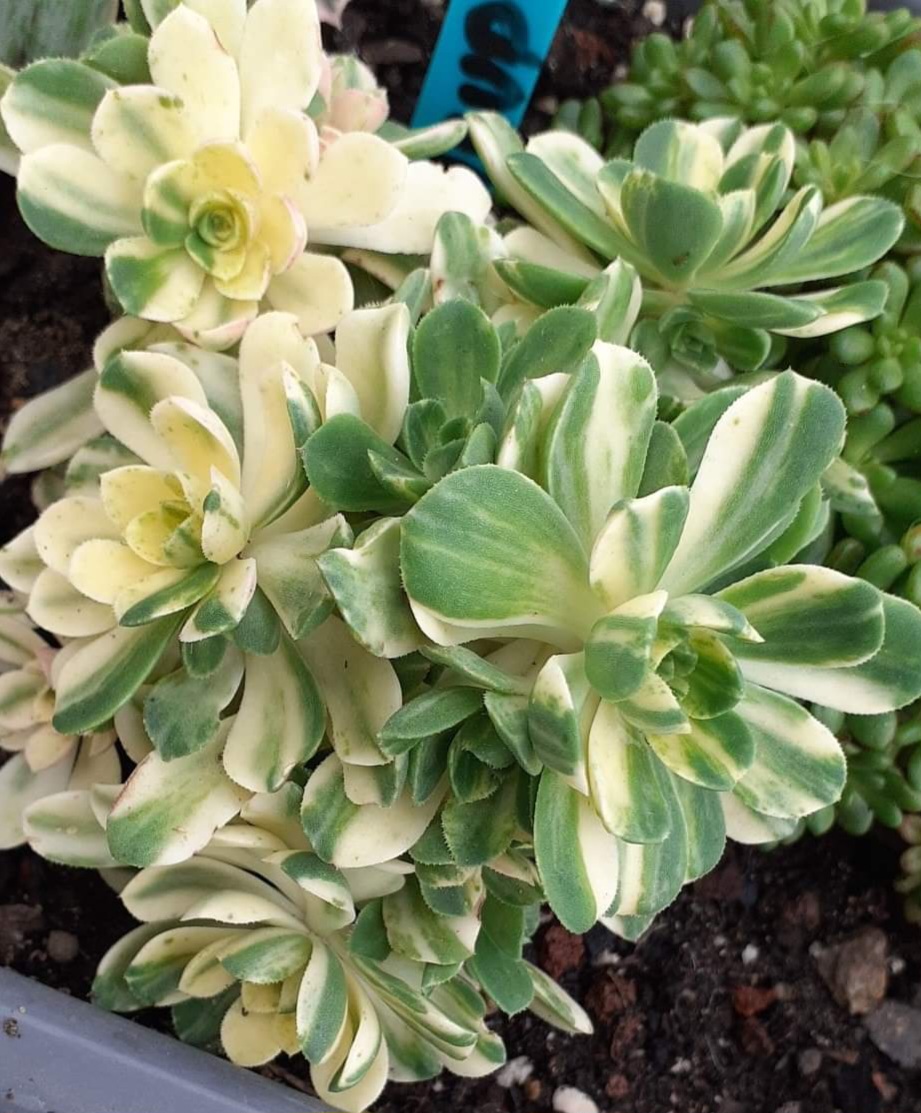
The fleshy leaves of ‘Suncup’ show irregular green, yellow, and creamy-white variegation.
The pattern can vary greatly from one rosette to another.
This is one of the cultivar’s most interesting traits: two rosettes on the same plant may display completely different patterns.
Some may be heavily marked with cream and yellow, while others retain a much larger proportion of green.
This variation also occurs among offsets. Specialist growers report that different heads on one plant may show very different levels of variegation.
The pattern is therefore not as regular as in some more recent cultivars.
Seasonal color development
One quality of ‘Suncup’ is the relative consistency of its foliage.
Unlike many modern variegated aeoniums whose colors change radically from winter to summer, ‘Suncup’ generally retains its variegated appearance throughout the year.
Light intensity can nevertheless affect the strength of its colors.
Under strong light, the leaf margins may develop subtle pink shades, a response also described in several horticultural references.
This remains secondary to the yellow, cream, and green variegation that defines the cultivar.
Reversions: a phenomenon to monitor
‘Suncup’ can produce reversions—shoots that partially or completely return to the appearance of Aeonium castello-paivae.
The phenomenon is particularly interesting because it does not necessarily affect the entire plant.
A single clump may simultaneously carry:
- strongly variegated rosettes;
- lightly variegated rosettes;
- almost entirely green rosettes;
- and occasionally rosettes with very extensive variegation.
This diversity makes almost every specimen unique.
Occasional rosettes may also be entirely lacking chlorophyll and appear white or yellow. These shoots generally cannot sustain independent long-term growth and should be monitored.
Conversely, all-green shoots may become much more vigorous and eventually dominate the variegated sections.
Fully reverted shoots may therefore need to be removed gradually to preserve a well-variegated plant.
A vigorous, freely branching Aeonium
Despite its variegation, ‘Suncup’ is generally considered vigorous and easy to propagate.
It branches readily and can quickly form a small, dense clump.
A sufficient proportion of green tissue generally allows the plant to maintain good growth.
Flowering of Aeonium ‘Suncup’


Like its botanical parent, ‘Suncup’ may flower during summer.
The relatively loose inflorescence bears small flowers that are generally white to greenish white. The flowers usually have 7 to 9 floral parts, as reported in several horticultural descriptions.
Flowering generally occurs after a sufficiently long period of growth.
As in other aeoniums, a flowering rosette eventually dies, but the strong branching ability of ‘Suncup’ usually allows the rest of the plant to continue developing.
Note: flowering may be especially impressive on a heavily branched plant when several inflorescences appear at once.
Cultivation and exposure
Aeonium ‘Suncup’ prefers a bright to partly shaded position.
Good light is important for compact growth and expression of the variegation.
However, extremely hot exposures combined with very dry air should be avoided.
In summer, growth may naturally slow and the foliage may close inward.
Mild periods, especially from fall through spring, generally correspond to much more active growth.
Avoid excess moisture
‘Suncup’ is fairly easy to grow, but its root system remains sensitive to prolonged excess water.
A very free-draining growing medium is therefore recommended.
Allow the medium to dry sufficiently between waterings and adapt watering frequency to temperature, light, and the plant’s actual activity.
Cold hardiness
Like other aeoniums, ‘Suncup’ is sensitive to frost.
Horticultural sources place it approximately in USDA zones 9b to 11b, with limits depending on local conditions and the duration of cold exposure.
A fully dry, acclimated plant may tolerate a brief temperature drop, but frost presents a significant risk, especially when the tissues are wet.
Container cultivation allows the plant to be moved easily into a protected space when freezing temperatures are forecast.
WINTER PHOTOGRAPHS


SUMMER PHOTOGRAPHS


CONTINUE EXPLORING


