Origin:
Unknown to date. Several hypotheses circulate, including a possible relationship with Aeonium cuneatum, but its ancestry is not sufficiently documented to be considered established.
Known names:
‘Taeyang’ (official name). The Korean word 태양 (Taeyang) means “sun.”
Creation / commercialization date:
South Korean origin. The earliest photographs found date to 2019 and are notably associated with K Succulent, a South Korean nursery. The cultivar remains relatively uncommon in collections.
Botanical description
Aeonium ‘Taeyang’ is a variegated Aeonium of uncertain origin whose botanical parentage has not been determined with confidence.
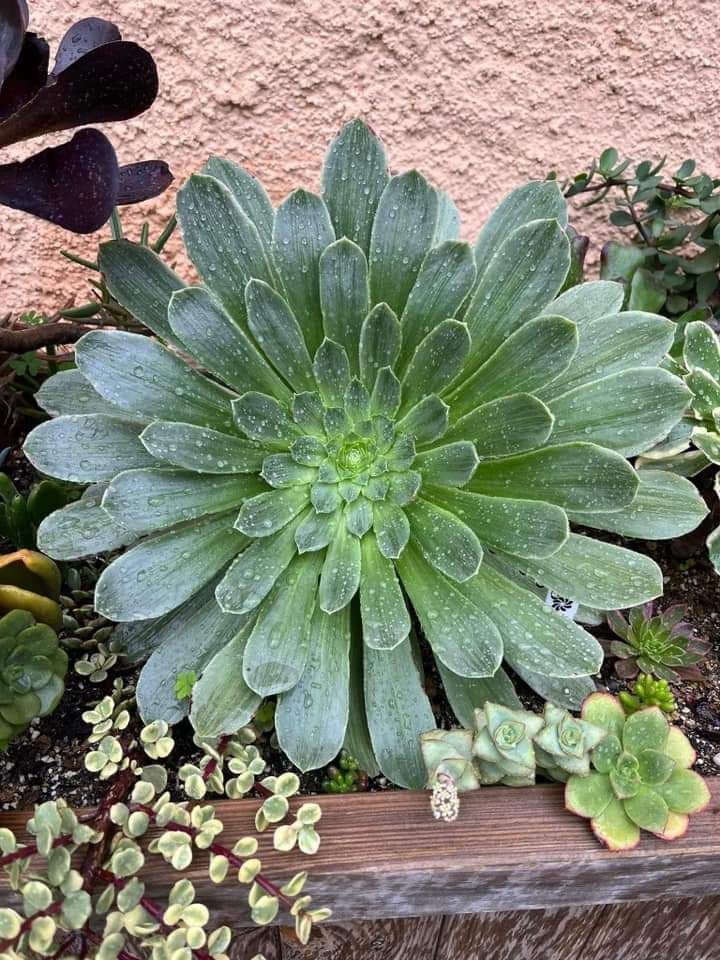
Its growth habit is one of its main distinguishing features. Unlike many shrubby aeoniums that quickly develop substantial stems, ‘Taeyang’ generally remains relatively compact and low. Cultivation observations nevertheless indicate that mature plants can eventually form especially large rosettes, approximately 12 to 16 inches (30 to 40 cm) in diameter.
It can also produce several heads and form clumps, gradually becoming more substantial without necessarily developing a very tall trunk.
Especially stable silver variegation
The foliage of Aeonium ‘Taeyang’ is mainly green and crossed by numerous silver, creamy white, to silver-gray streaks.
This fine, diffuse variegation gives it a very different appearance from variegated aeoniums with marginal bands or a broad chlorophyll-free central zone.
The expression of the variegation may change throughout the year. At times, especially when light conditions are less favorable, the streaks can become much more subtle and make the plant appear to have lost part of its variegation.
This apparent disappearance is generally temporary: the marbling and streaks return when conditions improve.
This feature is especially important in ‘Taeyang’, because it should not automatically be interpreted as a true reversion.
Limited seasonal color change
Aeonium ‘Taeyang’ appears to undergo relatively limited seasonal change.
Its foliage remains broadly green and silver throughout the year, although the intensity and visibility of the streaks may vary with light, temperature, and the plant’s hydration.
Some observations also report color changes in older leaves when the plant is stressed or exposed to particular conditions.
An especially stable cultivar
One of the most interesting features of ‘Taeyang’ appears to be its good stability.
Unlike some recently introduced variegated aeoniums whose pattern may quickly disappear or regularly produce all-green sections, ‘Taeyang’ seems to retain its variegated expression relatively well.
Cultivation and behavior
Aeonium ‘Taeyang’ has a moderate growth rate and appears able to produce offsets readily, allowing multi-rosette plants to develop fairly quickly.
It does not appear especially fragile and seems reasonably tolerant of moisture, provided the growing medium is sufficiently free-draining.
Its compact growth is also an advantage for container cultivation.
Like all aeoniums, however, ‘Taeyang’ remains sensitive to frost and must be protected from subfreezing temperatures.
A still-mysterious Aeonium
Aeonium ‘Taeyang’ is a good example of an Asian cultivar whose origin remains difficult to trace with confidence.
Its appearance in South Korea is relatively well documented by older photographs, but its botanical parentage remains uncertain. A possible connection with Aeonium cuneatum is an interesting hypothesis that requires further morphological observation.
Its compact habit, large rosettes, and especially its fine, relatively stable silver variegation nevertheless make it a highly recognizable Aeonium.
WINTER PHOTOGRAPHS


SUMMER PHOTOGRAPHS


Flowering of Aeonium ‘Taeyang’


Mutation repeatedly observed in ‘Taeyang’ plants

Reversion of ‘Taeyang’

FLOWERING OF ‘TAEYANG’

CONTINUE EXPLORING


