Origin:
The genetic origin remains unknown. Based on the earliest observations available, this Aeonium probably derives from a mutation of Aeonium ‘Maybach’, itself derived from Aeonium ‘Green Cashmere’.
Another hypothesis suggests a variation or mutation closely related to Aeonium ‘Green Medusa’.
Further observations will be needed to confirm its parentage.
Known names:
‘Sinya’ (the most commonly used name), ‘Sinya Variegated’, ‘Sinnia’, 辛尼亚, and ‘Yinyue’.
Creation date / Breeder:
A Chinese introduction, commercially available from 2023. The breeder is unknown.
Botanical description
Aeonium ‘Sinya’ is a recent variegated cultivar whose origin has yet to be established with certainty.
The earliest available information nevertheless points to a probable mutation from the ‘Maybach’ lineage, which could explain some of its morphological similarities with that group of cultivars.
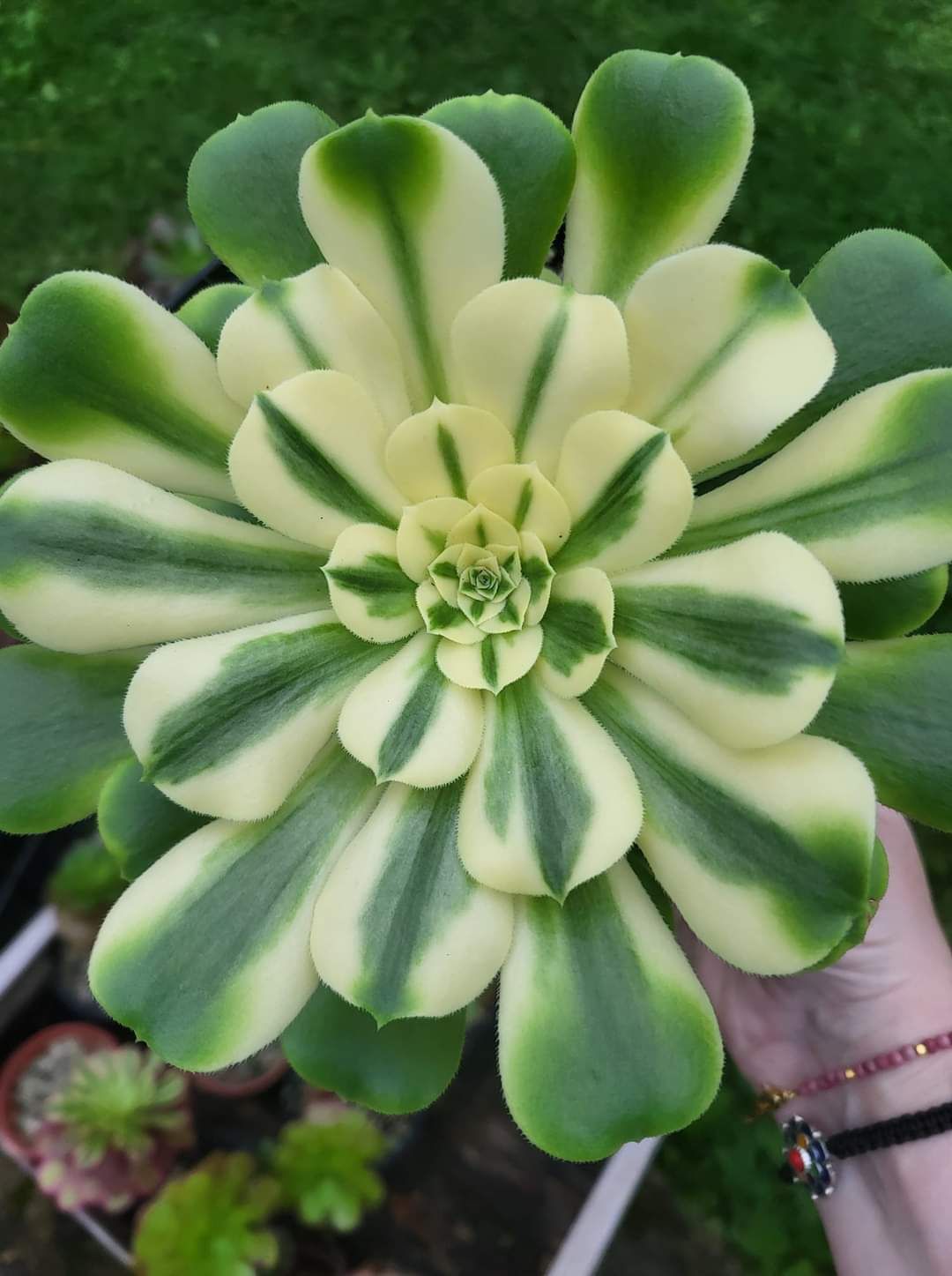
Its main distinguishing feature is centrally variegated foliage, with a broad green median zone flanked by two cream-white to ivory bands.
This pattern gives the rosette a clear contrast between chlorophyll-rich areas and areas that contain less chlorophyll.
Distinctive variegation that changes over time
One of the most notable features of Aeonium ‘Sinya’ is the way leaf coloration changes with age.
The oldest leaves on the outside of the rosette often become darker green, sometimes almost uniform, with less visible variegation.
By contrast, the young leaves at the center of the rosette usually show the cultivar’s characteristic contrast more strongly, with more pronounced pale bands.
This progression can make a single rosette appear to display several levels of coloration, which helps with identification.
Some observations also report that in summer, especially under high heat or particular light conditions, Aeonium ‘Sinya’ may temporarily show less variegation and produce much greener leaves.
This phenomenon remains to be confirmed and could reflect a physiological adaptation that preserves more photosynthetic capacity during stressful periods.
Growth and cultivation behavior
Aeonium ‘Sinya’ grows fairly vigorously compared with many variegated aeoniums.
Its natural ability to produce offsets is considered good, making propagation easier and allowing it to form clusters.
Under the conditions observed so far, it does not appear to show any particular cultivation weakness.
One phenomenon nevertheless deserves special attention: it may produce offsets entirely lacking chlorophyll.
These entirely white or very weakly pigmented offsets are generally unable to sustain growth on their own. They should be monitored so they do not develop excessively at the expense of normally variegated growth.
As with all strongly variegated Aeonium cultivars, it is advisable to provide:
- enough light to preserve coloration;
- protection from intense summer heat;
- a very free-draining growing medium;
- watering adjusted appropriately during periods of stress.
A recent cultivar that still requires observation
Aeonium ‘Sinya’ is among the newer Chinese selections to have appeared recently on the international market.
Its main distinguishing characteristics are:
- its clearly defined central variegation;
- the contrast between young and old leaves;
- its distinctive seasonal changes;
Several more years of observation will be needed to better understand:
its potential to produce new mutations;
the stability of its variegation;
its summer behavior;
its actual relationship with the ‘Maybach’, ‘Green Cashmere’, or ‘Green Medusa’ lineages.


WINTER PHOTOGRAPHS


SUMMER PHOTOGRAPHS


CONTINUE EXPLORING


