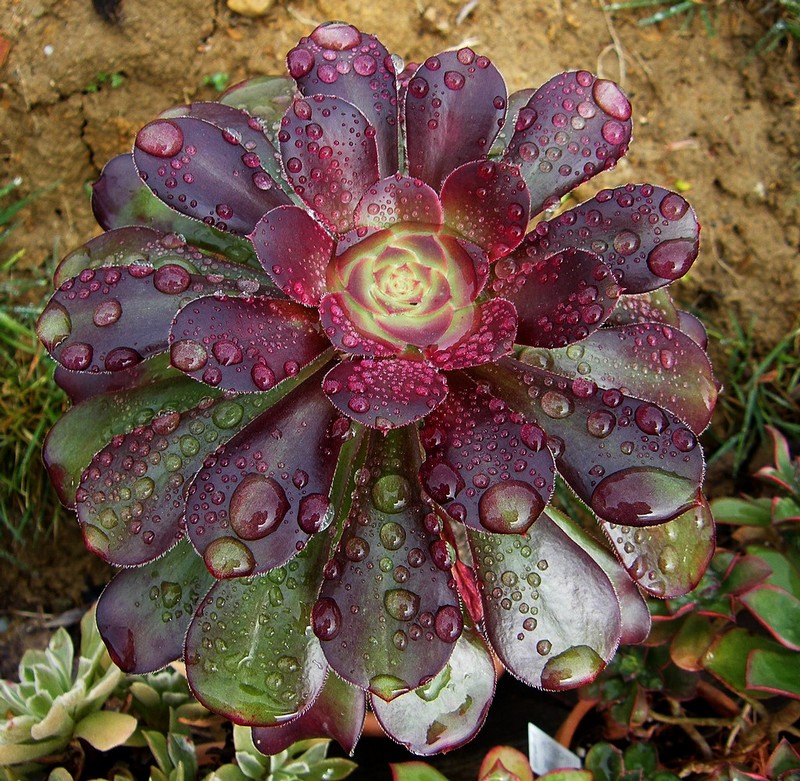
A still-mysterious lineage behind several of the most sought-after variegated aeoniums.
Among the major variegated Aeonium lineages, the lineage of Aeonium ‘Plum Purdy’ holds a special place.
Created by the renowned American horticulturist John William “Jack” Catlin, Aeonium ‘Plum Purdy’ belongs to the same group of hybrids as Aeonium ‘Velour’ and Aeonium ‘Blushing Beauty’. These three creations share genetic heritage from the cross between Aeonium arboreum ‘Zwartkop’ and Aeonium canariense, although their morphological characteristics differ noticeably.
The history of Aeonium ‘Plum Purdy’ does not end with the original hybrid.
For several years, various variegated plants have circulated in Asian and European collections under names such as Aeonium ‘Chanel’, Aeonium ‘Lina’, Aeonium ‘Chanel Middle’, and Aeonium ‘Ice Cream’.
This raises a fascinating question:
Do these plants really derive from Aeonium ‘Cornish Rose’, as long claimed, or do they actually belong to the lineage of Aeonium ‘Plum Purdy’?
This is one of the most intriguing questions currently being explored in the world of variegated aeoniums.
AEONIUM ‘PLUM PURDY’: THE ORIGINAL HYBRID
Origin :
A hybrid of Aeonium arboreum ‘Zwartkop’ × Aeonium canariense. It is a sibling of the well-known Aeonium ‘Velour’ and ‘Blushing Beauty’, two other Jack Catlin creations. It resembles ‘Velour’, but has more compact rosettes and a taller, more slender habit.
Known names : ‘Plum Purdy’ (official name)
Creation date / Breeder :
Created by Jack Catlin in the United States in 1994.
Botanical description
Aeonium ‘Plum Purdy’ is a particularly elegant Aeonium.
Its name refers to its distinctive plum, burgundy, and purple tones, which appear most strongly when the plant receives high light levels.
The rosette generally retains a greener center while the leaves gradually develop much darker tones toward their tips.
Its rosettes can reach approximately 25 cm in diameter.
In cultivation, it can develop a relatively tall, branching habit of up to 90 cm, although some plants remain more compact.


A disputed origin
For many years, Aeonium ‘Chanel’ was presented as a mutation of Aeonium ‘Cornish Rose’.
This origin is now disputed by Variegated Aeonium and by many other Aeonium specialists.
Why?
When the plants are compared, the morphology of Aeonium ‘Chanel’ appears to show many similarities to Aeonium ‘Plum Purdy’ and differs considerably from that of Aeonium ‘Cornish Rose’.
This observation alone does not constitute botanical proof.
However, it becomes especially interesting when several elements converge:
- the appearance of the rosettes during active growth;
- the shape and thickness of the leaves;
- the appearance of the rosette during dormancy;
- reversions
A theory, not a certainty
This distinction must be stated very clearly.
There is currently no scientific analysis proving definitively that Aeonium ‘Chanel’ is a mutation of Aeonium ‘Plum Purdy’.
It would therefore be incorrect to present this hypothesis as an established fact.
Nevertheless, several growers and collectors have observed similarities significant enough for this theory to merit further investigation.
Some specialist Chinese growers, including ABC Succulent, historically sold Aeonium ‘Chanel’ under the name Aeonium ‘Plum Purdy variegata’, while others sold it as Aeonium ‘Cornish Rose variegata’.

Photo : Redhills Garden

Photo : Sandrine Glotin

Photo : ABC Succulent

Photo : ABC Succulent

Photo : Cécile Chesnel

The debate therefore remains open, as one point still calls this theory into question.
This is precisely what makes this lineage so fascinating.
Reversions: a particularly interesting clue
In a variegated Aeonium, a reversion is the appearance of a rosette that loses its variegation and becomes closer in appearance to the non-variegated parent.
Caution is still required.
A reversion does not necessarily reproduce the original cultivar exactly.
It may retain some characteristics of the mutation while recovering part of the parent’s morphology.
C’est précisément ce qui rend reversions de Aeonium ‘Chanel’ particulièrement intéressantes car leur morphologie est très proche voire similaire à l’Aeonium ‘Plum Purdy’.
This resemblance still cannot, by itself, establish parentage.
However, it provides one more element in the body of evidence supporting this hypothesis.


The one element that raises a question
One morphological characteristic does not fit this theory perfectly.
Aeonium ‘Chanel’ can produce basal offsets.
This behavior is also observed in Aeonium ‘Cornish Rose’.
By contrast, Aeonium ‘Plum Purdy’ does not appear to produce this type of offset.
This is currently one of the factors that makes the hypothesis more complex.
VARIEGATED AEONIUMS DERIVED FROM ‘PLUM PURDY‘

CHANEL / PLUM PURDY VARIEGATA
Known names : round leaf white brocade, Cornish rose variegated 1, Short Black The White (a name to avoid because ‘Short Black’ refers to Aeonium ‘Zwartkin’ and ‘Chanel’ does not derive from ‘Zwartkin’), 圆叶白/香奈儿
More information here.

FIRE KIRIN
Known names : Fire Kirin.
New in 2024
Slight mutation of ‘Chanel’.

ICE CREAM
Known names : ‘Ice Cream’ (most widely used name), ‘Green Chanel’.
It is reported to be a mutation of ‘Chanel’.

CHANEL PINK
Mutation of ‘Chanel’.
Created in 2025

RED DIAMOND
Known names : ‘Red Diamond‘ (most widely used name), ‘红钻’ (Hóngzuàn).
It is reported to be a mutation of ‘Chanel’.
It may be the same cultivar as ‘Pink Chanel’.
Created in China in 2026.
LINA / PLUM PURDY SUPER WHITE VARIEGATA
Known names : Lina (most widely used name), Cornish Rose Variegata 3

SUNSET GLOW / PLUM PURDY MIDDLE
Known names : ‘Sunset Glow’, Chanel Middle, Short Black middle (a name to avoid because ‘Short Black’ refers to Aeonium ‘Zwartkin’ and ‘Chanel’ does not derive from ‘Zwartkin’), 圆叶中斑.
More information here.

CHANEL YELLOW / PLUM PURDY YELLOW
This may be the cultivar known as ‘Ice Cream’.
This Aeonium no longer appears to be sold by Chinese growers. If you have information about it, please contact me.
Differences between ‘Chanel’, ‘Lina’, and ‘Ice Cream’


CONTINUE EXPLORING


