Origin:
The Aeonium ‘Chanel’ has long been presented as a mutation of Aeonium ‘Cornish Rose’. However, the latest observations and morphological comparisons tend to demonstrate that it actually comes from the Aeonium ‘Plum Purdy’.
This original confusion is probably linked to the strong visual similarities between certain cultivars of this family. A more detailed analysis of this hypothesis is available in the category ‘Plum Purdy variegata’.
Known names:
‘Chanel’ (most common name), Round Leaf White Brocade, Cornish Rose Variegated 1, (Yuan Ye Bai), 香奈儿 (Chanel in Chinese), ‘Short Black the White‘.
Creation date / Creator:
Marketing observed from 2021 (China).
Botanical description
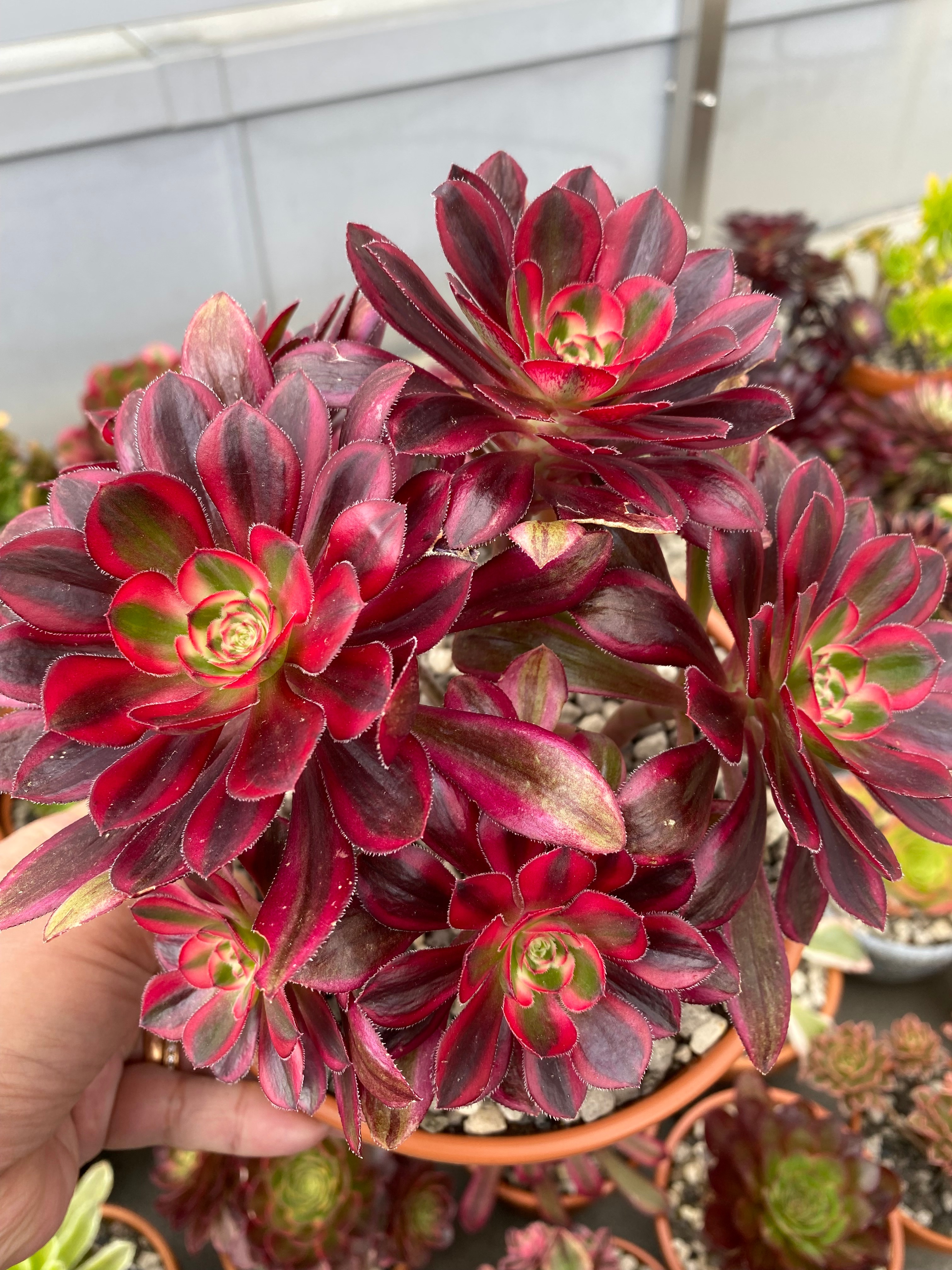
The Aeonium ‘Chanel’ is a variegated shrubby Aeonium (variegata) from the Aeonium ‘Plum Purdy’.
This cultivar is distinguished by particularly elegant foliage combining green, cream and red areas in a very aesthetic balance.
In winter, when the light is lower, the rosette generally presents:
- a more or less thin green central strip;
- large creamy yellow to creamy white lateral areas;
- a fine pink to red border around the edges of the leaves.
This variegation structure gives the Aeonium ‘Chanel’ a bright and refined appearance, a characteristic sought after by Aeonium variegata collectors.
A colorful evolution depending on the brightness
Like many Aeonium variegata, ‘Chanel’ fully expresses its aesthetic potential when light conditions increase.
With more sun and favorable temperatures:
- the cream side areas gradually become colored;
- the edges of the leaves take on more pronounced pink then red shades;
- the contrast between the different areas of the foliage becomes more intense.
This seasonal evolution makes it possible to obtain a plant with very different appearances between the winter period and the summer period.
Culture and behavior
The Aeonium ‘Chanel’ is a relatively easy cultivar to maintain in cultivation.
Its main characteristics:
- Growth: average for an Aeonium variegata;
- Ability to reject: good;
- Fragility: no particular sensitivity observed to date.
Its good proportion of chlorophyll zones allows it to maintain correct vigor, unlike some strongly depigmented Aeonium which can be more delicate.
Like all Aeoniums, however, it remains sensitive to frost and requires special attention during periods of high summer heat when the plant slows down.
WINTER PHOTOS


SUMMER PHOTOS


Difference between Aeonium ‘Chanel’ and Aeonium ‘Lina’
The Aeoniums ‘Chanel’ and ‘Lina’ are sometimes confused due to their assumed common origin and close appearance.
After comparing numerous subjects, it appears, however, that it is indeed a question of two distinct cultivars, probably from different mutations of the same parent.
The main observable difference concerns their chlorophyll level:
Aeonium ‘Chanel’
- has a larger white/cream area;
- has less chlorophyll tissue;
- its foliage generally appears more contrasted.
Aeonium ‘Lina’
- retains more green areas;
- therefore has a greater quantity of chlorophyll;
- could logically present slightly higher vigor.
This difference in proportion between green areas and areas devoid of chlorophyll directly influences the photosynthetic capacity of the plant and can explain potentially faster growth in ‘Lina’.

And below you will find some photos of ‘Lina’.

An elegant Aeonium from a complex lineage
The Aeonium ‘Chanel’ perfectly illustrates the identification difficulties that we regularly encounter in the world of modern Aeonium variegata.
Between historical errors of origin, commercial synonyms and close mutations from the same parent, precisely tracing the genealogy of these cultivars often requires several years of observations.
It is now part of the recent Chinese Aeonium variegata which quickly found its place in international collections.
REVERSION OF A CHANEL OFFSET

DIFFERENCES BETWEEN DIFFERENT AEONIUMS FROM CHANEL


Share:

CONTINUE EXPLORING


