‘Velour’, ‘Blushing Beauty’, ‘Plum Purdy’, ‘Cyclops’, ‘Voodoo’, ‘Garne‘Velour’, ‘Blushing Beauty’, ‘Plum Purdy’, ‘Cyclops’, ‘Voodoo’, ‘Garnet’, ‘Zwartkin’…
These names are familiar to many Aeonium collectors. Some have become classics in our collections, others have been used as parents for new generations of hybrids, and a few can even be found, directly or indirectly, in the ancestry of many modern variegated Aeoniums.
Yet behind these plants stands a man who is relatively little known today:
John William “Jack” Catlin (1919–2008).
A trained biologist, artist, landscape designer, collector and hybridizer, this American based in California was one of the important figures in the modern horticultural history of the genus Aeonium.
Thanks to an article published in 1993 in the Cactus and Succulent Journal, while Catlin was still alive, it is now possible to reconstruct part of his life and, above all, to better understand how some of his most famous Aeoniums came into existence.
A passion that began in childhood
Jack Catlin was born on November 29, 1919, in Springfield, Illinois.
His interest in cacti and succulent plants began remarkably early.
He recalled that this fascination was already firmly established by the time he was ten years old.
In 1929, he acquired his first Haworthia cymbiformis. Even more remarkably, when he told this story to Larry W. Mitich in 1993, he still had, at his home in La Cañada, California, the very same clone he had purchased more than sixty years earlier.
A few years later, around 1935, his father helped him build a small greenhouse attached to the family home.
His collection of cacti and succulents then began to grow in earnest.
As a teenager, Catlin also discovered the illustrated catalogues of Harry Johnson, the famous Californian cactus and succulent grower.
He sent Johnson a photograph of his own collection, which at the time consisted of around fifty plants.
To his great surprise, Harry Johnson published the photograph in his 1936 catalogue.
Jack Catlin was only sixteen.
Decades later, he would recall how much this small recognition had strengthened his passion.
That fascination with plants would remain with him for the rest of his life.
From biology to art
After finishing high school in 1938, Catlin studied biological sciences at Illinois State Normal University, now Illinois State University.
The Second World War interrupted his studies.
From 1942 to 1945, he served in the US Navy as a Hospital Corpsman, notably in the Pacific with the Marines.
During periods spent in California, he discovered the landscapes and succulent flora around San Diego and La Jolla. For the young man from Illinois, the cacti, Dudleya, Californian nurseries and Balboa Park were a revelation.
His military service also took him to Okinawa, the Philippines and China.
In Beijing, where he was stationed near Nan Yuan, Catlin became fascinated by one of Asia’s great historical centres of art and architecture.
After the war, he chose to complement his scientific education with artistic training.
He attended the School of Fine Arts at Washington University in St. Louis, followed by the Art Center College of Design in Los Angeles.
Biology and art would thereafter accompany him throughout his career.
After working in industrial design, particularly for the ceramics industry, he eventually turned to landscape design.
This dual sensitivity — botanical and artistic — probably helps us understand his later work with Aeoniums.
Catlin was not merely looking for biologically interesting hybrids.
He selected plants for their colour, architecture, texture and performance in the garden.
California: the ideal testing ground
Settling in La Cañada, California, Jack Catlin gradually built up a considerable plant collection.
He was interested in cacti and succulents, but also in bonsai, conifers and many other groups of plants.
Abutilon became one of his major passions. He hybridized them for more than forty years and personally produced numerous colour drawings of his creations.
His work with other plant genera deserves mention because it helps us understand something essential:
Jack Catlin was already an experienced hybridizer when he began working seriously with Aeoniums.
He possessed practical knowledge of plant breeding, carefully observed his seedlings and retained individuals displaying the most interesting horticultural characteristics.
With Aeoniums, this approach would produce remarkable results.
‘Zwartkop’: the key to much of his work
To understand Jack Catlin’s hybrids, we must begin with one fundamental plant:
Aeonium ‘Zwartkop’.
Its extremely dark coloration was a spectacular horticultural trait.
Catlin understood the potential of crossing ‘Zwartkop’ with different Aeonium species possessing very different morphologies.
The principle was as simple as it was fruitful:
use ‘Zwartkop’ as a source of pigmentation and combine it with the distinctive characteristics of other species.
With Aeonium tabuliforme, he could seek a flatter rosette.
With Aeonium canariense, a different texture and architecture.
With Aeonium undulatum, much greater size.
From this idea emerged several of the most iconic horticultural Aeoniums of the late twentieth century — plants that would, in turn, contribute to many contemporary hybrids.
1976: Aeonium tabuliforme × ‘Zwartkop’
One of Catlin’s earliest major documented crosses dates back to 1976.
He crossed:
Aeonium tabuliforme × Aeonium ‘Zwartkop’
The objective was particularly interesting.
A. tabuliforme produces an extraordinary, extremely flattened rosette that appears almost pressed against the ground. ‘Zwartkop’, by contrast, is prized for its exceptionally dark pigmentation.
Catlin therefore attempted to combine these two traits in a single plant:
a dark rosette retaining something of the architecture of tabuliforme.
This cross would give rise to several important selections.
Aeonium ‘Zwartkin’
The selection most directly associated with this experiment is:
Aeonium ‘Zwartkin’.
Larry Mitich’s 1993 article is particularly valuable here.
It explicitly records:
Aeonium tabuliforme × A. arboreum ‘Zwartkop’ — 1976.
At the time, however, the name appeared as ‘Zwartkind’.
Thanks to corrections subsequently published by the Huntington, we now know that this was an error.
The name Catlin intended was indeed ‘Zwartkin’.
It was a play on words.
In English, kin means a relative, someone or something related, or belonging to the same family.
‘Zwartkin’ was therefore, quite literally, a relative of ‘Zwartkop’.
Over the years, an initial catalogue error transformed the name into ‘Zwartkind’, while a later attempt to correct it produced yet another version, ‘Zwartkint’.
These different spellings still occasionally circulate today.
Its rosettes retain a very dark coloration for much of the year and become far less green than most other cultivars derived from ‘Zwartkop’.
Growth is relatively slow, and the plant generally reaches between 40 and 50 cm in height.


Three clones, three destinies
Later Huntington records allow us to understand the outcome of this experiment much more precisely.
Jack Catlin retained three clones from the seedlings produced by this cross.
The first was ‘Zwartkin’, the plant that came closest to his original objective.
Another, designated ‘Zwartkin #3’, had predominantly green foliage and offered insufficient improvement over its parents.
But the second would prove far more interesting.
Catlin simply called it:
‘Zwartkin #2’.
Its rosette was less flat than he had originally hoped for.
However, the plant possessed other qualities: it was vigorous, produced large rosettes, developed attractive reddish coloration and performed particularly well under summer conditions.
It was successfully grown in the Huntington’s Desert Garden.
And several years later, it would meet an unexpected fate.
Aeonium ‘Jack Catlin’
Jack Catlin died in June 2008, at the age of 88.
After his death, Gary Lyons, then curator of the Huntington Desert Garden, proposed naming the former ‘Zwartkin #2’ in Catlin’s honour.
The plant was officially distributed through the International Succulent Introductions programme in 2009, under the reference:
ISI 2009-10 — HBG 73035
It became:
Aeonium ‘Jack Catlin’
The choice has a fitting symbolic dimension.
The plant that bears Catlin’s name today was not exactly the plant he had originally intended to create.
He had been seeking a very dark, extremely flattened rosette.
The seedling ultimately retained was different.
But it proved to be an excellent horticultural plant.
Perhaps this is one of the best illustrations of Catlin’s work: hybridization begins with a precise idea, but the breeder’s eye must then be capable of recognizing an interesting plant even when it does not correspond exactly to the result originally imagined.
Its rosettes, which can reach around twenty centimetres in diameter, are intermediate in shape between the two parents: deeper than those of Aeonium tabuliforme, but more open than those of ‘Zwartkop’.
The centre of the rosette remains bright green, while the tips of the leaves gradually develop deep red tones under strong sunlight.
It also shows excellent tolerance of intense summer heat and develops dense, well-balanced growth.


Where does Aeonium ‘Garnet’ fit in?
Another Catlin cultivar is associated with the same parentage:
Aeonium ‘Garnet’.
It is documented as resulting from:
Aeonium tabuliforme × Aeonium ‘Zwartkop’
and was distributed by the ISI in 1995 under the reference ISI 95-12.
It is sometimes claimed that ‘Garnet’, ‘Zwartkin’ and ‘Jack Catlin’ were exactly the three clones retained by Catlin.
However, Huntington records suggest greater caution.
The documentation concerning ‘Jack Catlin’ describes three clones, one of which was green and considered insufficiently interesting.
Based on the sources currently available, it is therefore preferable to regard ‘Garnet’ as another Catlin selection from the same parentage, without claiming that it was one of the three specific clones mentioned in the history of ‘Zwartkin’.
This distinction perfectly illustrates the difficulty of reconstructing the exact genealogy of old cultivars several decades later.
Its name refers to the particularly intense garnet colour developed by its foliage under strong light.
It gradually forms a compact, highly branched shrub composed of numerous dense rosettes. Its habit is more spreading than that of ‘Jack Catlin’, and its growth is relatively vigorous. The rosettes retain a green centre surrounded by bronze-red to garnet foliage that intensifies during summer. This colour combination has also earned it the nickname ‘Irish Eyes’ among some English-speaking growers.
At maturity, the plant can reach approximately 60 cm in height and more than one metre across, producing numerous offsets. Its foliage is generally darker than that of ‘Jack Catlin’, while its growth habit more strongly recalls the compact appearance inherited from Aeonium tabuliforme.
1984: Aeonium canariense × ‘Zwartkop’
Eight years after his tabuliforme cross, Catlin continued his experiments.
In 1984, he made the cross:
Aeonium canariense × Aeonium ‘Zwartkop’
This date is particularly well documented, as it appears directly in Larry Mitich’s 1993 portrait of Catlin.
This new parentage would produce several plants of major importance in the horticultural history of the genus.
Aeonium ‘Blushing Beauty’
The first clearly documented selection is:
Aeonium ‘Blushing Beauty’
Mitich gives 1984 as the date of creation and states that the plant was subsequently offered through International Succulent Introductions in 1992.
It was distributed under the reference:
ISI 92-27 — HBG 66756
‘Blushing Beauty’ combines characteristics inherited from both parents.
Its slightly pubescent texture recalls A. canariense, while its pigmentation reflects the influence of ‘Zwartkop’.
Depending on growing conditions and the season, the rosettes can change from green to various reddish, pinkish or bronze shades.
This ability to change considerably in appearance remains part of its horticultural appeal today.


Aeonium ‘Plum Purdy’
The same parentage also produced:
Aeonium ‘Plum Purdy’
The plant was distributed in 1994 under the reference ISI 94-14.
It is particularly notable for the plum-coloured tones its foliage can develop.
In May 1995, the Los Angeles Times, announcing a major plant sale at the Huntington, specifically mentioned John Catlin’s Aeonium hybrids and the deep purple foliage of ‘Plum Purdy’.
Catlin’s Aeoniums were therefore already remarkable enough for his name to be used to attract the Californian horticultural public.


Aeonium ‘Velour’
Another member of this same family is one of his most important cultivars:
Aeonium ‘Velour’
Its fine foliar pubescence, inherited from the influence of A. canariense, gives the leaves a subtly velvety surface, explaining its name.
At the same time, pigmentation inherited from ‘Zwartkop’ allows the rosettes to develop magnificent dark, purple or mauve tones.
‘Velour’ would not be officially distributed by the ISI until 2000, under the reference ISI 00-41.
This chronology is particularly instructive.
With Catlin, many years could pass between making a cross, selecting an interesting seedling, propagating it, naming it and its official distribution.
This is why the “creation dates” found in modern catalogues should be treated with caution.


1988: the birth of Aeonium ‘Cyclops’
In 1988, Jack Catlin attempted another combination:
Aeonium undulatum × Aeonium ‘Zwartkop’
This time, the objective was to combine the vigorous growth and large rosettes of A. undulatum with the dark pigmentation of ‘Zwartkop’.
The result was spectacular.
Aeonium ‘Cyclops’
Larry Mitich described it in 1993 as dark bronze and extremely large — it generally reaches between 1.5 and 2 metres in height — with rosettes measuring 14 to 16 inches, or approximately 35 to 40 centimetres in diameter.
The plant was officially distributed a few years later, in 1995, under the number ISI 95-11.
With its large bronze-red to purple rosettes and generally greener centre, ‘Cyclops’ became one of Catlin’s most immediately recognizable creations. This distinctive feature inspired its name, recalling the single eye of the Cyclops of Greek mythology.


Aeonium ‘Voodoo’
The same parentage also produced:
Aeonium ‘Voodoo’
It therefore shares the same parents as ‘Cyclops’:
Aeonium undulatum × Aeonium ‘Zwartkop’
but displays its own combination of characteristics.
This hybrid combines the imposing stature of Aeonium undulatum with the dark coloration of ‘Zwartkop’.
It ranks among the largest known cultivars and can exceed two metres in height under favourable growing conditions.
Its broad rosettes develop very dark purple tones, almost black during summer, before partially returning to green during the growing season.
Naturally only lightly branched, it develops a tall, upright habit that gives it a particularly spectacular silhouette.
It was distributed much later under the reference:
ISI 2001-12
The existence of ‘Cyclops’ and ‘Voodoo’ illustrates a fundamental principle of hybridization: two plants originating from the same parents are not necessarily identical.
Every seedling represents a new genetic combination, and it is then up to the breeder to decide which ones deserve to be retained.


Catlin’s Aeoniums and the essential role of the Huntington
Jack Catlin’s story is closely linked to the Huntington Botanical Gardens in San Marino, California.
Catlin was active there for several decades and maintained close relationships with several key figures at the gardens.
Above all, the Huntington would play an essential role in the preservation, identification and distribution of his creations.
Its International Succulent Introductions programme now allows us to establish a particularly valuable documentary chronology:
- 1976 — ‘Zwartkin’: hybridization documented in Catlin’s account published in 1993
- 1984 — ‘Blushing Beauty’: hybridization documented; distributed as ISI 92-27 in 1992
- 1988 — ‘Cyclops’: hybridization documented; distributed as ISI 95-11 in 1995
- 1994 — ‘Plum Purdy’: distributed as ISI 94-14
- 1995 — ‘Garnet’: distributed as ISI 95-12
- 2000 — ‘Velour’: distributed as ISI 00-41
- 2001 — ‘Voodoo’: distributed as ISI 2001-12
- 2009 — ‘Jack Catlin’: distributed as ISI 2009-10
This chronology also demonstrates why caution is necessary when assigning a “creation date” to an old Aeonium cultivar.
The date of the cross, selection of the clone, naming of the cultivar and its commercial distribution may represent four entirely different moments.
Catlin, the collector and conservationist
Although his hybridization work is now the most visible part of his legacy in the Aeonium world, it tells only part of his story.
Jack Catlin was deeply committed to the preservation of plant collections.
He was notably responsible for an important historical collection of Haworthia originating from J. R. Brown and, in 1992, participated in transferring duplicates to the Succulent Plant Trust in England in order to preserve these clones.
This aspect of his life deserves brief mention because it sheds light on the way he regarded plants.
For Catlin, a collection was not merely a group of beautiful specimens.
It was also a living heritage that had to be identified, propagated, shared and passed on.
This philosophy feels particularly relevant today, when we consider how some old Aeonium cultivars have become rare or disappeared entirely.
A hybridizer recognized during his lifetime
In 1993, when Larry W. Mitich published his portrait of Jack Catlin in the Cactus and Succulent Journal, Catlin had recently received the Special Service Award from the Cactus & Succulent Society of America.
The award recognized, among other things, his important hybridization work, his contribution to spreading enthusiasm for succulents and his efforts in plant conservation.
Other honours marked his career, including a major horticultural distinction in California in 1983 and the Golden Leaf Award from the Descanso Bonsai Society in 1992.
His name would later be given to a CSSA award specifically dedicated to Aeoniums:
the Jack Catlin Award.
Having his name associated with the finest Aeonium presented at a show is perhaps one of the most fitting tributes to his work.
Creations that continued to evolve after him
The story could have ended with the cultivars Catlin created himself.
But his influence runs much deeper.
His hybrids continued to be used as parents by other breeders.
And this is where his story connects directly with that of modern variegated Aeoniums.
One of the most important examples concerns Aeonium ‘Mardi Gras’.
This cultivar was created by American hybridizer Renée O’Connell from genetic material that included two of Jack Catlin’s creations:
‘Velour’ and ‘Garnet’.
The work of the two hybridizers is therefore directly connected.
Catlin had used botanical species and ‘Zwartkop’ to create new combinations.
A generation later, these hybrids themselves became the parents of new creations.
From Jack Catlin to contemporary Asian variegated Aeoniums
This lineage becomes particularly interesting when we examine the recent history of variegated Aeoniums.
Mardi Gras has played a considerable role in the development of several modern lineages.
Variegated mutations emerged from this genetic background and were subsequently selected, propagated and, in some cases, mutated again, particularly in Asia.
When reconstructing some of these families today, we can therefore trace the lineage progressively backwards:
from contemporary mutations,
to ‘Mardi Gras’,
then to its parents,
and finally to hybrids such as ‘Velour’ and ‘Garnet’.
In other words, behind some of the most modern variegated plants in our collections are still genes originating from experiments carried out several decades earlier by Jack Catlin.
This continuity is probably one of the reasons why his story deserves to be told today.
When cultivars become heritage
The history of Catlin’s Aeoniums also reveals a difficulty familiar to anyone attempting to document old cultivars.
A horticultural variety can become extremely popular and then gradually disappear.
Plants change owners.
Labels are lost.
Names become distorted.
Different plants begin circulating under the same name.
The story of ‘Zwartkin’, which became ‘Zwartkind’ and then ‘Zwartkint’ in certain catalogues, is an almost perfect example.
The Huntington itself had to locate authentic material again after losing the plant from its collections.
Preserving a cultivar therefore means simultaneously preserving:
the plant, its name and its history.
If any one of the three disappears, part of its horticultural heritage disappears with it.
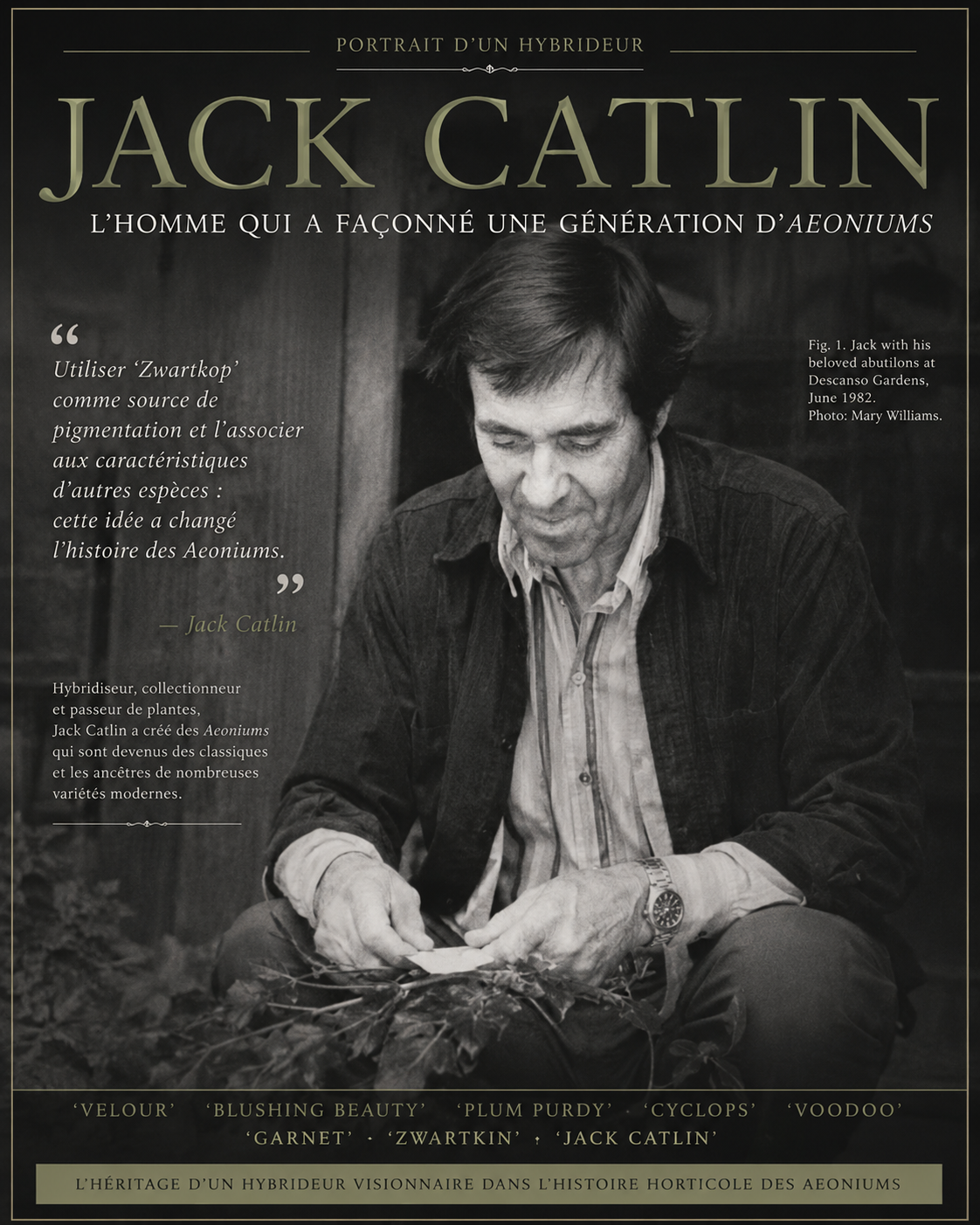
Jack Catlin photographed in 1982
For many years, clearly identified photographs of Jack Catlin seemed difficult to locate.
Larry W. Mitich’s 1993 portrait now provides a valuable historical document.
A black-and-white photograph shows Jack Catlin at Descanso Gardens in June 1982, working among the Abutilon he particularly loved.
The photograph is credited to Mary Williams.
Rather than showing a man formally posing in front of a collection, the image captures a gardener leaning over his plants.
In the end, it seems a particularly fitting image of the man.
The legacy of Jack Catlin
Jack Catlin died in June 2008.
He left behind far more than a collection of cultivars.
He belonged to a generation of horticulturists who helped transform Aeoniums from relatively specialized botanical plants into a genuine field of horticultural experimentation.
His idea of using ‘Zwartkop’ as a source of pigmentation and combining it with the different morphologies of other species proved extraordinarily productive.
With tabuliforme came ‘Zwartkin’, ‘Garnet’ and the lineage that would later produce ‘Jack Catlin’.
With canariense came, among others, ‘Blushing Beauty’, ‘Plum Purdy’ and ‘Velour’.
With undulatum came ‘Cyclops’ and ‘Voodoo’.
Then some of these hybrids themselves became parents.
A new generation of hybridizers took over.
New mutations appeared.
And the story continued.
The man behind our collections
When we look at an Aeonium ‘Velour’ or ‘Cyclops’ today, it is easy to see nothing more than a name on a label.
Yet behind that label lies nearly a century of horticultural history.
There is the young boy in Springfield building a greenhouse with his father.
The teenager proud to see a photograph of his fifty succulents published in a catalogue.
The biologist who became an artist.
The Californian landscape designer.
The collector capable of preserving for more than sixty years the same clone he had bought when he was ten.
And above all, the hybridizer who understood that by combining the extraordinary colour of ‘Zwartkop’ with the architecture of other Aeonium species, he could create something that had never existed before.
Jack Catlin did not merely create several Aeoniums that would become famous.
He helped build one of the horticultural lineages that still underpins part of the diversity found among modern Aeoniums.
And when we attempt today to reconstruct the origins of certain contemporary variegated mutations, we sometimes find that, at the far end of the family tree, his work is still there.
More than forty years after his first hybridizations, Jack Catlin is still present in our collections.
CONTINUE EXPLORING


