Among the many botanical Aeoniums that have produced variegated mutations, Aeonium haworthii holds a special place.
This small species from Tenerife in the Canary Islands is the source of several variegated cultivars now highly valued by collectors. Some, such as Aeonium ‘Dream Color’, are particularly well known, while others remain much less familiar.
Before exploring these different mutations, it is worth looking at the botanical Aeonium from which they originated.
Aeonium haworthii: a small Aeonium endemic to Tenerife
Aeonium haworthii Webb & Berthel. is a botanical species endemic to Tenerife.

The species was published in 1841 in the third volume of Histoire naturelle des îles Canaries, the monumental work devoted to the archipelago’s flora and fauna by Philip Barker Webb and Sabin Berthelot.
Its specific epithet haworthii honors British botanist Adrian Hardy Haworth (1767–1833), a leading specialist and collector of succulent plants.
A highly branched small shrub
In its natural habitat, Aeonium haworthii forms a highly branched small shrub that can reach approximately 28 inches (70 cm) in height.
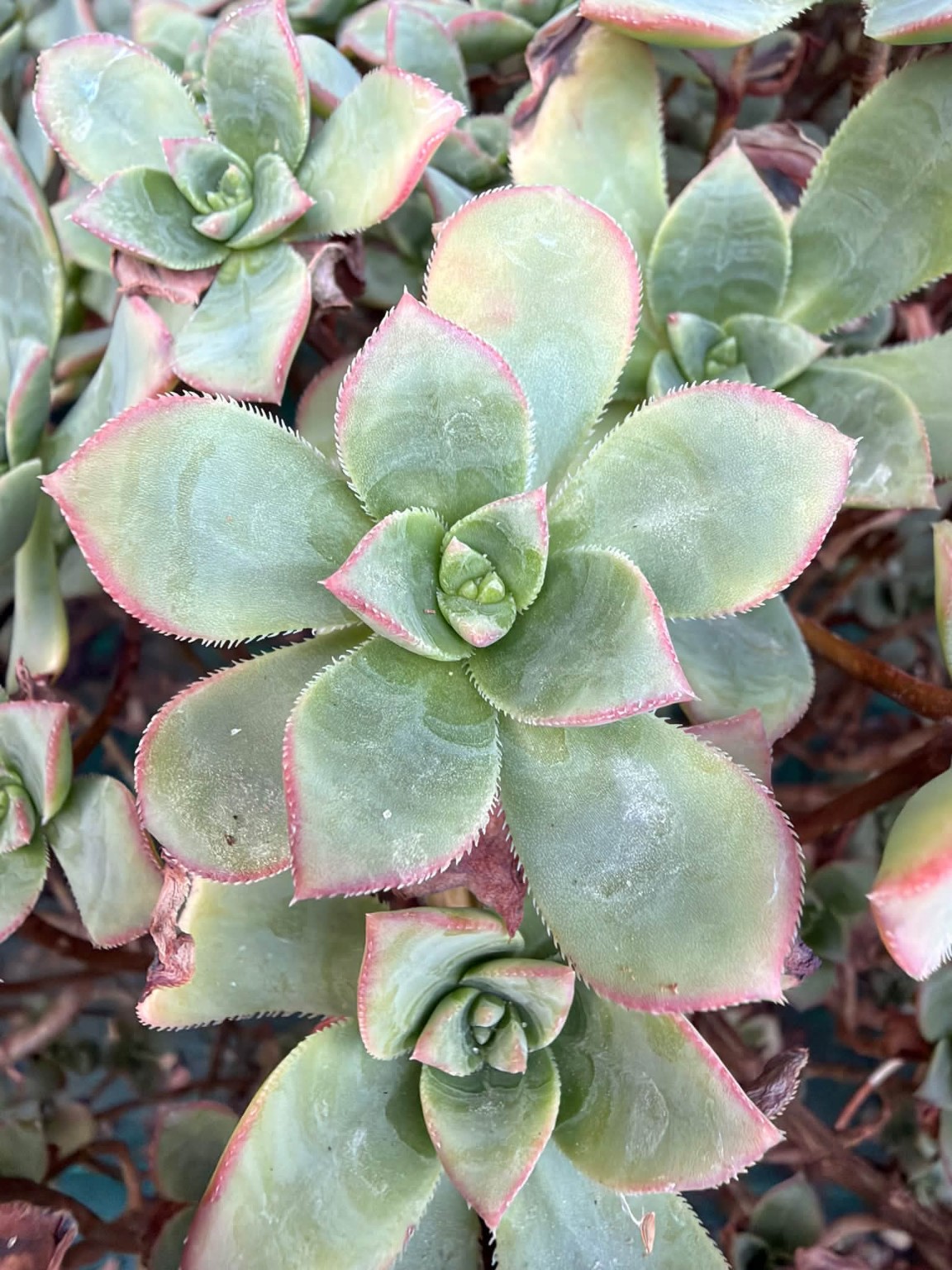
Its woody stems bear numerous concave rosettes at their tips.
These generally consist of 15 to 25 leaves and may reach approximately 4 inches (10 cm) in diameter. The leaves are thick, obovate, gray-green to blue-green and usually 1.2 to 2.4 inches (3–6 cm) long. Their edges are often outlined by a narrow red margin.
This combination of small branched stems, compact rosettes, bluish foliage and red margins gives Aeonium haworthii its distinctive appearance.
An Aeonium of Tenerife’s cliffs
Aeonium haworthii grows naturally in rocky environments on Tenerife.
Historical botanical records mention cliff and rock habitats, particularly in the island’s coastal areas.
This origin partly explains its excellent adaptability in cultivation.
It is generally considered an easy and relatively vigorous Aeonium, able to tolerate a fairly wide range of conditions.
It appreciates bright light and can be grown in full sun.
In regions with very hot summers, however, bright partial shade may be preferable during the hottest hours.
Excellent branching ability
One of the most interesting qualities of Aeonium haworthii is its ability to produce numerous branches.
Over time, a plant can quickly become a small bush made up of many rosettes.
This characteristic is also retained by several of its variegated cultivars, although at a smaller scale.
White to cream flowers
The flowering of Aeonium haworthii is also noteworthy.
Inflorescences appear at the ends of the branches and bear small flowers that are generally white to cream, sometimes marked with reddish shades.
Botanical data indicate flowers about 0.4 inch (1 cm) across, generally with 7 to 9 petals.
This white flowering is particularly interesting when compared with some of its variegated cultivars.


VARIEGATED AEONIUMS DERIVED FROM HAWORTHII
The family of variegated Aeonium haworthii remains relatively small compared with major lineages such as ‘Mardi Gras’ or ‘Madeira Rose’.
It nevertheless contains several particularly interesting plants.

DREAM COLOR
Known names: ‘Dream Color’ (official name), ‘Kiwi’, ‘Kiwionium’, ‘Tricolor’, ‘Kiwi Verde’ and ‘Verde’; “haworthii” is also often placed before these names.
Learn more here.

FLORESENS
Known names: ‘Floresens’ (official name); it was also often incorrectly called ‘Starburst’ when first introduced.
Learn more here.

MACAROON
Known names: ‘Macaroon’ (the most common name), Macaron, Leucoblepharum Middle.
Learn more here.

KIWI VARIEGATA
Known names: ‘Kiwi Variegata’ (although it is reportedly not a mutation of Aeonium ‘Dream Color’).
American origin. Appeared around 2018.


