
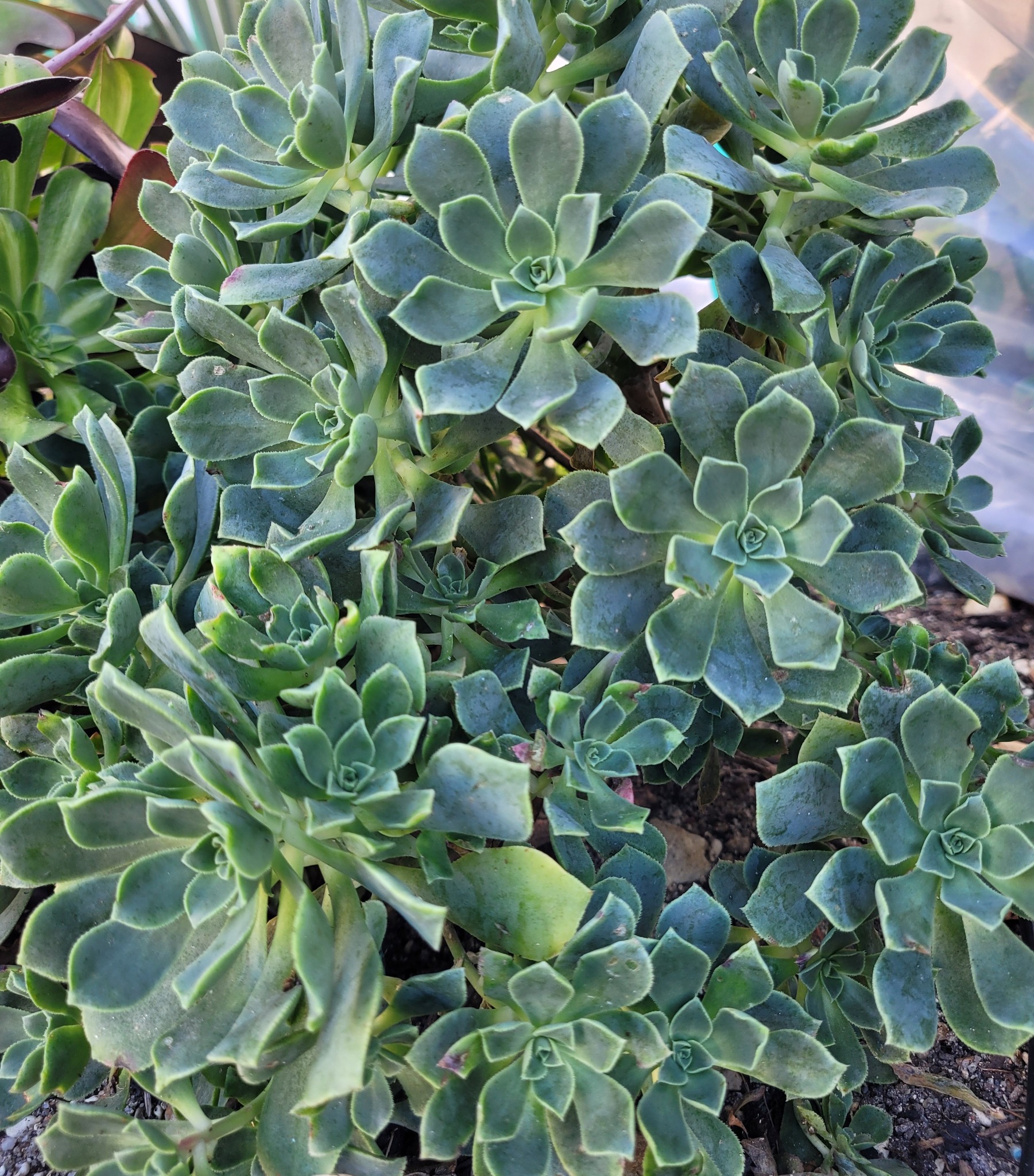
On the rocky slopes of La Gomera, Aeonium castello-paivae unfolds bouquets of little rosettes, sometimes with a beautiful blue-green sheen. It has the quiet elegance that makes the botanical species so rewarding to discover.
- Reference name
- castello-paivae
- Botanical name
- Aeonium castello-paivae Bolle
- Botanical section
- Leuconium
- Genus
- Aeonium
- Type
- Botanical taxon
- Country of origin
- Spain
- Native range
- La Gomera
- Growth habit
- Shrubby
- Plant height
- Up to 70 cm
- Rosette diameter
- 3–7 cm
- Branching
- Highly branching
- Name publication
- 1859
Origin and history
The story begins on La Gomera, the only island to which this species is native. It grows among rocky crevices and on stony slopes; plants have been studied on dry, sunny rocks at Hermigua.
Carl Bolle published the name Aeonium castello-paivae in 1859. Later botanical accounts also used Sempervivum paivae (1866), Aeonium paivae (1869) and Aeonium gomeraeum. These historic names recall how exploration of the Canary Islands enriched, and sometimes complicated, our understanding of Aeoniums.

Chronological milestones
1859 — Reported — Documented name publication.
Botanical description
Branches that form a bouquet
The species develops into a densely branching shrub, reaching up to around 70 cm in some specimens. Its winding, sometimes trailing branches end in relatively flat rosettes 3–7 cm across, with slightly upright inner leaves. Aerial roots can appear along the stems.
Subtle shades
The fleshy leaves broaden towards their tips and range through soft greens, sometimes with bluish tones or reddish markings. The foliage varies naturally between plants. On La Gomera, the local form known as var. sarae illustrates this diversity with its low habit and smaller rosettes. The horticultural name does not have an established formal botanical varietal status.
The variegated form ‘Suncup’, also known as ‘Harry Mak’ or 爱染锦, has brought the elegance of this species into our collections.
Flowering
Have you photographed this cultivar in bloom? Share flowering photographs on the Forum.
Mature rosettes bear terminal clusters of tiny greenish-white stars. Their seven to nine narrow, pointed petals contrast delicately with the foliage. After flowering the individual rosette dies, while the remaining branches sustain the shrub.
Photographs
Do you grow this cultivar? Help document its shapes and seasonal colours. Share your photographs on the Forum.
General photographs


Mutations of ‘castello-paivae’
Direct mutations

Documented descendants of ‘castello-paivae’
Reserved for Premium members
Growing conditions
☀️ Exposure
Provide bright light, gradually acclimatising the plant to direct sun. Light shade during the hottest hours helps prevent scorching.
💧 Watering
Water during active growth when the mix has dried. Reduce watering during hot dormant periods.
🪨 Substrate
Use an airy, mineral-rich, free-draining mix in a stable pot with drainage holes to accommodate the branching habit.
🌡️ Temperatures
Protect it from frost and prolonged cold damp conditions. Good ventilation helps during hot spells.


