
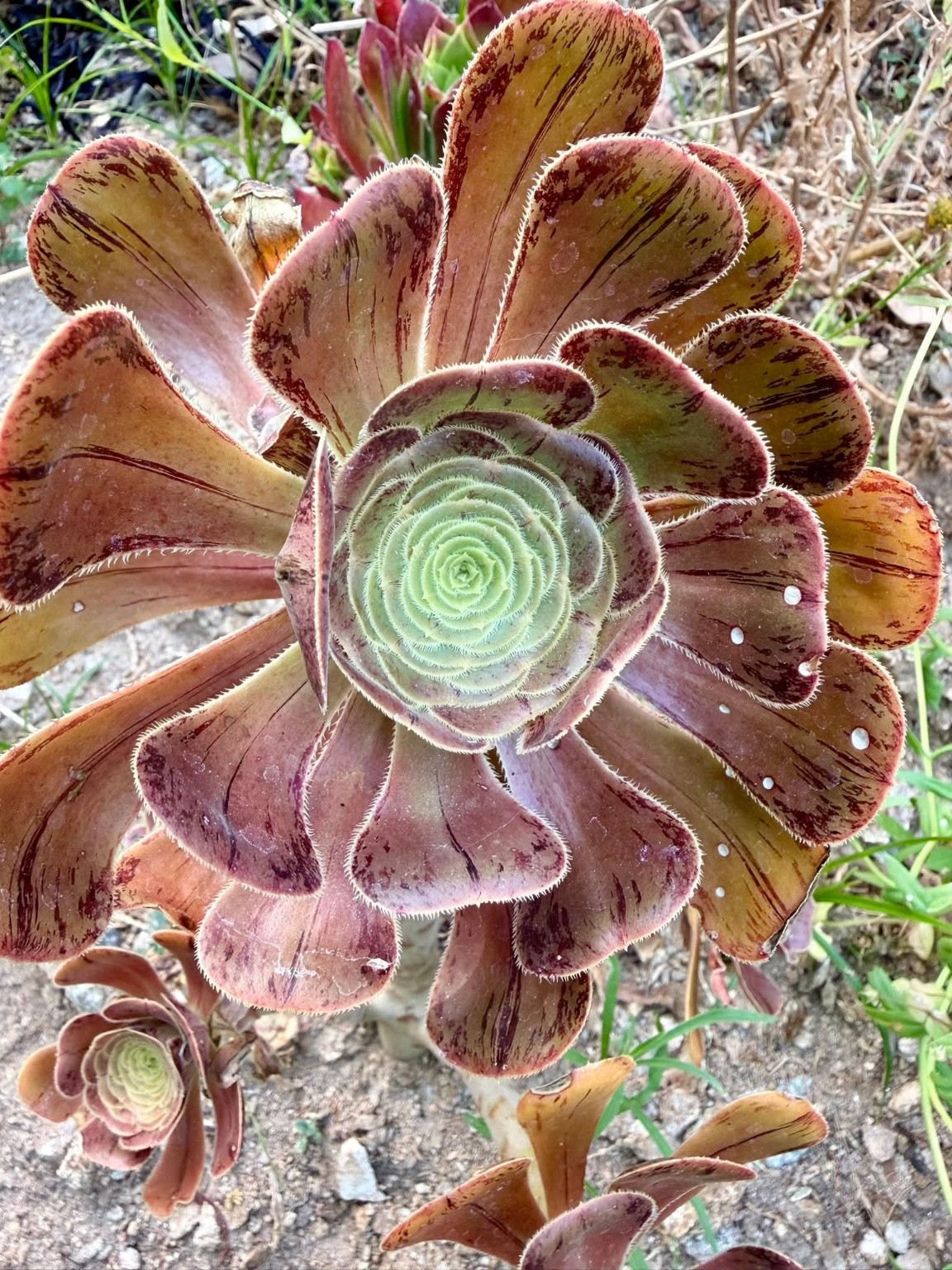
Broad green rosettes crown tall stems, taking on warmer colours as the sun returns. Yet this Aeonium from La Gomera hides its most intriguing distinguishing feature in its flowers.
- Reference name
- arboreum ssp holochrysum var. rubrolineatum
- Botanical name
- Aeonium rubrolineatum Svent.
- Other names
- Rubrolineatum · Aeonium arboreum var. rubrolineatum · Aeonium rubrolineatum
- Genus
- Aeonium
- Type
- Botanical taxon
- Country of origin
- Spain
- Native range
- La Gomera
- Growth habit
- Tree-like
- Plant height
- Up to 200 cm
- Name publication
- 1950
Origin and history
Native to La Gomera in the Canary Islands, this Aeonium occurs on sunny rocky slopes and is recorded up to around 1,200 m. Its natural range should not be confused with the wider distribution of plants grouped under Aeonium arboreum subsp. holochrysum.
In 1950 the botanist Eric Sventenius published the name Aeonium rubrolineatum. H.-Y. Liu placed it within A. arboreum as a variety in 1989. The Royal Botanic Gardens, Kew now recognises it as a species in its own right, although the varietal name remains in botanical and horticultural use.
Two lovely selections are associated with this group: Aeonium ‘Rubrolineatum Variegata V’, with expansive cream markings flushed red, and Aeonium ‘Rubrolineatum Middle’, whose central variegation may develop purple streaks. Whether their precise origin lies with rubrolineatum or holochrysum remains to be confirmed, particularly through their flowers.
Chronological milestones
1950 — Publication of Aeonium rubrolineatum Svent., Bol. Inst. Nac. Invest. Agron. 10(23): 9; date and reference verified in POWO.
1989 — Combination Aeonium arboreum var. rubrolineatum (Svent.) H.Y.Liu, NMNS Taiwan Special Publ. 3: 68 (1989), cited as a homotypic synonym by POWO.
Botanical description
A miniature tree
Sturdy upright stems gradually lend the plant a small tree-like silhouette. Their tips carry broad crowns of fleshy, elongated, bright green leaves. In collections, plants grown under this name can become quite substantial, depending on their age and growing conditions.
As spring turns into summer, stronger light brings warmth to the foliage. Ochre and orange tones and reddish-brown lines may emerge, to striking effect. These leaf markings alone, however, cannot establish the identity of true rubrolineatum.
Flowering
Have you photographed this cultivar in bloom? Share flowering photographs on the Forum.
True rubrolineatum bears rounded to egg-shaped flower clusters measuring 8–15 cm in length. Its small pale-yellow flowers often have reddish streaks on the petals. The International Crassulaceae Network points out that these floral streaks inspired its name. The flowering rosette completes its life cycle afterwards.
Photographs
General photographs


Documented descendants of ‘arboreum ssp holochrysum var. rubrolineatum’
Reserved for Premium members
Growing conditions
☀️ Exposure
Provide plenty of light to bring out the foliage colours. Introduce direct sunlight gradually and offer shade at the hottest time of day when needed.
💧 Watering
Water thoroughly during active growth and let the potting mix dry before watering again. Reduce watering when the rosettes tighten in hot weather.
🪨 Substrate
Use an airy, gritty mix that supports the developing stems without holding excessive moisture.
🌡️ Temperatures
Protect the plant from frost and prolonged winter rain. Good airflow is especially helpful during hot spells.


