
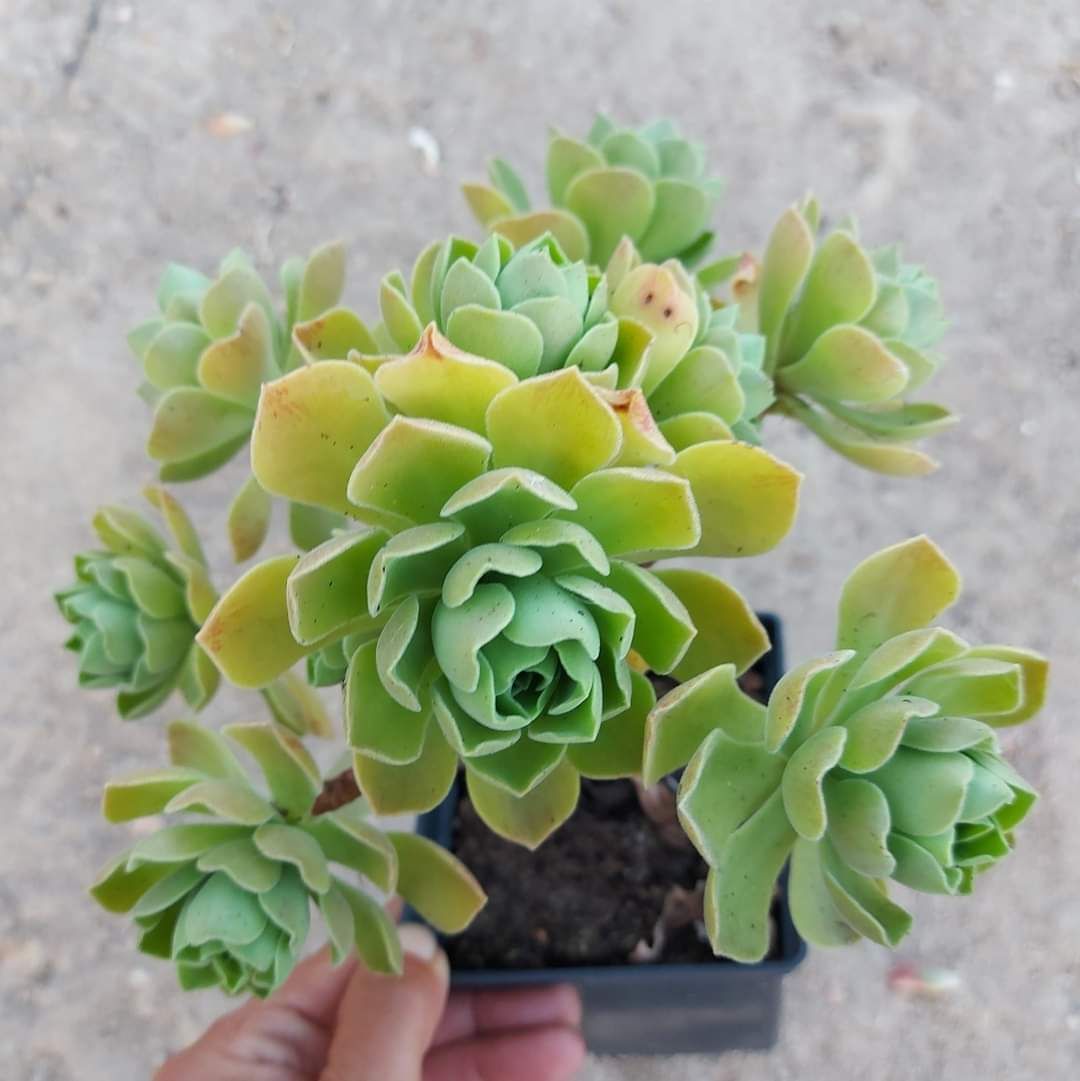
Rounded rosettes, softly hairy leaves and a balsamic fragrance: this is one of those remarkable Aeonium hybrids that nature has fashioned for itself.
- Reference name
- × globosum
- Botanical name
- Aeonium × globosum Arango
- Other names
- Aeonium × globosum
- Genus
- Aeonium
- Type
- Botanical hybrid
- Origin type
- Hybridization
- Growth habit
- Branching shrub
- Plant height
- 35–40 cm
- Rosette diameter
- 12–15 cm
- Branching
- Branching
- Name publication
- 2019
- Parents
- canariense subsp. christii × spathulatum
Family tree
Reserved for Premium members
Origin and history
On La Palma, two Aeonium species sometimes meet and give rise to something new. Aeonium × globosum is a natural hybrid between A. spathulatum and A. canariense subsp. christii. Octavio Arango encountered it only once growing among its parents, in the Los Gomeros ravine near Tijarafe, at 680 m above sea level.
He collected type material on 18 February 2011 and formally described the hybrid in 2019 in Vieraea, volume 46. He chose the epithet globosum for the rounded shape of the rosettes, especially pronounced during dormancy.
In collections, the beautiful variegated Aeonium ‘Ballerina’ is associated with this hybrid on the basis of horticultural knowledge rather than a formal botanical publication. ‘Goblin’, also known as ‘Green Ballerina’, is its green reversion, not a synonym of the wild taxon. Each cultivated form has a history of its own.
Chronological milestones
February 18, 2011 — Type material collected near Tijarafe, La Palma, on 18 February 2011 by O. Arango (ICN).
2019 — Original publication of Aeonium × globosum Arango in Vieraea 46: 115–146, section pp. 117–123 (2019).
Botanical description
Globe-shaped rosettes
The material described by Arango forms a sparsely branched subshrub 35–40 cm tall, bearing rosettes 12–15 cm across. The brownish stems produce numerous small aerial roots.
The soft green leaves broaden towards their tips and curve inwards like little spoons. Fine glandular hairs make them sticky and give them a pronounced balsamic scent. During dormancy, the rosettes become almost spherical, a particularly charming shape.
Flowering
Have you photographed this cultivar in bloom? Share flowering photographs on the Forum.
The flowering season reported in the wild is April to May. The buds open into dense, broad, nearly flat-topped clusters of golden-yellow flowers around 2 cm across. Usually with eight petals, they form a gathering of little stars above the foliage.
Photographs
General photographs


Mutations of ‘× globosum’
Direct mutations

Growing conditions
☀️ Exposure
Give this hybrid bright light and gentle sunshine. Avoid sudden exposure to the hottest rays.
💧 Watering
Water during active growth and allow the mix to dry between waterings. As the rosettes close, reduce watering gradually.
🪨 Substrate
Use an airy, free-draining potting mix and a container with drainage holes. Avoid prolonged saturation.
🌡️ Temperatures
Shelter the plant from frost, excessive winter moisture and prolonged extreme heat. The precise requirements of the wild hybrid are less well known than those of its cultivated relatives.


