
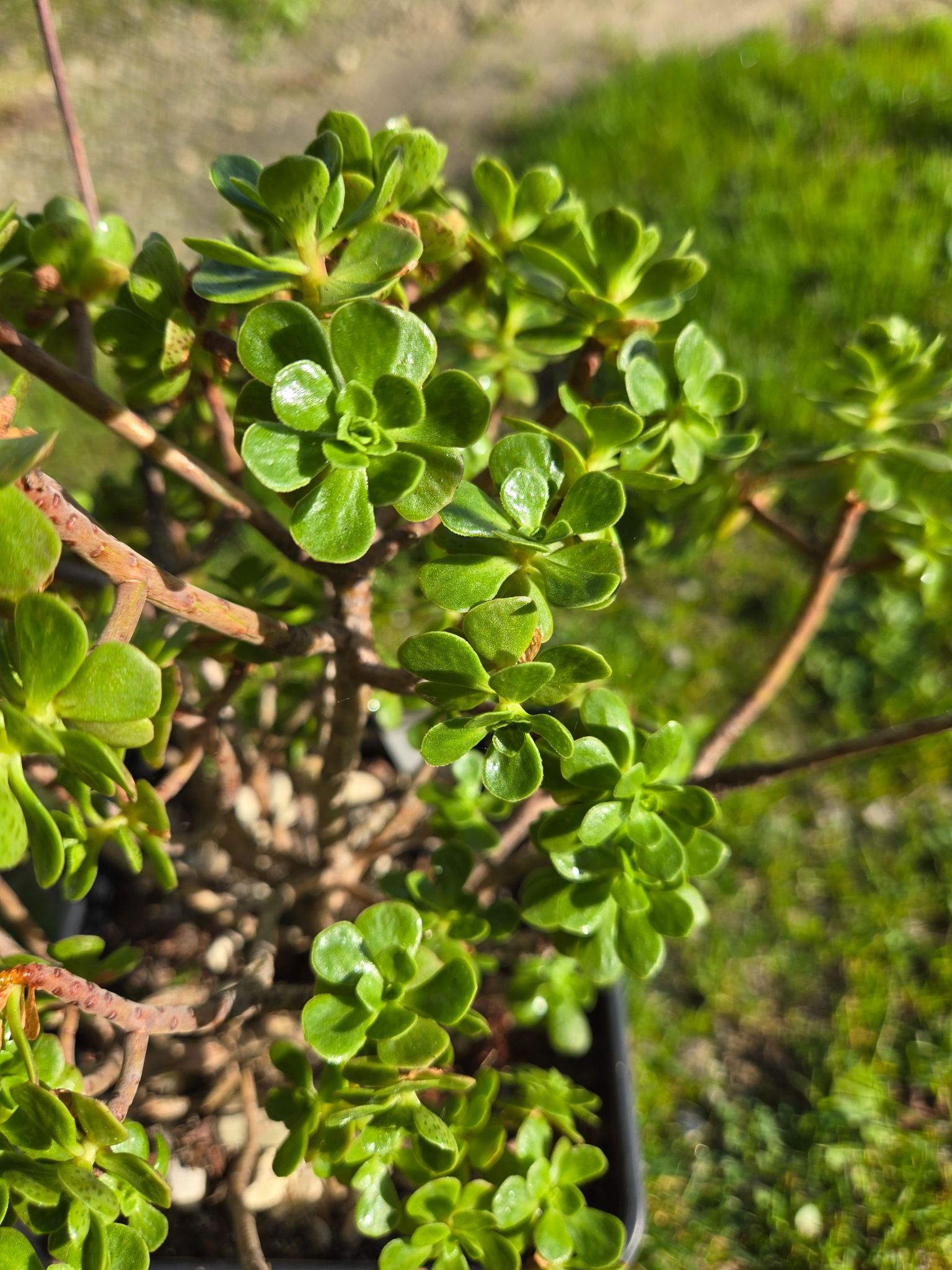
A multitude of tiny green rosettes at the tips of slender woody branches gives Aeonium spathulatum the appearance of a miniature shrub. This Canary Islands species is also distinguished by the brown lines beneath its leaves, bead-shaped marginal cilia and rosettes that close tightly in summer.
- Accepted name
- Aeonium spathulatum
- Type
- Botanical species
- Natural distribution
- Western Canary Islands
- Habit
- Densely branched shrub
- Described height
- Up to 60 cm
- Rosette diameter
- 1–5 cm
- Botanical section
- Chrysocome
- Genus
- Aeonium
- Plant height
- Up to 60 cm
- Branching
- Highly branching
Origin and history
Aeonium spathulatum is endemic to the Canary Islands, occurring notably on Tenerife, La Palma, La Gomera, El Hierro and Gran Canaria. It grows on cliffs, rocky slopes, old walls and volcanic ground, often in pine-forest areas and near heath and laurel-forest vegetation. Depending on the space and conditions available, it may form small, low clumps or taller, densely branched shrublets.
The species was first described by Jens Wilken Hornemann as Sempervivum spathulatum in 1819, then transferred to Aeonium by Robert Lloyd Praeger in 1929. The epithet spathulatum refers to the spoon-like shape of its leaves, which widen towards their tips. Several nineteenth-century names, including Aeonium barbatum and Aeonium cruentum, are now treated as botanical synonyms.
Aeonium spathulatum bears some of the smallest rosettes in the genus. Combined with its freely branching growth, this sometimes gives the plant the appearance of a miniature natural bonsai. In the Canarian mountains, its cushions of rosettes spread through cracks in the rock before being dotted with golden-yellow flowers in spring.
Chronological milestones
1819 — Reported — Publication of the original botanical name.
1928 — Reported — Publication of a new botanical combination.
Botanical description
Habit and branching
Aeonium spathulatum is a perennial succulent subshrub, upright or spreading, with abundant branching from its base. Its many slender stems may be twisting or irregular; with age they become woody, forming a dense little shrub up to around 60 cm tall. The grey-brown bark of older stems shows scars left by fallen leaves and may peel off in thin lengthwise strips. Young shoots remain fleshier and greener.
Each branch ends in a small rosette, generally just 1–5 cm across and often only 2–3 cm. Rosettes may be nearly flat during active growth or distinctly cup-shaped, with the inner leaves held upright. Their great number gives the plant a finely branched outline unlike that of Aeonium species bearing large solitary rosettes.
Leaves and their distinctive features
The leaves are small but clearly succulent, obovate to spoon-shaped, narrowed towards their base and rounded at the tip. They measure approximately 0.5–2.5 cm long, 0.3–0.9 cm wide and 1–1.5 mm thick. The green to olive-green surface is finely downy and can be slightly sticky.
The underside often shows lengthwise brown to reddish lines associated with tannin deposits. Along the margin are tiny translucent, bead-shaped cilia, around 0.7–1 mm long. Both details can be difficult to see from a distance but are valuable identification features when the leaves are examined closely.
Seasonal changes and summer dormancy
During active growth, the rosettes open to reveal small green leaves, sometimes edged or tinged with pink and red in stronger light. In summer, as moisture becomes scarce and growth slows, older outer leaves may dry and fall away while those remaining fold tightly around the growing point. Each rosette then forms a compact, nearly spherical bud, sometimes only 1–2 cm across.
This closure helps protect the growing centre during the dry season. As cooler, moister conditions return, the rosettes open again and the branches resume growth. The contrast between their open cups and tightly rounded summer buds gives the species much of its changing seasonal character.
Flowering
Have you photographed this cultivar in bloom? Share flowering photographs on the Forum.
In spring, generally from March to June in the Canary Islands, some branches develop upright, often reddish flowering stalks about 5–20 cm long. They bear branched inflorescences around 3–10 cm tall, sometimes broader than they are high, with numerous small, star-shaped golden-yellow flowers.
Flowers usually have eight to ten elliptic petals, about 4.5–6 mm long, yellow and occasionally crossed by fine reddish lines. The sepals are finely hairy, while the stamens have hairless filaments. After fruiting, the rosette that flowered completes its cycle, but the many branches that remain vegetative continue to grow. The species can be propagated by seed or by stem cuttings.
Photographs
Do you grow this cultivar? Help document its shapes and seasonal colours. Share your photographs on the Forum.
Documented descendants of ‘spathulatum’
Reserved for Premium members
Growing conditions
☀️ Light
Provide bright light, avoiding abrupt exposure changes for the tiny rosettes.
💧 Watering
Water during active growth, then let the mix dry before watering again; reduce frequency in summer.
🪨 Potting mix
A porous, sharply draining medium helps prevent persistent moisture beneath the dense branches.
🌡️ Temperatures
Protect from frost and maintain good airflow between the stems.


