Understanding the light needs of Aeoniums during the winter period
Aeonium is a unique succulent plant. Unlike many succulent plants capable of supporting average light, it remains a demanding species that requires a significant amount of light to maintain its compact habit, its intense colors and its harmonious development.
As we mentioned in our previous article dedicated to wintering of Aeoniums, certain regions sometimes require indoor winter protection, particularly when temperatures drop sustainably below the tolerance thresholds of these plants originating mainly from the Canary Islands, Madeira or Cape Verde.
However, bringing your Aeoniums indoors doesn’t just mean placing them behind a window. The natural light in a home is generally very insufficient to meet their physiological needs.
This article was produced with the valuable help ofÉric Degrelle (pseudo Éric de Locqui), manager of the company ISLED, specialized since 2013 in the design and manufacture of professional LED horticultural lighting.
The objective is to give you the keys to understanding the different parameters to take into account and choosing a solution adapted to your collection.
Inner light: an illusion for our Aeoniums
One of the most common mistakes among collectors is to think that a bright room is enough to properly maintain an Aeonium during the winter.
In reality, even a room with good exposure generally receives very low light intensity compared to natural conditions.
For information only:
| Situation | Approximate light intensity |
|---|---|
| Interior room away from a window | 50 to 100 lux |
| Interior near a bright window | 100 to 500 lux |
| Outer shadow | several thousand lux |
| Overcast weather outdoors | 10,000 to 20,000 lux |
| Soleil direct | 50,000 to more than 100,000 lux |
(Lux corresponds to the illuminance received by a surface. 1 lux is equivalent to 1 lumen per m².)
The difference is considerable: even placed in front of a window, an indoor plant often receives several dozen times less light than outdoors.
To easily measure this difference, there are now many free applications allowing you to use the light sensor of smartphones to obtain an estimate of illuminance in lux.
To more precisely compare several locations or adjust the height of a lamp, a digital light meter offers more reproducible measurements than a smartphone. It measures illuminance in lux, but does not replace a professional device that precisely measures photosynthetically active radiation.
The conclusion is therefore simple:
Successful indoor wintering of Aeoniums almost always requires the use of suitable artificial lighting.
What criteria should you take into account when choosing a horticultural lamp?
Before choosing a lighting technology, several elements must be analyzed:
- the total surface area to be illuminated;
- the number of plants;
- the necessary light power;
- electricity consumption;
- the daily duration of use;
- the distance between the lamp and the plants.
1. Calculate the power needed for your Aeoniums
The first step is to determine the surface area actually occupied:
Length × width = area in m²
The larger this surface area, the greater the power required.
For adult Aeoniums, we generally consider:
- 150 to 200 W/m² for established plants;
- approximately 100 W/m² for cuttings or young plants.
Insufficient power can sometimes be compensated for by longer lighting duration, but this remains an imperfect solution. A plant receiving too little light will tend to stretch, lose its compactness and see its colors diminish.
Calculate the electrical cost
Monthly consumption can be estimated using this formula:
Cost (€) = (Power in watts ÷ 1000) × number of daily hours × 31 days × price per kWh
This estimate makes it possible to precisely anticipate the necessary budget before installation.
A power meter on socket allows you to control the power actually consumed and the number of kilowatt hours used. It is particularly useful when several lamps are operated daily throughout the winter.
2. Daily lighting duration
Aeonium follows a natural day/night cycle essential to its physiological balance.
It is therefore advisable to use a programmateur automatique. It ensures the same lighting duration every day without depending on manual intervention.
Two strategies are possible:
12 hours of daily lighting
This is the solution closest to natural conditions and the one that generally brings the best results.
8 hours of daily lighting
Possible with sufficiently powerful lighting, in particular to reduce electricity consumption.
In all cases, a period of complete darkness of approximately 10 hours a day, essential for the metabolic rest of the plant.
The different lighting technologies available
1. Low-cost horticultural LEDs
Budget indicatif : 15 to 40 €
Prix moyen : environ 2 €/W
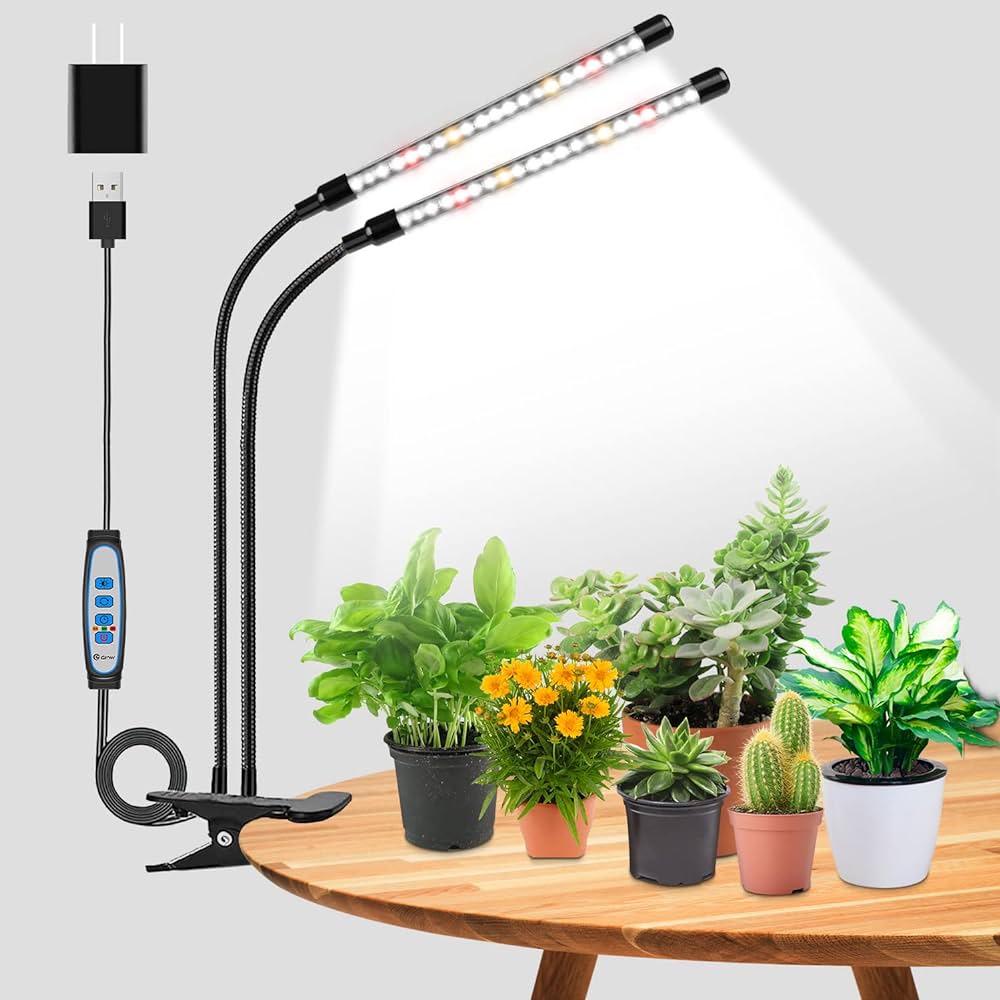
These petites lampes LED horticoles may be suitable for a small collection or a few cuttings.
Avantages :
- prix accessible ;
- installation simple ;
- often equipped with an integrated programmer;
- immediate solution to get started.
Limites :
- real power often low;
- lower energy efficiency;
- spectrum sometimes poorly adapted;
- limited lifespan;
- frequent lack of after-sales service.
In particular, you should avoid models composed only of blue and red LEDs. Plants appreciate more a balanced spectrum that also includes white LEDs.
These products can help, but they remain far from the performance of professional horticultural lighting.


2. Professional horticultural LEDs
Budget indicatif : 1.5 to 5 €/W
Modern horticultural LEDs represent one of the most efficient solutions today.
They generally combine:
- Broad spectrum white LEDs;
- Red LEDs around 660 nm;
- sometimes distant red (far red, environ 730 nm).
Their spectrum is specially studied to optimize photosynthesis while respecting the needs of plants.
This equipment exists in different forms:
- panneaux LED (quantum boards) ;
- rampes ;
- strips;
- modular systems.
Understanding PPFD
Unlike simple lux measurements, horticulture mainly uses PPFD (Photosynthetic Photon Flux Density).
This value measures the quantity of photons actually usable by the plant.
For full sun succulents like Aeoniums, a value between:
150 and 300 µmol/m²/s for approximately 12 hours per day constitutes a good basis.
Advantages of horticultural LEDs:
- excellent energy efficiency;
- low heat generation;
- long life;
- installation simple ;
- perfectly studied spectrum.
Disadvantages:
- greater initial investment;
- Additional heating sometimes necessary in a cold room.
However, for a large surface area, the investment can be amortized thanks to their low consumption.
Recent horticultural LED lighting mixes white LEDs and red LEDs. These are the ones that consume the least and allow you to have plants in perfect health. Some horticultural LEDs can be adjusted in intensity, which is very practical. They last much longer than lighting with any other non-LED technology.
They are either in the form of panels (quantum boards), LED rails or strips, up to 120cm long, or several LED rails connected together.
Their spectrum is studied according to the needs of the plants. We removed what is of little use to them and added what they need most, blue, red for photosynthesis, and possibly a little far red located between red and infrared (far red 726nm). Note that any self-respecting LED horticultural lamp has at least one secondary peak in the red 660nm.

Avantages:
-Do not require wiring, they are plug and play.
-Operate at low safety voltage, with an external low voltage power supply.
-Most are waterproof, so no risk with water.
Disadvantages:
-Rather high price to illuminate areas of several m². Indeed, with 200W/m2 we are at 3€ per Watt (which is really the minimum) or 600€ to light a surface area of 2m². But the investment in lamps can quickly pay for itself due to the relatively low electricity consumption. So over time we find ourselves there. But when we only do wintering we only use them about 5 months a year.
-They do not heat up or only slightly, so they do little or nothing to heat the room, which must be coupled if necessary with heating which will also consume electricity. A CMH lamp is more suitable if your surface area exceeds 1.5m2 and you are looking to warm up your space.
If you are interested in horticultural LED lamps, do not hesitate to contact Eric Degrelle (ISLED).

3. Domestic or industrial white LEDs
Budget indicatif : 1 to 3 €/W
The 4000 K white domestic or industrial LEDs can constitute an interesting alternative for simple wintering.
They exist in the form:
- strips;
- panels;
- slabs;
- spots.
They do not have an optimized horticultural spectrum, but can give good results on small installations.
Choosing the right color temperature
Color temperature is measured in Kelvin.
2200 to 3000 K (Warm white)
- yellow/orange light;
- not very suitable for Aeonium.
4000 K (Blanc neutre)
- meilleur compromis ;
- balanced spectrum;
- recommended for overwintering.
5000 to 6500 K (Cool white)
- excess blue;
- less visually pleasing;
- to avoid.
For domestic LEDs, choose:
4000 K with a CRI (color rendering index) of at least 80.
A high CRI also allows you to observe the true colors of the variegations and pigments of your Aeoniums. The color rendering index CRI or R:
R70 => a lot of blue, a little red
R80 => wider spectrum, better represented in the reds
R90 => we are getting closer to the solar spectrum, we are more full spectrum.
The higher the R or the CRI, the more complete the spectrum, and the better you see the true colors of your plants, but the more expensive the LEDs are and the more they consume.
Advantages of domestic white LEDs:
- excellent energy efficiency;
- low heat generation;
- long life;
- installation simple ;
- perfectly studied spectrum.
Disadvantages:
- greater initial investment;
- Additional heating sometimes necessary in a cold room.
- Some are not waterproof

Please note: These domestic lights operate on 230V 50Hz, are sold unwired and require installation by an electrician. Some are not waterproof, and water and electricity do not mix well. It’s very dangerous. Do not do this type of installation yourself if you do not have the necessary skills.


4. CMH 315 W lamps: the Variegated Aeonium choice
Technology close to the sun
CMH lamps (Ceramic Metal Halide) constitute a particularly interesting technology for collectors with large surfaces to illuminate.
Their main advantage is their very complete spectrum, close to that of the sun, including in particular:
- visible light;
- rouge ;
- bleu ;
- rayonnement ultraviolet.
For Aeoniums, the version 4000 K is generally preferable. The spectrum is very complete, close to the solar spectrum with UVs and perfectly suited to Aeoniums.
CMH horticultural lamps are available in two versions: 3000 K (warm white full spectrum) and 4000 K (neutral white blue spectrum). For Aeoniums, it is preferable to take 4000K.


Advantages of CMH:
- lower purchasing cost than powerful horticultural LEDs;
- spectre exceptionnel ;
- remarkable color rendering;
- useful heat release in winter.
This radiated heat can become an advantage in a cold greenhouse or a poorly heated room.
Disadvantages:
- higher power consumption;
- shorter bulb life;
- presence of UV requiring precautions.
Eye protection is recommended during prolonged exposure.
As an indication, a consumption of 350 W for 12 hours per day represents around twenty euros of monthly electricity depending on the kWh rate.
If you are interested in CMH lamps, do not hesitate to contact Eric Degrelle (ISLED) who can give you personalized advice and sell you perfectly adapted equipment.
Some ensembles CMH 315 W are also available on Amazon. Before purchasing, check that the set includes the necessary compatible elements and that it corresponds to the surface to be illuminated.
What type of installation to choose?
The positioning of the lamp is as important as its choice.
A lamp placed too high will cover a large area but with less intensity.
Conversely, a lamp close to the plants will offer more light energy but over a smaller area.
Some adjustable pulley suspensions facilitate gradual height adjustment as plants grow or their arrangement changes. They must be chosen according to the weight of the lamp and securely fixed.
Installation with LED
The shelves are particularly suitable:
- each level can receive its own lighting;
- the lamp/plant distance is controlled;
- the light is homogeneous.

Installation with CMH
They are generally installed suspended from the ceiling or above plants placed on the ground or on tables.
They are more suitable for large collections requiring overall lighting.

Conclusion: invest in light to preserve the beauty of your Aeoniums
Wintering an Aeonium indoors should not be considered as simple sheltering from the cold. It is a true adaptation of its natural environment.
Without sufficient light, even the most beautiful variegata cultivars will gradually lose their compactness, color and aesthetic potential.
The choice of lighting will therefore depend on your collection, your space and your budget:
- some plants: domestic LEDs or small horticultural LEDs;
- intermediate collection: high-performance horticultural LEDs;
- large collection: CMH or professional LED installations.
Light remains one of the fundamental parameters for success in the cultivation of Aeonium.
A beautiful Aeonium is above all an Aeonium that receives sufficient light energy.
I hope I have been able to answer the many questions you may have about the ideal lamp for you. Do not hesitate to exchange on our Facebook group or directly on this site.
The checklist for properly lighting your Aeoniums
A successful installation does not only depend on the lamp. It is necessary to measure the light, adapt the power to the surface, automate the daily duration and control consumption.
- Mesurer : one application may be enough to get started; a digital light meter facilitates comparisons between multiple locations.
- Choose according to the collection: small horticultural LED light for a few plants, LED blanche 4000 K for an economical solution, or professional lighting suitable for large areas.
- Automatiser : a programmateur maintains a regular cycle of light and dark.
- Check the actual cost: a power meter on socket measures power and cumulative consumption.
- Adjust the height: some adjustable suspensions allow you to adapt the distance between the lamp and the plants.
- Secure: respect the admissible power, protect the connections from humidity and entrust all fixed wiring to a competent person.
Information on affiliate links: some links in this guide refer to products available on Amazon. If you make a purchase through them, Variegated Aeonium may earn a small commission, at no additional cost to you. These revenues contribute to the operation of the site and the creation of free content. Products are only offered when they can be useful for growing Aeoniums.
Cet article vous a plu ?

CONTINUE EXPLORING


