
After dedicating a previous article to mealybugs, one of the most common pests affecting Aeonium, let’s now turn our attention to a much more discreet enemy: caterpillars.
Often underestimated by collectors, caterpillars can cause surprisingly extensive damage in just a few days. While one or two caterpillars will generally cause only limited damage, a severe infestation can quickly disfigure an entire collection by feeding on the plants’ foliage.
Fortunately, a few simple observations can help detect their presence early and allow action to be taken before the damage becomes too severe.
Why Do Caterpillars Attack Aeonium?
The most significant attacks are generally observed in autumn, a period that coincides with the hatching of many moth and butterfly species.
After eggs are laid during summer, the young caterpillars emerge with an urgent need to feed in order to sustain their extremely rapid growth.
Their first meal is often the chorion, the thin protective outer layer of the egg. They then immediately begin searching for their host plant.
In some species, young larvae can increase their body weight several hundredfold, and sometimes by nearly a thousand times, during their development. This spectacular growth explains their particularly voracious appetite.
When an Aeonium is among their host plants, its leaves can quickly become their main source of food.
Caterpillars: A Few Biological Basics
Caterpillars are the larval stage of butterflies and moths (order Lepidoptera).
The vast majority of species are phytophagous, meaning that they feed exclusively on plant material.
Depending on the species, their feeding habits can vary considerably.
- Monophagous caterpillars feed on only one plant species or a very restricted group of plants. If deprived of their host plant, they generally stop feeding and are unable to survive.
- Polyphagous caterpillars are far more opportunistic and can feed on many different types of plants. These are the caterpillars most commonly encountered in gardens and are among those capable of damaging Aeonium.
Pests That Are Mainly Active at Night
Observations made by many collectors indicate that caterpillars found on Aeonium are primarily active:
- at dusk;
- during the night;
- early in the morning;
- on cool evenings.
This behavior makes them particularly difficult to detect.
The culprits often belong to various species of noctuid moths (family Noctuidae), whose larvae are well known for their voracious feeding habits.
During the day, they generally remain hidden:
- between the leaves;
- deep within the rosettes;
- underneath pots;
- in the growing medium or among nearby plant debris.
What Damage Do Caterpillars Cause to Aeonium?
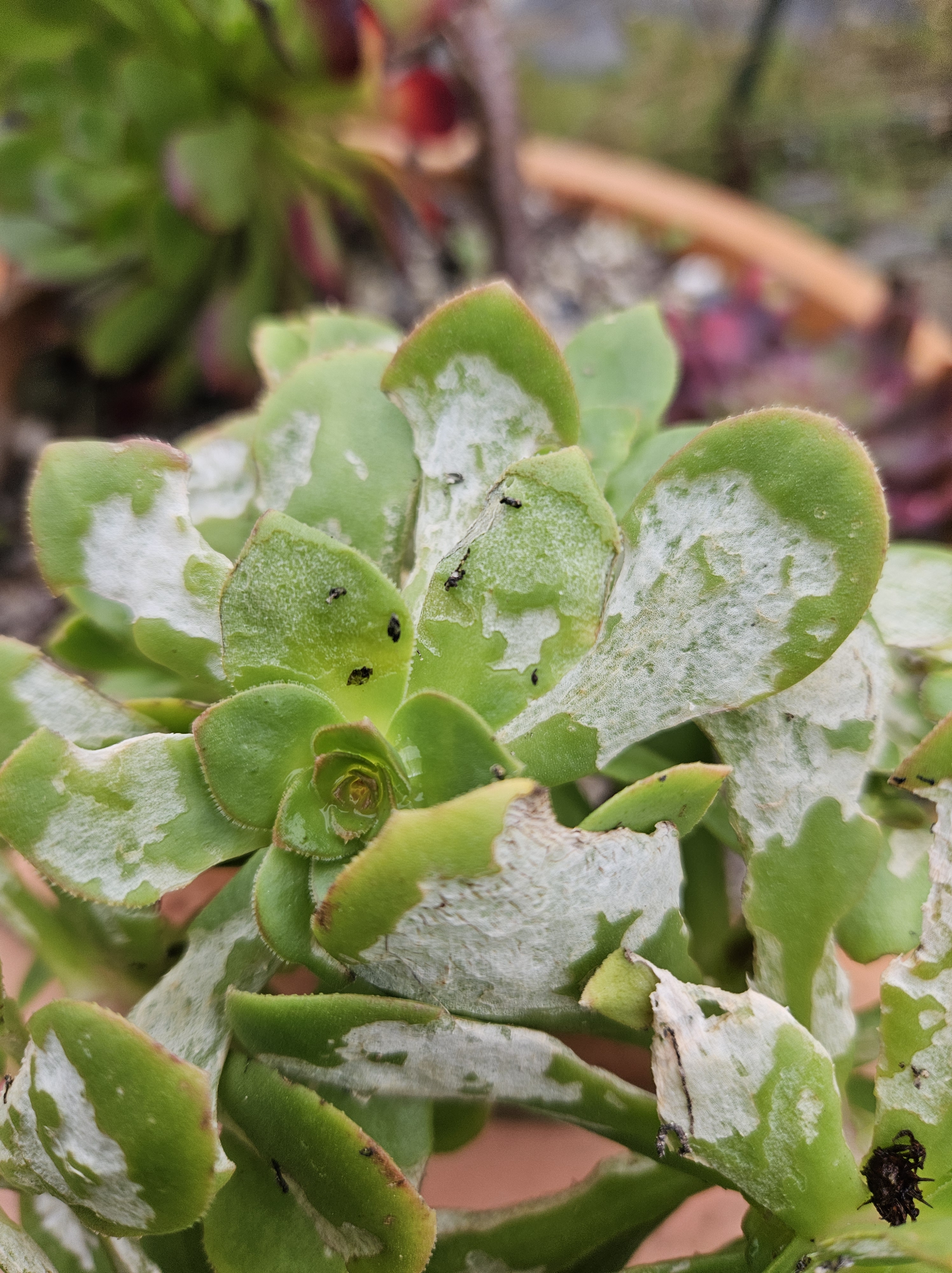
The first signs of damage generally appear on the foliage.
Young larvae initially graze the surface of the leaves before taking increasingly deeper bites as they grow.
The damage can take several forms:
- irregular holes in the leaves;
- partially eaten leaves;
- chewed leaf margins;
- destruction of the center of the rosette in severe infestations.
This damage is quite different from that caused by slugs or snails, which generally leave larger feeding marks accompanied by visible slime trails.
Some Examples of Caterpillars Found on Aeoniums


How Can You Quickly Detect Their Presence?
Caterpillars are often easier to detect from the signs they leave behind than by spotting the insects themselves.
Black Droppings
This is often the first warning sign.
Caterpillars produce very small black droppings, resembling grains of pepper, which can accumulate on the leaves or in the center of the rosettes.
If several of these small black specks appear, it is strongly recommended to inspect the plant immediately.
Holes in the Leaves
The feeding damage is generally irregular.
Young caterpillars often graze only one surface of the leaf, while larger, more developed larvae may chew completely through the leaf blade.
The Presence of Eggs
Some species lay their eggs directly on the leaves.
Depending on the species, these egg masses may appear as small whitish, yellowish, or greenish clusters.
Removing the eggs before they hatch can often prevent an infestation from developing.
Leaves Stuck Together
Some caterpillars use silk threads to pull several leaves together, creating a discreet shelter where they remain hidden during the day.
This is a particularly revealing sign of their presence.


How to Control Caterpillars
The earlier you intervene, the more effectively you can limit the damage.
Several solutions are available.
Manual Removal
This is the most environmentally friendly method.
By inspecting the plants at dusk or using a flashlight in the evening, it is often possible to spot the caterpillars and remove them by hand.
Collectors who wish to preserve biodiversity can then relocate them to another part of the garden, where they can continue their development without damaging the Aeonium plants.
It is worth remembering that these larvae will eventually become moths or butterflies, whose populations have declined significantly in recent decades.
Black Soap
Liquid black soap may be useful only against very young, newly hatched larvae.
Its effectiveness becomes much more limited once the caterpillars are larger and more developed.
A commonly used preparation consists of diluting approximately 5 tablespoons of liquid black soap in 1 liter (about 34 fl oz) of water, then thoroughly spraying the entire plant, including the undersides of the leaves.
If necessary, the treatment may need to be repeated for several consecutive days.
Bacillus thuringiensis (Bt)
Bacillus thuringiensis (Bt) is currently one of the most widely used biological solutions for controlling caterpillars.
This bacterium naturally produces proteins that act specifically on the digestive system of the larvae of many moth and butterfly species.
After ingesting treated plant material, the caterpillars quickly stop feeding and die a few days later.
The treatment is particularly effective against young larvae.
To maximize its effectiveness, it is recommended to:
- intervene as soon as the first signs of damage appear;
- spray toward the end of the day;
- avoid treating during rainy periods;
- carefully follow the dosage and instructions provided by the manufacturer.
Chemical Insecticides
Certain insecticides approved for caterpillar control may also be used.
These include insect growth regulators, such as pyriproxyfen, which interfere with insect development and prevent normal metamorphosis.
However, these products have several disadvantages:
- they may affect non-target insects;
- their use is strictly regulated;
- product approvals and permitted uses change regularly from one country to another.
Before using any insecticide, it is essential to check that the product is currently authorized for the intended use in your country and to carefully follow all label instructions and safety precautions.
Prevention Is Better Than Cure
Regular monitoring remains the best way to effectively protect an Aeonium collection.
Just a few minutes of observation each week can often reveal the first signs of an infestation before significant damage occurs.
Pay particular attention to:
- the center of the rosettes;
- the undersides of the leaves;
- young shoots;
- plants located near outdoor lighting, which often attracts moths.
Early intervention generally avoids the need for more intensive treatments and helps preserve the appearance of your plants.
Share Your Observations
The caterpillar species capable of feeding on Aeonium vary depending on the region of the world and remain relatively poorly documented.
If you have observed particular species, identified unusual behaviors, or tested effective control methods, please feel free to share your observations with Variegated Aeonium.
Your feedback will help enrich this article and contribute to improving our collective knowledge of these pests, which are still too often overlooked by Aeonium collectors.
Useful Tools for Detecting and Managing Caterpillars
1. Inspect at the Right Time
- A rechargeable headlamp: keeps both hands free and makes inspection easier at dusk, when many caterpillars become active.
- An LED magnifying glass: useful for spotting eggs, young larvae, droppings, and silk threads deep within the rosettes.
2. Remove Caterpillars Without Damaging the Plant
A pair of long, fine-tipped tweezers makes it easier to reach between the leaves and remove a larva or egg mass without forcing the rosette apart.
3. Treat Only When Necessary
- Newly hatched larvae: liquid black soap can be used alongside manual removal, although its effectiveness decreases considerably against larger caterpillars.
- Large numbers of young caterpillars: a product containing Bacillus thuringiensis may be considered only if its use is authorized for the intended purpose in your country. Always follow the product label, recommended dosage, and application instructions.
Recommended order of intervention: inspect, remove manually, monitor the plants again, and only apply a treatment if the damage continues. This step-by-step approach reduces the amount of products used and helps protect non-target insects.
Links in This Article
The links included in this article lead to products available on Amazon. If you make a purchase, Variegated Aeonium receives a small commission that helps support the cost of website hosting and the creation of free content. The price remains exactly the same for you.
Cet article vous a plu ?

CONTINUE EXPLORING


