Among the many unusual phenomena that can be observed in Aeoniums, cristation is undoubtedly one of the most fascinating. These atypical forms, often described using the terms cristata, crested, or cristate, attract both passionate collectors and enthusiasts of unusual plants.
But what exactly is a crested Aeonium? What causes this remarkable mutation? Is it hereditary? And does it require any special care?
In this article, Variegated Aeonium explores the mechanisms behind cristation, explains its relationship with fasciation, and provides practical advice for growing these extraordinary plants.
What Is Cristation?
Cristation is a growth abnormality affecting the apical meristem — the region of the plant responsible for new growth.
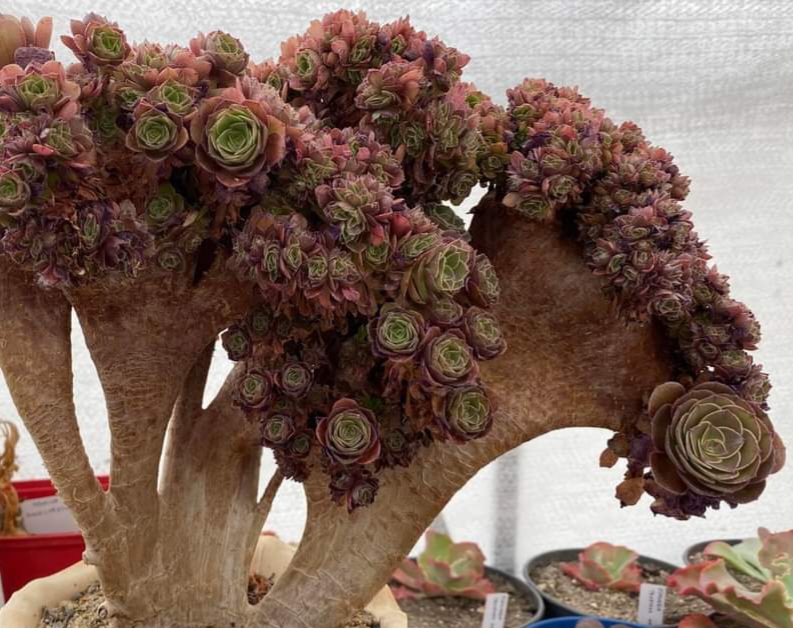
Instead of producing a typical cylindrical stem, the meristem gradually elongates into an extended crest, which may become wavy or sinuous. Rosettes then develop continuously along this line of growth, creating spectacular shapes that are unique to each individual plant.
In Aeoniums, this mutation can completely transform the plant’s architecture, producing unusual forms that are particularly prized by collectors.
Cristation or Fasciation: What Is the Difference?
The terms cristation and fasciation are often used interchangeably. In botany, however, they describe two closely related but slightly different phenomena.
Fasciation is an abnormal growth pattern in which a stem, instead of remaining cylindrical, becomes flattened and broadened. Several tissues or growing points may progressively merge, forming a ribbon-like or blade-like structure.

Cristation is a particular form of fasciation. The meristem no longer functions as a single growth point and instead expands into a continuous line, creating the distinctive crest-like shape characteristic of plants described as crested.

These abnormalities can affect the stems, but may also occur, more rarely, in roots, inflorescences, or certain floral organs.
The Role of the Meristem
To understand cristation, it is essential to look at the meristem, the true driving force behind plant growth.
In a typical Aeonium, the meristem is located at the center of the rosette. It continuously produces new tissues from a single growth point, allowing the plant to develop a regular cylindrical stem.
When cristation occurs, this growth point gradually elongates. Growth no longer takes place around a single point but instead develops along a line, profoundly altering the geometry of the plant.
The result is a continuous succession of interwoven rosettes, sometimes giving the plant the appearance of a true living sculpture.
What Causes Cristation?
To date, the exact origin of cristation is still not fully understood.
The most likely explanation is a spontaneous mutation affecting cells within the meristem. This hypothesis is supported by the fact that some crested forms can be preserved through vegetative propagation and, more rarely, may even be passed on to offspring.
However, various external factors also appear capable of occasionally triggering fasciation or cristation:
- spontaneous genetic mutations;
- bacterial or viral infections;
- insect damage;
- mechanical injury;
- chemical or environmental stress.
It is therefore likely that several different mechanisms can lead to the development of this phenomenon, depending on the species and growing conditions.
Are Crested Aeoniums Rare?
Yes. Crested Aeoniums remain relatively rare, both in nature and in cultivation.
When a stable crested form appears on a particularly desirable cultivar, it can quickly become highly sought after by collectors. Some crested forms therefore acquire a distinct horticultural identity and can be propagated from cuttings to preserve this characteristic as faithfully as possible.
However, each specimen develops differently, making virtually every plant unique.
Growing and Caring for Crested Aeoniums
The growing requirements of crested Aeoniums are generally similar to those of their regular forms.
They appreciate:
- plenty of light;
- a very well-draining growing medium;
- good air circulation;
- watering adapted to their active growth period.
The main difference lies in their unusual morphology.
The numerous folds and crevices created by the crests can easily trap dry leaves, plant debris, and moisture. These areas can quickly become ideal hiding places for mealybugs and may also encourage the development of rot during winter.
Regular maintenance is therefore recommended.
Gently remove dead leaves that accumulate between the crests, ensure excellent air circulation around the plants, and regularly check for signs of pests.
This extra attention can help keep crested specimens healthy for many years.
Some Examples of Crested Aeoniums
Depending on the cultivar, the crests may remain relatively compact or, on the contrary, grow to impressive proportions and develop into true living sculptures.
A Botanical Curiosity That Leaves No One Indifferent
Crested Aeoniums often divide enthusiasts. Some are fascinated by these spectacular forms, seeing them as true works of art created by nature. Others prefer the perfectly symmetrical elegance of classic rosettes.
This is also part of what makes the genus Aeonium so fascinating: an incredible diversity of shapes, colors, and mutations that continues to surprise collectors around the world.
What about you? Are you a fan of crested Aeoniums, or do you prefer the traditional forms?
A Few Examples in Photos


LUseful Tools for Caring for a Crested Aeonium
Cleaning Between the Folds Without Damaging the Crest
- A pair of long, fine-tipped tweezers: useful for removing dry leaves or trapped debris without forcing your way between the folds of the crest.
- A very soft brush: gently removes dust and small debris when the plant is dry. Avoid stiff brushes, which may damage or mark the tissues.
- An LED magnifying glass: particularly useful for inspecting compact areas where mealybugs can remain hidden.
Supporting Heavy Growth
Soft plant ties, combined with a sturdy stake, can help support a large, heavy crest without constricting the stem. Always leave some room for growth and check the attachment point regularly.
Cutting Only When Necessary
To remove a damaged section or take a cutting, use clean, disinfected precision pruning shears. A clean cut helps minimize tissue crushing. Allow the wound to callus in a dry, well-ventilated location before resuming normal care.
Key point: cristation is neither a disease nor a defect that needs to be corrected. These tools are simply intended to help keep the plant clean, well ventilated, and stable — never to alter its natural shape.
Links in This Article
The links included in this article lead to products available on Amazon. If you make a purchase, Variegated Aeonium receives a small commission that helps support the cost of website hosting and the creation of free content. The price remains exactly the same for you.
Cet article vous a plu ?

CONTINUE EXPLORING


