Why do Aeoniums go dormant in summer?
The summer dormancy of the Aeonium is probably one of the subjects that raises the most questions and debates among enthusiasts of this magnificent succulent plant.
Every year, when temperatures rise, many collectors observe a sometimes surprising phenomenon: their Aeoniums significantly slow down their growth, their rosettes close, the outer leaves may turn yellow or dry, and the plant literally seems to “stop living”.
However, this behavior is perfectly natural. It is not a disease or a cultural problem, but a adaptation strategy developed during evolution by Aeoniums in order to survive difficult summer periods in their original environmente.
Understanding dormancy therefore allows you to better support your Aeoniums and avoid cultivation errors that could lead to losses, particularly among rare cultivars and Aeoniums variegata.
What is dormancy?
According to the general definition of dormancy, it is a physiological state during which an organism temporarily reduces its metabolic activity and growth in order to conserve energy and improve its chances of survival in the face of adverse conditions.
In plants, dormancy corresponds to a period when growth processes are significantly slowed down, or even temporarily interrupted.
In Aeonium, this phase mainly results in:
- a halt or sharp slowdown in growth;
- a gradual closure of the rosettes;
- a reduction in the leaf surface exposed to the sun;
- a significant reduction in water absorption;
- sometimes the natural loss of peripheral leaves.
This strategy allows the plant to considerably limit its water loss through transpiration.
Why does Aeonium go into summer dormancy?
Aeonium are native mainly to the Canary Islands, Madeira, Cape Verde and certain regions of North Africa.
In their natural environment, they often grow in areas where summer conditions are very particular:
- high temperatures;
- rayonnement solaire intense ;
- long periods without precipitation;
- low atmospheric humidity.
To survive these difficult periods, the Aeonium has developed a protective mechanism: summer dormancy.
When conditions become unfavorable, the plant reduces its activity in order to limit its energy and water needs.
The closure of the rosettes then plays an essential role:
- it reduces the surface exposed to solar rays;
- it reduces evaporation;
- it protects the heart of the plant against excessive temperatures.
A dormant Aeonium can thus survive several weeks, even several months, with very little or no water intake.
What are the factors that trigger dormancy in Aeonium?
Contrary to popular belief, summer dormancy is not caused solely by heat.
It results from a combination of several environmental factors.
1. Temperature
Rising temperatures are obviously a major factor.
When daytime temperatures regularly exceed 30°C, and especially when nights remain warm, the Aeonium receives a signal that conditions are becoming difficult.
High temperatures naturally slow down enzymatic activity and the plant’s ability to efficiently carry out gas exchange.
2. Lack of water and water stress
The absence of precipitation constitutes a second determining factor.
In its natural habitat, the Aeonium generally associates high summer heat with a dry period. The plant therefore anticipates this situation by reducing its activity even before being completely deprived of water.
It is important to understand that the Aeonium does not go dormant because it is « running out of water », but because it perceives a period when water may become unavailable.
3. The duration of sunshine: an often forgotten factor
The photoperiod, that is to say the daily duration of exposure to light, also plays an important role in the vegetative cycle of the Aeonium.
In spring and summer, long days associated with strong solar radiation constitute a seasonal signal indicating the arrival of the hot and dry period.
Even with regular watering, an Aeonium exposed to intense sunlight for long hours can therefore naturally slow down its growth.
Conversely, an Aeonium placed in a cooler environment, with subdued lighting and a moderate temperature, will be able to remain active longer.
It is for this reason that certain Aeoniums grown in shade or in an oceanic climate remain growing for a large part of the summer, while the same plants exposed to full sun in a Mediterranean region quickly go into rest.
Is dormancy mandatory for an Aeonium?
Non.
Dormancy is not an obligatory physiological need for Aeonium. It is above all a survival mechanism in the face of extreme conditions.
In cultivation, it is entirely possible to keep an Aeonium active during the summer by offering it more favorable conditions:
- moderate temperatures;
- protection from the scorching afternoon sun;
- appropriate watering;
- perfectly draining substrate.
In certain regions with a mild and humid climate, Aeoniums can grow almost all year round.
How to avoid or limit summer dormancy?
If you want to keep your Aeonium growing during the summer, several parameters can be adjusted.
Choosing the Right Location
The ideal exposure during the summer period is often:
- a bright situation;
- protected from the scorching afternoon sun;
- with a gentle morning sun.
Growing under a light shade or under trees can also be beneficial.
The objective is not to deprive the Aeonium of light, but to avoid thermal excesses.
Adapt watering
Unlike many succulent plants, the Aeonium appreciates water relatively well during its growth period.
In summer, if the plant remains active, it is possible to water regularly, sometimes every 2 to 3 days depending on:
- temperature;
- the volume of the pot;
- the nature of the substrate;
- the exhibition.
However, two rules remain essential:
- utiliser a very draining substrate ;
- always allow the substrate to partially dry between two waterings.
An actively growing Aeonium can use a lot of water.
How to wake up a dormant Aeonium?
The awakening must be gradual.
It is not recommended to water a deeply dormant Aeonium abundantly after several weeks of rest.
During dormancy:
- the roots absorb very little water;
- metabolic activity is reduced;
- fabrics are more sensitive to excess humidity.
The recommended method:
- Wait for temperatures to drop.
- Possibly move the plant to a cooler location.
- Resume watering gradually.
- Then increase the quantities when the first signs of recovery appear.
Signs indicating an awakening are usually:
- gradual opening of the rosette;
- appearance of new central leaves;
- resumption of heart growth.
Can you water a dormant Aeonium during a heatwave?
This is a very important question.
During a period of high heat, a constantly humid substrate can become dangerous, particularly for Aeonium grown in pots.
The combination: high heat + permanent humidity + low root activity can cause:
- root rot;
- stem rot;
- development of fungi.
In these extreme conditions, it is often better to let the plant go dormant naturally rather than trying absolutely to maintain its growth.
If rot appears, the solution is generally to quickly cut off the healthy parts and take cuttings.
Are Aeoniums variegata more sensitive to dormancy?
Yes, in many cases.
Variegated Aeonium (variegata) are often more delicate than classic botanical forms.
The presence of areas devoid of chlorophyll results in:
- reduced photosynthetic capacity;
- often slower growth;
- increased sensitivity to environmental stresses.
Conclusion: should we fight against the summer dormancy of Aeonium?
Summer dormancy is not a problem to fight, but a natural phenomenon to understand.
A dormant Aeonium is an Aeonium that adapts perfectly to its environment.
The collector’s objective is not necessarily to prevent this phase, but to know how to support it:
- protect the plant from excess heat;
- avoid excessive watering during extreme heat;
- gradually resume care when conditions become favorable again.
Each climate, each exposure and each cultivar will react differently. It is by observing our plants that we truly learn to understand the marvelous functioning of Aeonium.
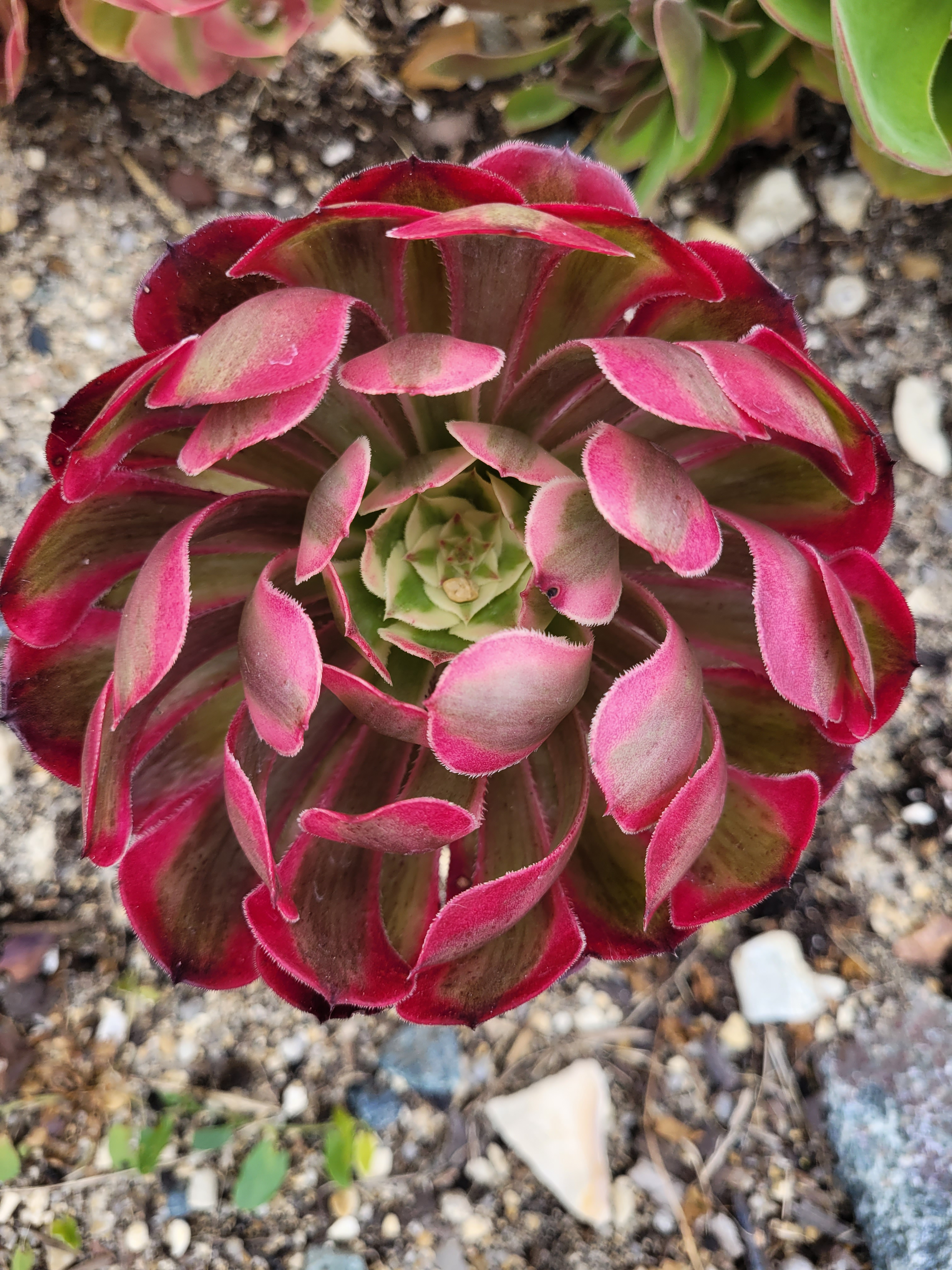
SOME PHOTOS OF DORMANT AEONIUM


Useful equipment during summer dormancy
1. Monitor actual heat
- A connected thermometer-hygrometer with alert : it warns when a threshold is exceeded in a greenhouse or veranda, even in your absence.
- A infrared thermometer : it occasionally measures the surface temperature of a pot, a shelf or exposed ground. These surfaces can be significantly warmer than the surrounding air.
2. Reduce heat stress
- A horticultural shade net from 40 to 50% : it limits direct radiation while maintaining good brightness. Install it gradually and adapt the shading rate to your climate and exposure.
- A greenhouse circulation fan : it avoids pockets of burning air and improves the homogeneity of the atmosphere. However, it cannot lower the temperature below that of the outside air and must be installed with a power supply suitable for humid environments.
The order of priorities during hot periods: shade, ventilate, keep pots away from hot surfaces and reduce watering if the plant is actually dormant. Watering more does not compensate for excessive temperature when roots are slowing down.
When you wake up: wait for the lasting drop in temperatures and the opening of the heart of the rosette before gradually resuming watering.
The links in this article
The links provided in this article refer to products available on Amazon. In case of purchase, Variegated Aeonium receives a small commission to help finance the hosting of the site and the creation of free content. The price remains strictly the same for you.


