
Origin:
Resulting from a mutation of the Aeonium ‘ Phoenix Flame ‘.
Known names:
‘Phoenix White’ – common international name -, ‘Phoenix Flame Variegata’ , ‘Phoenix Flame Variegated’ , ‘Phoenix Variegated’ , ‘White Fire Phoenix’ , 凤凰锦 ( Fènghuáng Jǐn , « Variegated Phoenix ») and 火凤凰锦 ( Huǒ Fènghuáng Jǐn , “Phoenix of variegated fire”). ‘Fenghuang Brocade’ is a literal translation of 凤凰锦.
⚠️ Beware of homonyms: Do not confuse Aeonium ‘ Phoenix White ‘ with Aeonium ‘ White Phoenix ‘. Despite their extremely similar names, they are two different cultivars with distinct origins. ‘ Phoenix White ‘ comes from ‘ Phoenix Flame ‘, while ‘ White Phoenix ‘ belongs to a different lineage.
Date of creation / commercialization:
Mutation commercialized in China in 2021. Commercial photographs dated November 19, 2021 already show the plant under the names ‘Phoenix Flame Variegated’ and 凤凰锦.
Botanical description
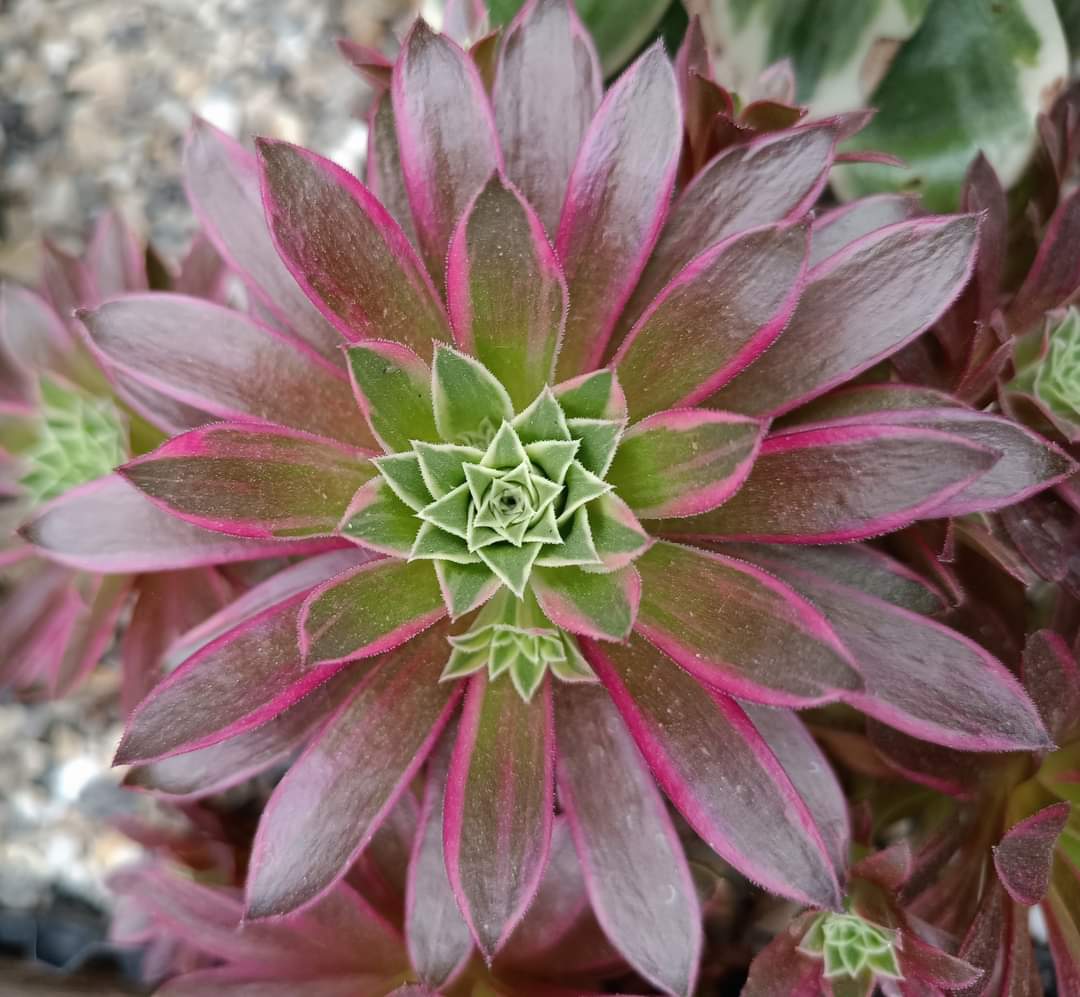
Aeonium ‘ Phoenix White ‘ is a small, variegated , shrubby Aeonium with a particularly compact and creeping habit.
It gradually forms a small, rounded clump composed of numerous closely spaced rosettes. This structure strongly resembles certain characteristics inherited from Aeonium ‘ simsii ‘, present in its indirect lineage.
The rosettes are made up of relatively thin, long and pointed leaves , giving the plant a very different silhouette from that of shrubby Aeoniums with large fleshy leaves.
The stems, on the other hand, are thin and relatively fragile . With age, some may lose their vigor, dry out, or become less able to properly nourish the terminal rosettes.
This is an important characteristic of this cultivar: a beautiful specimen can gradually lose its aesthetic appeal if the old stems become bare.
A deliberately subtle variegation
In winter, when the light is weaker, the foliage generally exhibits:
- a wide central green band ;
- two pale yellow to cream lateral bands ;
- a relatively regular variegation;
- parfois une légère coloration rosée sur les marges.
The variegation of ‘Phoenix White’ is quite different from that of many modern, highly colorful variegated Aeoniums.
It generally remains subtle and elegant, with a relatively soft contrast between the green center and the pale margins.
This subtlety is precisely part of its charm: ‘Phoenix White’ may not necessarily appear spectacular at first glance, but it develops a highly refined appearance when it forms a dense clump of small rosettes.
Coloration That Intensifies with Light
As light levels increase in spring, the yellow and cream areas gradually begin to develop more color.
The margins can then take on pink and eventually red tones, whose intensity depends greatly on light exposure, temperature, and the plant’s water status.
In plants receiving strong light exposure, this coloration can become particularly noticeable along the tips and edges of the leaves.
However, it is important to keep in mind that ‘Phoenix White’ remains, overall, an Aeonium with relatively subtle coloration. The same level of contrast seen in cultivars such as ‘Medusa’ or certain mutations of ‘Mardi Gras’ should therefore not be expected.
A Small Plant That Quickly Forms a Dense Clump
One of the main attractions of ‘Phoenix White’ is its ability to produce numerous rosettes.
Over time, the plant can develop into a compact, ball-like clump composed of multiple heads. Specialized growers now even offer specimens with several dozen rosettes, confirming its strong tendency to branch.
This characteristic is particularly appealing to collectors: a single plant can therefore develop relatively quickly into a small, very dense clump.
However, the individual rosettes themselves grow rather slowly.
‘Phoenix White’ is therefore an Aeonium that multiplies readily through branching but does not quickly develop large rosettes or long stems.
The Issue of Aging Stems
This is probably one of the most important points to be aware of when growing ‘Phoenix White’.
Its slender stems can age relatively poorly. Some may gradually dry out or lose their ability to adequately support and supply the rosettes growing at their tips.
When this happens, it may become necessary to take rosette cuttings in order to rejuvenate the plant.
This technique helps preserve the most vigorous parts of the plant and gradually establish a new clump.
With this cultivar, taking cuttings should therefore not necessarily be regarded as a rescue measure: it can also be considered part of the plant’s normal long-term management.
Slow Growth but a Strong Tendency to Produce Offsets
Available observations indicate a relatively slow growth rate.
However, its ability to produce offsets is high. This combination explains why a plant can remain relatively small while gradually becoming very dense and full.
Sensitive to Excess Moisture and High Temperatures
This is probably the main point to watch when growing ‘Phoenix White’.
Several cultivation observations indicate a sensitivity to excess moisture, as well as to high temperatures.
Like many Aeoniums, its growth cycle is strongly influenced by temperature. When conditions become excessively hot, the plant’s activity can slow considerably.
Under these conditions, watering too frequently can become problematic: the growing medium remains moist while root activity has slowed.
It is therefore best to provide:
- very good light;
- a particularly well-draining growing medium;
- good air circulation;
- protection from extreme summer heat.
A bright position with some protection during heatwaves may therefore be preferable to intense, direct sunlight throughout the entire day.
Cold Hardiness Should Be Treated with Caution
Its parentage is particularly interesting, as ‘Phoenix Flame’ is known to show some tolerance to light frost, a characteristic attributed to its relationship with Aeonium simsii.
However, this tolerance should not automatically be assumed for ‘Phoenix White’.
Variegation alters the plant’s physiological functioning and may make some tissues more vulnerable. As with other variegated Aeoniums, prolonged exposure to frost must be avoided.
Winter protection therefore remains essential whenever temperatures fall significantly below freezing.
WINTER PHOTOS


SUMMER PHOTOS


Cet article vous a plu ?

CONTINUE EXPLORING


