
Origin:
Middle mutation (central variegation) of the Aeonium ‘Medusa’ (type middle), itself resulting from a mutation of Aeonium ‘Velour’ (‘Purple Cashmere‘).
Known names:
‘‘Kilimanjaro’ — preferred international spelling —, ‘Kilimanjaro’, ‘Huana’, ‘Hua Na’, ‘Medusa Middle’, 花纳锦 (Huānà Jǐn) and 华纳锦.
Creation date / Creator:
Chinese mutation of unknown creator, appeared at the beginning of 2020. First dated nominative mention found on February 13, 2020, under the name 花纳锦. Exact date of creation unknown.
Botanical description
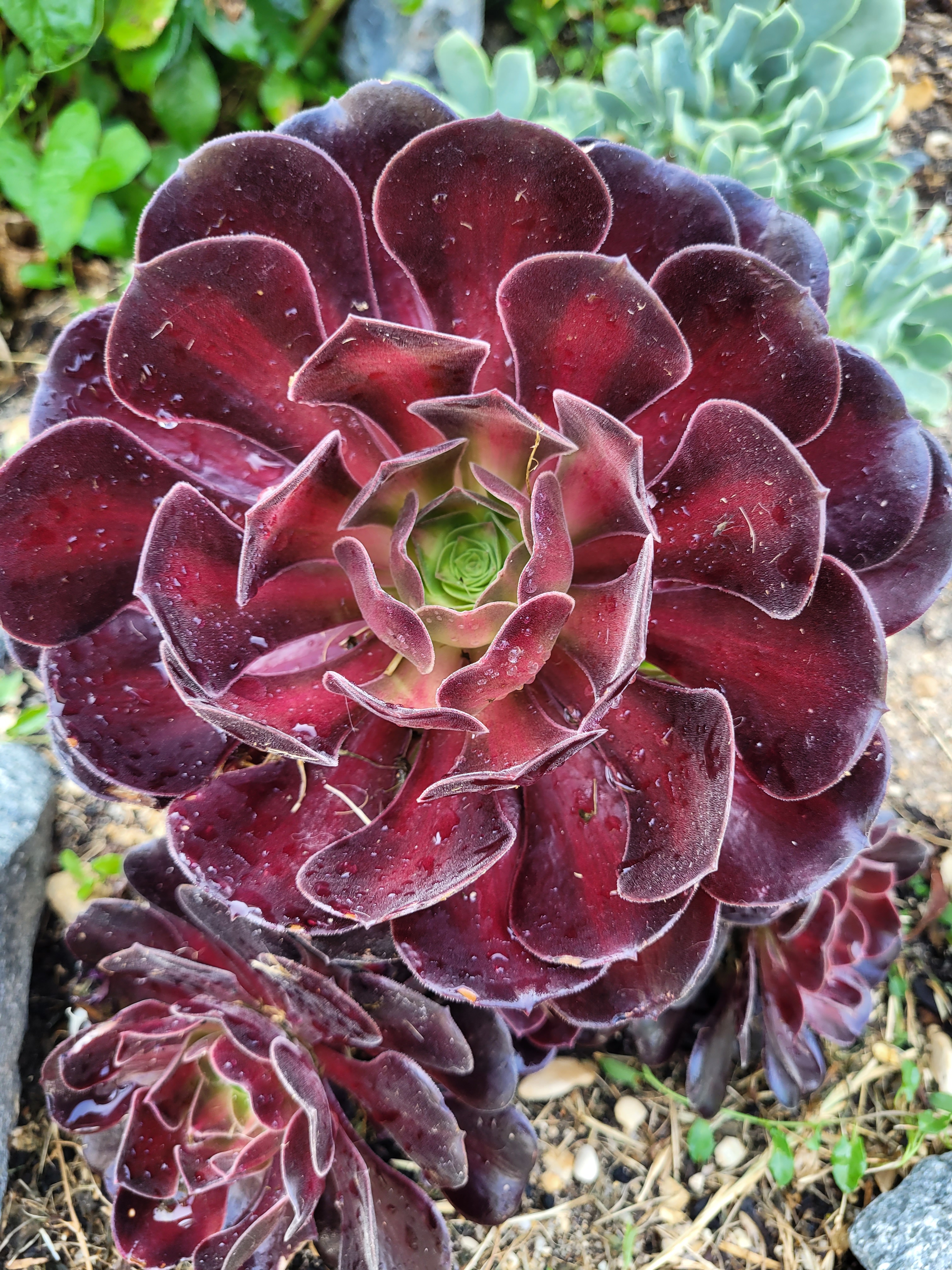
The Aeonium ‘Kilimanjaro’ is a variegated shrubby Aeonium (variegata) from a Middle mutation (central variegation)
Aeonium ‘Medusa’.
This mutation, also called “middle”, corresponds to a modification of the distribution of variegation: unlike its parent ‘Medusa’, where the light areas are mainly located on the peripheral parts of the leaf, ‘Kilimanjaro’ has a more marked central depigmented area.
This particularity gives it its own visual identity while retaining certain characteristic features of the lineage ‘Velour’ → ‘Medusa’.
Evolution of foliage throughout the seasons
In winter, when the light is lower, the foliage of the Aeonium ‘Kilimanjaro’ generally presents:
- a pale yellow to cream central band;
- two green lateral bands, the intensity of which may vary depending on the growing conditions.
This association between light core and peripheral green areas gives it a luminous and relatively soft appearance during the cool season.
With the increase in light, especially in spring and summer, its foliage changes significantly:
- the lateral borders of the leaves become progressively darker;
- they can take on dark brown to almost black shades;
- the central yellow band gradually evolves towards orange then red shades.
This seasonal transformation creates a spectacular contrast between the colored center of the leaf and the dark peripheral areas, reminiscent of the genetic influence of its parent ‘Medusa’.
Culture and behavior
The Aeonium ‘Kilimanjaro’ is considered a particularly interesting cultivar for its vigor and stability.
Its main horticultural characteristics:
- Growth: good vigor;
- Ability to reject: high;
- Stability of variegation: excellent;
- Fragility: no particular sensitivity observed to date.
Its ease of multiplication by discards constitutes an important advantage for its distribution in collections.
Unlike some heavily depigmented Aeonium variegata, it retains a sufficient quantity of chlorophyll to ensure regular growth and good general resistance.
Like all Aeoniums, however, it remains sensitive to frost and requires protection during prolonged negative temperatures.
A remarkable descendant of the ‘Medusa’ lineage
The Aeonium ‘Kilimanjaro’ perfectly illustrates the genetic richness of mutations originating from Aeonium ‘Medusa’.
Middle mutations (central variegation) are particularly interesting because they allow the appearance of new variegation balances from the same original cultivar.
This development explains why ‘Kilimanjaro’ retains some characters of ‘Medusa’ while developing a totally different coloring expression.
Its stability, vigor and seasonal color changes make it an Aeonium sought after by collectors today.
WINTER PHOTOS


SUMMER PHOTOS


CONTINUE EXPLORING


