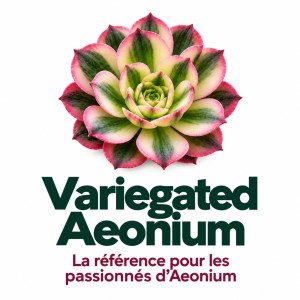

Origin:
A spontaneous mutation of Aeonium ‘Zeus’, itself derived from a mutation of Aeonium undulatum.
Known names:
‘Green Rose’ (the most commonly used name), ‘Rose’, 绿玫瑰, ‘Large Leaf Green Rose’, 大叶绿玫瑰锦.
Creation date / Breeder:
Marketed in China from 2021 onward.
THE HISTORY OF ITS ORIGIN
Aeonium ‘Green Rose’ belongs to the large family of mutations derived from Aeonium undulatum, a remarkable botanical species known for its majestic habit, large size and natural tendency to produce offsets from the base.
It is believed to have appeared as a mutation of Aeonium ‘Zeus‘, itself derived from a mutation of Aeonium undulatum. This lineage explains its many morphological similarities to ‘Zeus’, including its powerful growth, broad trunk and large flexible leaves.
Despite this presumed close genetic relationship, however, ‘Green Rose‘ has distinctive characteristics that clearly separate it from ‘Zeus‘, particularly in its seasonal development and the intensity of its coloration.
Botanical description:
Aeonium ‘Green Rose’ is a spectacular variegated cultivar that has inherited the imposing character of its parent Aeonium undulatum.
Like ‘Zeus‘, it is a large Aeonium that can exceed 1 meter in height under favorable conditions. Its trunk quickly becomes thick and sturdy, giving the plant a particularly majestic silhouette.
Its leaves are broad, long and thick, with a flexible texture. When cuttings are taken, the leaves often become temporarily soft and drooping. This is normal: they gradually regain their firmness once the cutting has developed a root system.
Cuttings of ‘Green Rose‘ also generally have a good ability to root, which facilitates propagation.
Color development
The aesthetic distinction of Aeonium ‘Green Rose’ lies in its tricolored foliage, mainly composed of:
- a broad green central area occupying much of the leaf;
- cream-white lateral margins characteristic of variegated mutations derived from ‘Zeus’;
- pink to reddish shades that may appear along the leaf edges depending on growing conditions.
Unlike some highly changeable variegated Aeoniums, ‘Green Rose’ largely retains its color pattern throughout the year.
Under strong light, high temperatures or mild water stress, however, its margins can become much pinker than those of ‘Zeus‘. This more pronounced pink coloring probably inspired the evocative name ‘Green Rose’, suggesting a green rose edged with pink.
Seasonal behavior
Like many Aeoniums derived from Aeonium undulatum, ‘Green Rose‘ may quickly enter summer dormancy when temperatures rise above approximately 25°C (77°F).
During this period, vegetative activity slows sharply. The center of the plant may then:
- close up;
- flatten;
- reduce its leaf surface to limit water loss.
This behavior is a natural adaptation to the hot, dry conditions of its original environment.
Growing it in a bright position protected from intense summer heat will generally help limit this resting phase.
BRANCHING ABILITY AND VIGOR
Aeonium ‘Green Rose’ retains some of the characteristics inherited from Aeonium undulatum.
New shoots frequently appear at the base of the plant rather than directly on the main stem, although lateral offsets may also develop.
Its growth is fairly fast under suitable conditions.
No particular fragility has been observed to date, apart from its natural sensitivity:
- to frost, like all Aeoniums;
- to excess moisture during hot periods, especially when the plant is dormant;
- to excessive summer temperatures.

It has the distinctive ability to retain its colors throughout the year, although the leaf edges may become considerably pinker than those of ‘Zeus’ in summer, which inspired the name ‘Green Rose’.
DIFFERENCES BETWEEN ‘ZEUS’ AND ‘GREEN ROSE’


WINTER PHOTOS


SUMMER PHOTOS


Mutation derived from Green Rose

A spontaneous mutation that appeared on a Green Rose plant in the collection of a major Japanese Aeonium collector in late 2023. I have not yet seen this mutation elsewhere. If you have any information, please contact me.
CONTINUE EXPLORING


