Origin:
Aeonium ‘Garnet White’ is generally marketed as a variegated mutation of Aeonium ‘Garnet’.
This parentage should, however, be treated with caution. The true Aeonium ‘Garnet’, created by Jack Catlin, is now difficult to identify with certainty. Many dark-leaved plants circulating under this name probably correspond to other clones or closely related cultivars.
To date, no documentation has been found tracing the appearance of ‘Garnet White’ on an authenticated Aeonium ‘Garnet’. It is therefore more accurate to associate this cultivar with the Asian commercial lineage known as “Garnet” or “Red Copper Pot,” without claiming that it is a direct mutation of Jack Catlin’s historic cultivar.
Its original parent plant consequently remains unidentified.
Known names:
‘Garnet White’ — principal name; ‘White Garnet’; ‘Garnet Super White’; ‘Red Garnet’; ‘Red Garnet Super White’; ‘Red Copper White’; ‘Red Copper Pot White’; ‘Red Copper Pot White Variegated’; ‘Garnet White Brocade’; ‘Red Flame Silk Variegated’; 赤銅壺白錦; 红铜壶白法师.
Creation / commercialization date:
Commercialized from 2018 (China).
Origin and history
The history of ‘Garnet White’ is closely connected with the distribution in China of several dark-leaved Aeoniums grouped under the names ‘Garnet’ and 红铜壶, literally translated as “Red Copper Pot.”
A pale variegated mutation is believed to have been isolated from one of these plants and then propagated vegetatively before entering the market in 2018. The selection was given several names referring either to its white variegation or to its presumed relationship with ‘Garnet’.
However, no known document shows the parent plant before the mutation appeared. There is therefore no evidence that it was the true Aeonium ‘Garnet’ created by Jack Catlin.
Botanical description
General description
Aeonium ‘Garnet White’ is a shrubby variegated Aeonium that forms regular rosettes at the tips of gradually branching stems.
Its leaves are oblong to spatulate, relatively broad and slightly pointed at the tip. Their surface is smooth, and their arrangement gives the rosette a dense, orderly appearance.
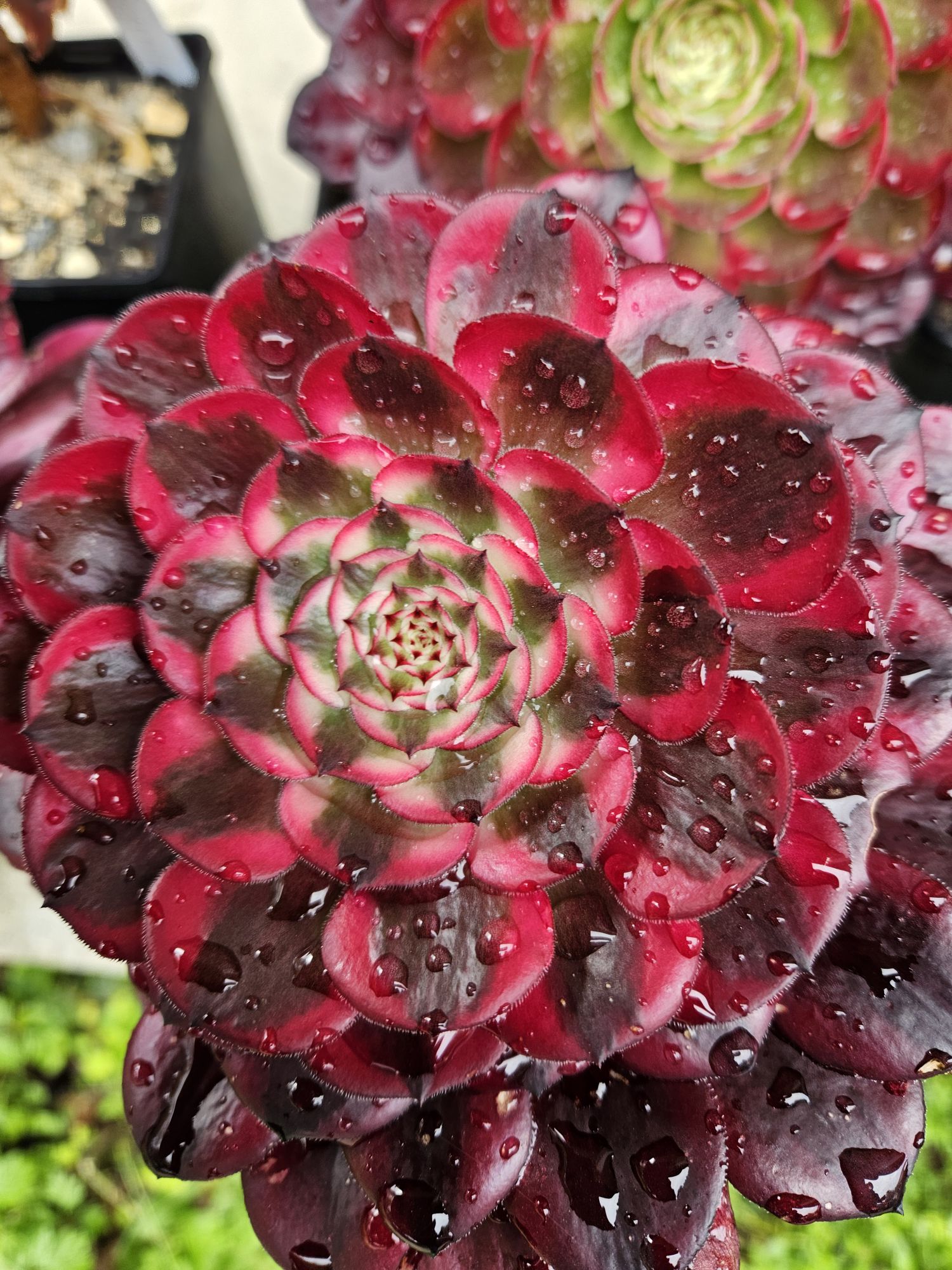
Its variegation mainly consists of a green central area surrounded by broad yellow, cream or almost white bands. Red, pink or purple pigmentation gradually develops along the margins and on the parts most exposed to light.
The combination of a pale center, darker areas and colored margins gives the plant a particularly striking contrast.
Seasonal changes
During winter or under moderate light, the plant displays a green central band and yellow-cream lateral bands. The margins remain green or begin to develop a faint pink blush.
As light levels and temperatures rise, the margins gradually turn pink, red and then purple. At the same time, the green central area may become much darker, eventually appearing purplish brown or almost black.
During summer, the rosettes close in to reduce their exposure to sun and heat. The contrast between the dark center, pale bands and red margins then becomes especially pronounced.
Its coloring nevertheless depends greatly on exposure, temperature, hydration and general growing conditions.
Growth and branching
Aeonium ‘Garnet White’ has a normal to relatively vigorous growth rate for a variegated cultivar.
It branches fairly readily and can eventually form a compact shrub bearing numerous terminal rosettes. Mature plants grown under favorable conditions may reach approximately 8 to 12 inches (20 to 30 cm) in height and develop several branches.
Its ability to produce offsets makes propagation easier and helps preserve the plant if one rosette is lost.
Stability and reversions
The variegation of ‘Garnet White’ appears generally stable. Reversions and further mutations seem less frequent than in some other variegated Aeoniums.
Entirely green or dark shoots may nevertheless appear occasionally. Their appearance could provide clues about the original parent plant, but a reversion alone is not sufficient to identify that parent cultivar with certainty.
If a non-variegated shoot becomes dominant, it may grow faster than the variegated sections and gradually unbalance the plant.
Particular vulnerabilities
No exceptional weakness has been observed in Aeonium ‘Garnet White’. It is generally considered relatively stable and manageable in cultivation.
As with many variegated Aeoniums, the main risk during summer is the combination of high temperatures and a growing medium that remains wet for too long.
Flowering
No distinctive flowering characteristic has been documented for Aeonium ‘Garnet White’.
As with other Aeoniums, each rosette is monocarpic: it gradually dies after flowering. On a well-branched plant, the remaining rosettes normally continue to develop.
Growing conditions
☀️ Light
Aeonium ‘Garnet White’ prefers very bright conditions. Good light helps maintain compact rosettes and encourages the development of pink, red and purple tones.
In fall, winter and spring, it can receive several hours of direct sunlight. Insufficient light produces greener foliage and reduces the contrast between its colors.
In summer, light protection during the hottest hours helps reduce the risk of scorching the cream or white areas. Any increase in sun exposure should be gradual.
💧 Watering
During its active growing period, it can be watered regularly, provided the growing medium is allowed to dry sufficiently between waterings.
When the plant enters dormancy in response to heat, its water requirements decrease sharply. Watering should then be spaced out and adjusted to the condition of the rosettes and roots.
Avoid keeping the growing medium wet during periods of high heat.
🪨 Growing medium
A very free-draining growing medium is recommended. It should allow excess water to drain quickly while retaining enough moisture to support fall, winter and spring growth.
Container cultivation makes watering easier to control and allows the plant to be moved according to the season.
🌡️ Temperatures
Aeonium ‘Garnet White’ must be protected from frost. A minimum temperature above 32°F (0°C) is preferable.
WINTER PHOTOS


SUMMER PHOTOS


Reversion of ‘Garnet White’


