Origin:
Presented by Chinese growers as a mutation of the famous Aeonium ‘Medusa’, although this parentage remains unconfirmed to date. This presumed origin nevertheless explains the name given to the cultivar. Aeonium ‘Medusa’ itself is considered a mutation of Aeonium ‘Velour’, discovered in the Netherlands in 2016 before being developed in China.
Known names:
Aeonium ‘Green Medusa’ (the most widely used name), ‘Green Bean Paste’, ‘Mung Bean Paste’, ‘Green Bean’, 绿豆沙 — Lǜ Dòushā. The name ‘White Medusa’ is sometimes used commercially, particularly in Turkey, but should be treated with caution.
Creation / commercialization date:
Commercialized from around 2021 in China. Breeder unknown. Its commercial introduction is generally placed around 2021 in China, although the earliest precisely dated public record found is from August 9, 2022.
Botanical description
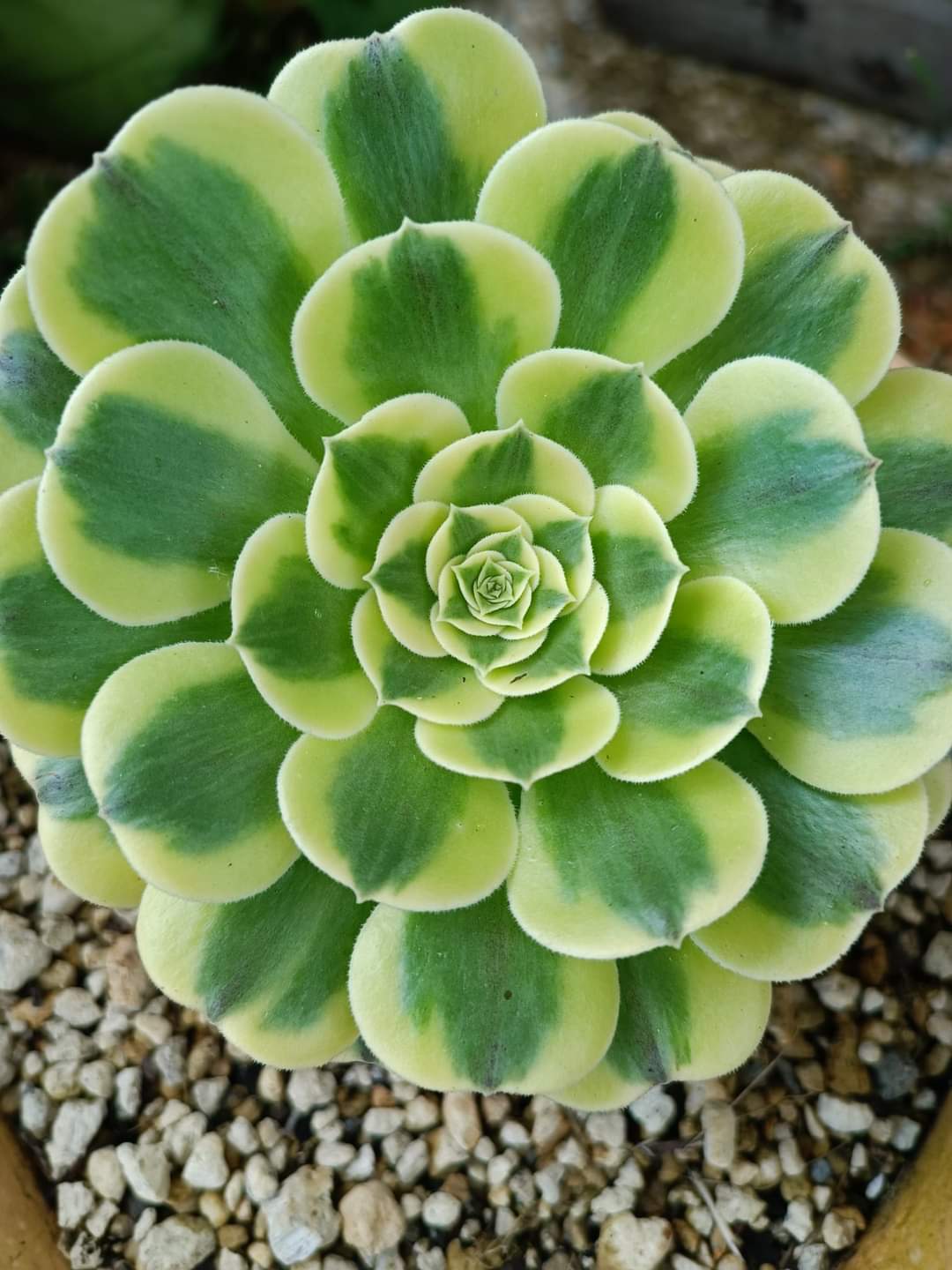
Aeonium ‘Green Medusa’ is a shrubby variegated Aeonium characterized mainly by different shades of green, white and cream.
Unlike many modern variegated Aeoniums whose appearance changes dramatically between winter and summer, ‘Green Medusa’ is among the cultivars showing relatively strong color stability throughout the seasons.
Its foliage generally consists of:
- a broad green central band;
- cream-white lateral zones;
- light-green tones that may gradually spread into the lateral areas;
- and, on certain older leaves, characteristic dark marks.
The plant therefore retains an overall fresh and luminous appearance for much of the year.
The distinctive regreening phenomenon
This is probably one of the most interesting characteristics of Aeonium ‘Green Medusa’.
The normally cream-white lateral bands may, at certain times, gradually take on green tones.
This phenomenon can be pronounced enough to noticeably alter the overall appearance of the rosette.
This characteristic is particularly interesting when comparing ‘Green Medusa’ with extremely similar cultivars such as ‘Yanning’ and ‘Maybach’.
In the latter cultivars, the lateral zones generally remain much more consistently white or cream. Observations of ‘Maybach’, in particular, indicate that it normally retains its white-and-green variegation and does not turn green in the same way as ‘Green Medusa’.
Relatively stable coloration throughout the seasons
Aeonium ‘Green Medusa’ displays less dramatic seasonal development than certain other variegated Aeoniums.
One should therefore not expect the extremely pronounced color changes seen in cultivars such as ‘Medusa’.
This stability is precisely one of its attractions.
In ‘Medusa’, for example, increasing light and temperatures can turn the central band from green to almost black, while the cream zones gradually become red.
‘Green Medusa’, by contrast, generally retains its green-and-cream identity, with greater variation in the proportion of green than in the appearance of new colors.
How can ‘Green Medusa’ be distinguished from ‘Yanning’ and ‘Maybach’?

This is probably one of the most interesting questions for collectors.
The three Aeoniums can look extremely similar when young or when photographed under different conditions.
Aeonium ‘Green Medusa’
The most useful characteristic is the possible regreening of the cream-white lateral bands.
The outer zones may therefore become noticeably greener at certain times.

Aeonium ‘Maybach’
‘Maybach’ also has a broad green central band surrounded by cream bands, but these tend to remain white or cream.
Another characteristic reported for ‘Maybach’ is the possible appearance of a fine pink edge in summer.
Aeonium ‘Yanning’
‘Yanning’ also belongs to this large family of green-and-cream Aeoniums. It is therefore particularly easy to confuse with ‘Green Medusa’.
In practice, observation over several seasons is often far more reliable than a single photograph.
‘Green Medusa’ or ‘Gold Emerald’?
Confusion with Aeonium ‘Gold Emerald’ is also common.
Both cultivars may display lateral bands that turn green.
The difference lies mainly in the overall tone of the variegation.
‘Gold Emerald’ generally displays brighter, more yellow tones, with green areas that may appear exceptionally vivid, almost fluorescent.
‘Green Medusa’, by contrast, may retain much whiter or creamier lateral zones.
This difference is particularly visible when the two cultivars are grown side by side.
A fairly simple distinction can therefore be remembered:
‘Green Medusa’ → green + white/cream, with possible regreening.
‘Gold Emerald’ → green + yellow/cream, generally with a more golden tone.
These are only practical identification criteria, however, and not official taxonomic characters.
The mysterious black marks on older leaves
Another characteristic regularly observed in ‘Green Medusa’ is the appearance of blackish streaks or marks on the oldest leaves.
These marks are particularly useful for identification because they are absent from ‘Yanning’, ‘Maybach’ and ‘Gold Emerald’.
They generally appear on the older parts of the foliage and can give the rosettes a slightly more contrasted appearance over time.

Growth and offset production
Aeonium ‘Green Medusa’ appears to have a fairly fast growth rate for a variegated Aeonium.
It also has an excellent capacity to produce offsets, quickly forming a well-branched plant.
This characteristic is confirmed by several horticultural observations: growers describe it as a highly prolific form capable of eventually forming a small, compact shrub.
This vigor is an important advantage over certain mutations containing very little chlorophyll, which remain much slower.
Good vigor for a variegated Aeonium
No particular weakness has been reported in the available observations to date.
This appears consistent with its relatively chlorophyll-rich foliage. The extensive green zones allow the plant to maintain sufficient photosynthetic activity.
It nevertheless remains an Aeonium, with the cultivation requirements typical of the genus.
Like other Aeoniums, ‘Green Medusa’ particularly appreciates:
- a very well-draining substrate;
- good light;
- protection from severe frost;
- careful watering management during very hot periods;
- and good air circulation.
Some growers particularly recommend partial shade in summer, as this may help the plant remain active when temperatures become very high.
WINTER PHOTOS


SUMMER PHOTOS


CONTINUE EXPLORING


