Origin:
Derived from the mutation of Aeonium ‘Green Cashmere’.
Known names:
‘‘Maybach‘ — the most common name; ‘Maybach Variegated‘; 迈巴赫; 邁巴赫; 迈巴赫法师; 邁巴赫法師; 迈巴赫锦; マイバッハ.
Creation date / creator:
2019 (Chinese creation).
Botanical description:
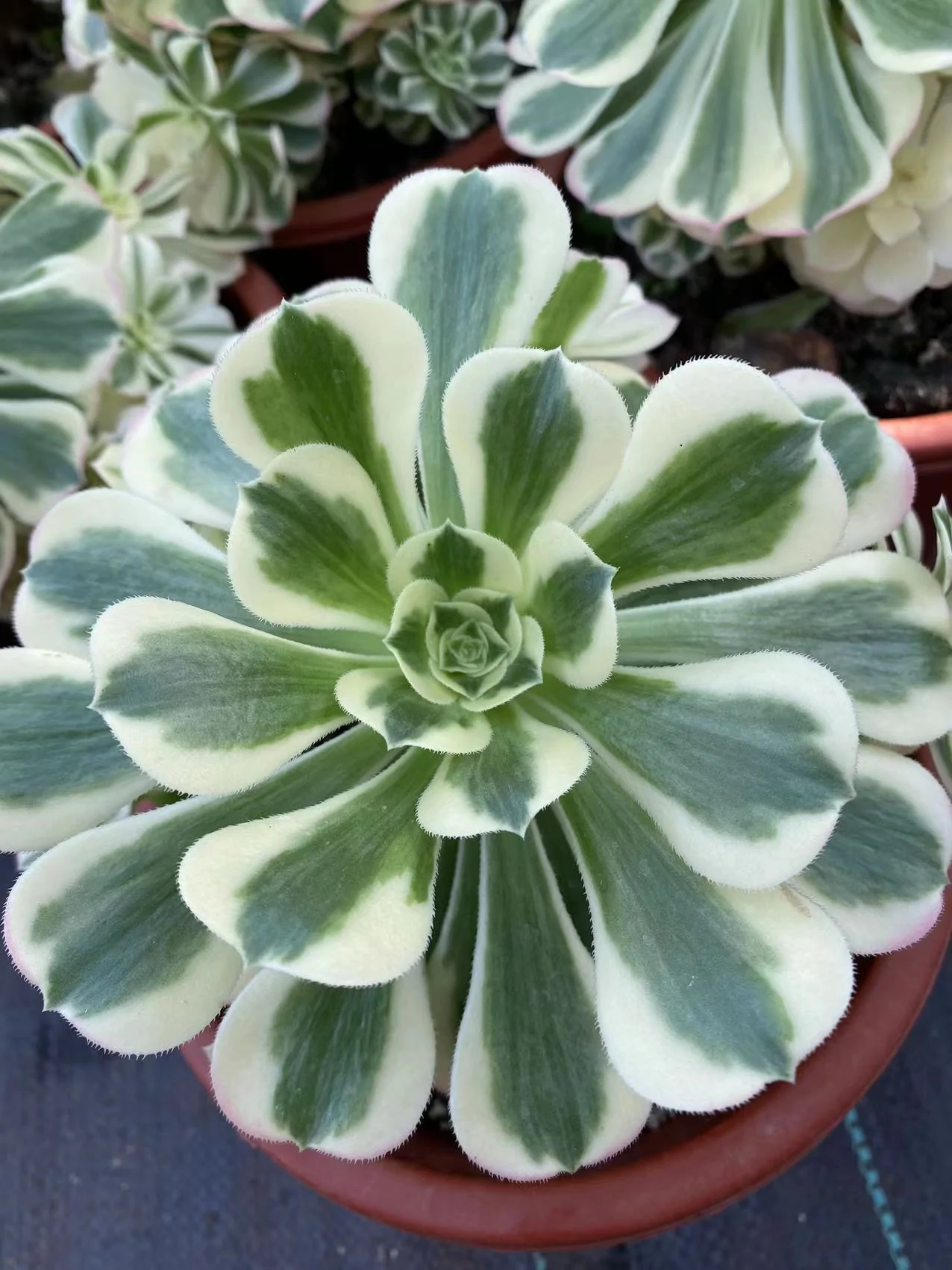
The Aeonium ‘Maybach’ is a variegated shrub Aeonium that comes from a mutation of Aeonium ‘Green Cashmere’. It belongs to a group of cultivars with a relatively stable variegation and whose appearance changes little over the seasons.
Its foliage is characterized by a wide central green stripe, the intensity of which can vary depending on growing conditions, surrounded by two white to cream side stripes. This regular color distribution gives the rosette a particularly striking contrast.
Unlike some Aeonium variegata from closely related lines, ‘Maybach’ generally retains this green/cream-white combination all year round.
During summer and under strong light, a thin pink to reddish edge may appear on the leaf margins. This coloration usually stays subtle and doesn’t significantly change the overall look of the cultivar.
How to tell ‘Maybach’ apart from similar cultivars?
Identifying ‘Maybach’ can be tricky, especially because it’s close to several Aeoniums from the same line, like ‘Yanning’, ‘Green Medusa’, ‘Gold Emerald’, or ‘Sinya’.
A particularly useful way to recognize ‘Maybach’ is the stability of its white to cream side stripes.
‘Maybach’ and ‘Green Medusa’
The main difference lies in the development of the variegation. ‘Green Medusa’ can show more significant changes in its side stripes and take on greenish, even very light shades depending on the conditions.
‘Maybach’, on the other hand, usually keeps its white or cream stripes, without a real seasonal greening.
‘Maybach’ and ‘Gold Emerald’
This distinction can also be useful with ‘Gold Emerald’. The latter tends more to temporary greening of the side areas, a phenomenon that is one of its characteristic traits.
In ‘Maybach’⟧, the side stripes normally stay white to cream. A plant that regularly shows significant greening in these areas should therefore be identified with care.
Another differentiating factor, ‘Gold Emerald’ generally shows shades from golden yellow to bright green even fluorescent, which is never the case with ‘Maybach‘.
‘Maybach’ and ‘Sinya’
The distinction with ‘Sinya’ can be particularly important, as the two cultivars can have quite similar morphology and color distribution.
An interesting difference concerns the tendency to produce rosettes strongly lacking chlorophyll. This phenomenon seems noticeably less common in ‘Maybach’, while it is regularly observed in ‘Sinya’.
So the stability of the variegation is an important element in identification, even though observing just one specimen doesn’t always allow for a definite conclusion.
Stability & variations
‘Maybach’ seems to be a cultivar particularly stable in expressing its variegation. This stability is interesting for collectors, especially when it comes to distinguishing it from similar cultivars whose colors may change more over the seasons.
However, it’s important to keep in mind that the coloring of an Aeonium variegata depends on many factors: light intensity, exposure duration, temperature, water availability, and the plant’s physiological state. The appearance of the same plant can therefore vary slightly without it being a real change in its variegation.
Growing & behavior
Based on current observations, ‘Maybach’ shows rather fast growth and a good ability to produce offsets. It thus fairly easily forms a branching and well-filled plant.
No particular fragility has been reported to date, apart from its sensitivity to frost, which is common to all Aeoniums.
Like other Aeoniums variegata, it enjoys a well-draining substrate, good lighting, and watering suited to its growth period. Sufficient light helps maintain a nicely contrasted variegation and a compact form.
Important note: One of the characteristics of ‘Maybach’ (like Yanning) compared to ‘Green Medusa’, ‘Gold Emerald’, and ‘Sinya’ is that it never turns green, even in winter. It keeps its white/green variegation all year round. Sometimes there are Aeoniums circulating under the name ‘Maybach’ that do turn green, so these are not true ‘Maybach’ but certainly one of the 3 mentioned earlier, more often ‘Sinya’ or ‘Green Medusa’.
It has a good ability to sprout and its growth is rather fast. It is not particularly fragile (except to frost like all Aeoniums).
COMPARISON MAYBACH / YANNING

WINTER PERIOD PHOTOS


SUMMER PERIOD PHOTOS


