
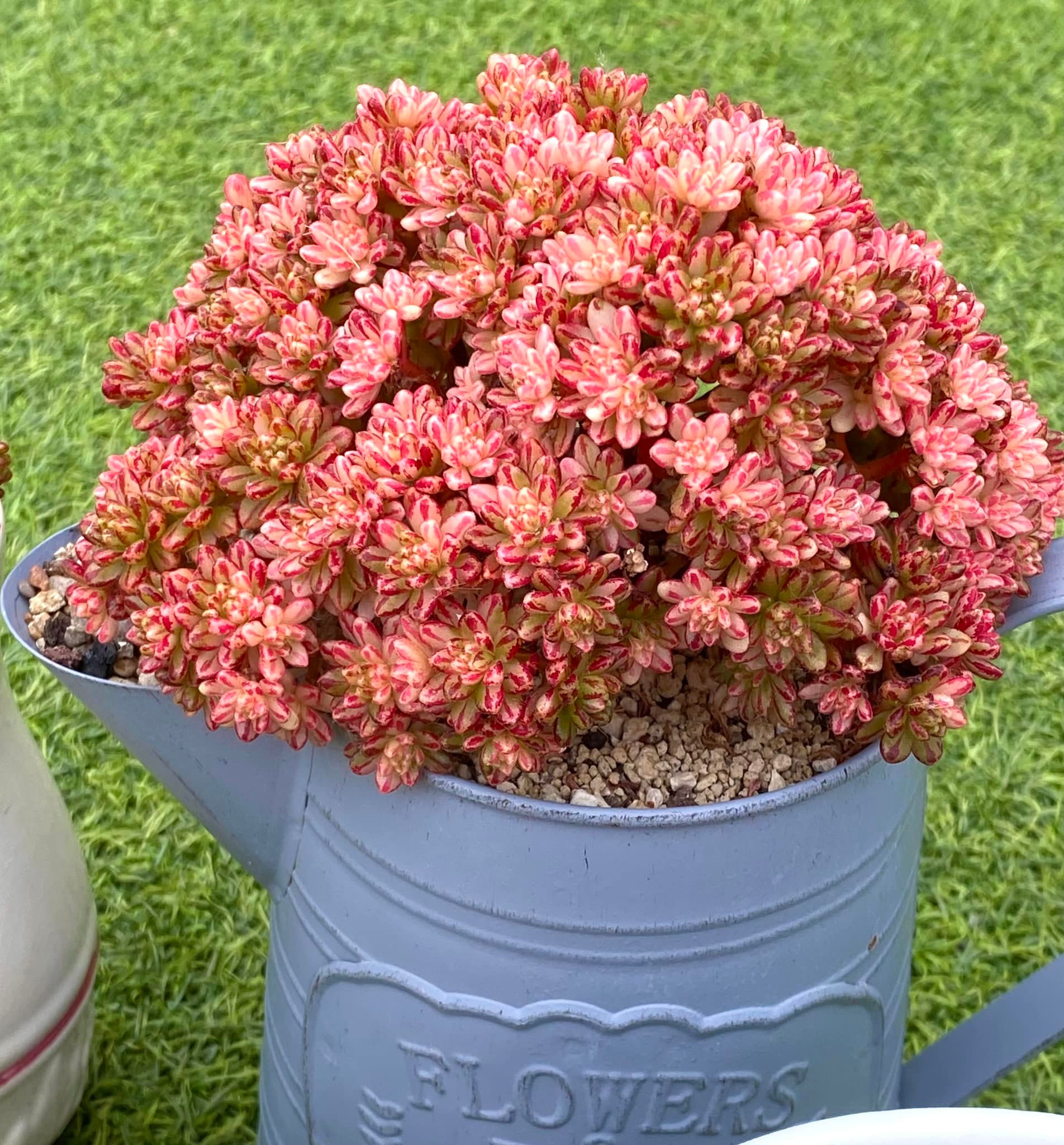
Few Aeoniums pack so much colour into such a small plant. With its tiny, fleshy leaves, ‘Sedifolium variegata’ turns from green and cream to deep, plum-like red, gradually gathering its bright rosettes into miniature cushions.
- Reference name
- Sedifolium variegata
- Other names
- 小人の祭り錦 · Dwarf Aeonium · 小人祭锦
- Genus
- Aeonium
- Type
- Variegated cultivar
- Mutation of
- sedifolium
- Growth habit
- Compact shrub
- Branching
- Branching
Family tree
Reserved for Premium members
Origin and history
‘Sedifolium variegata’ arose as a variegated mutation of the botanical species Aeonium sedifolium. Plants bearing this variegation have been documented online since at least 2019; the original grower, location and precise date of the mutation remain unknown.
Alongside ‘Sedifolium variegata’, names such as ‘Dwarf Aeonium’ and 小人祭锦 have circulated. The occasional label ‘× loartei variegata’ should not be treated as an accepted synonym: Aeonium × loartei is a hybrid involving A. sedifolium and A. spathulatum, not the variegated form of the species.
Botanical description
A tiny shrub with jewel-like leaves
This variegated form retains the delicate outline of its botanical parent: slender, branching stems topped with minute rosettes. In Aeonium sedifolium, the glossy, thick leaves are usually only 1–1.5 cm long and often carry natural reddish streaks. Cream-yellow bands bring an additional brightness to an already distinctive miniature plant.
A whole season of colours in one rosette
In gentler winter light, young leaves often display a green central stripe between pale cream sectors, sometimes touched with pink. With stronger light, the edges can deepen through red to purple, while older leaves become almost dark plum and the fresh centre stays greener. A single rosette can therefore hold several generations of leaves — and contrasting colour palettes — at once.
Slow to grow, generous with branches
Growth is slow, but this little Aeonium branches readily, gradually forming a close cushion of rosettes. Some offsets may revert towards green as they lose part or all of their variegation. With more chlorophyll, such growth may become stronger than the pale sections, so the stability of the pattern deserves attention. Darker seasonal colouring alone is not a reversion.
Comparing sedifolium with its variegated form
This documentary comparison shows the miniature leaves and branching habit inherited from the botanical species, alongside the additional colour contributed by variegation.

Flowering
Have you photographed this cultivar in bloom? Share flowering photographs on the Forum.
Botanical Aeonium sedifolium bears small inflorescences of bright yellow flowers, usually with 9–11 petals, often in April or May. Photographs of the variegated form in flower would be especially valuable for checking its floral characters and confirming the identification.
Photographs
Do you grow this cultivar? Help document its shapes and seasonal colours. Share your photographs on the Forum.
Winter photographs


Summer photographs

Growing conditions
☀️ Light
Provide bright light while acclimating the plant gradually to direct sun. Watch the pale cream variegated sectors, which may scorch after an abrupt increase in exposure.
💧 Watering
During active growth, water once the growing medium has dried sufficiently; reduce watering when intense heat slows growth. Avoid leaving the roots in persistently damp conditions.
🪨 Substrate
Use a very free-draining, airy potting mix in a container with drainage holes so excess water can escape quickly. Existing observations indicate sensitivity to prolonged dampness.
🌡️ Temperatures
Protect this Aeonium from frost and prolonged cold, wet conditions. No reliable minimum temperature specific to this variegated form has been established.


