
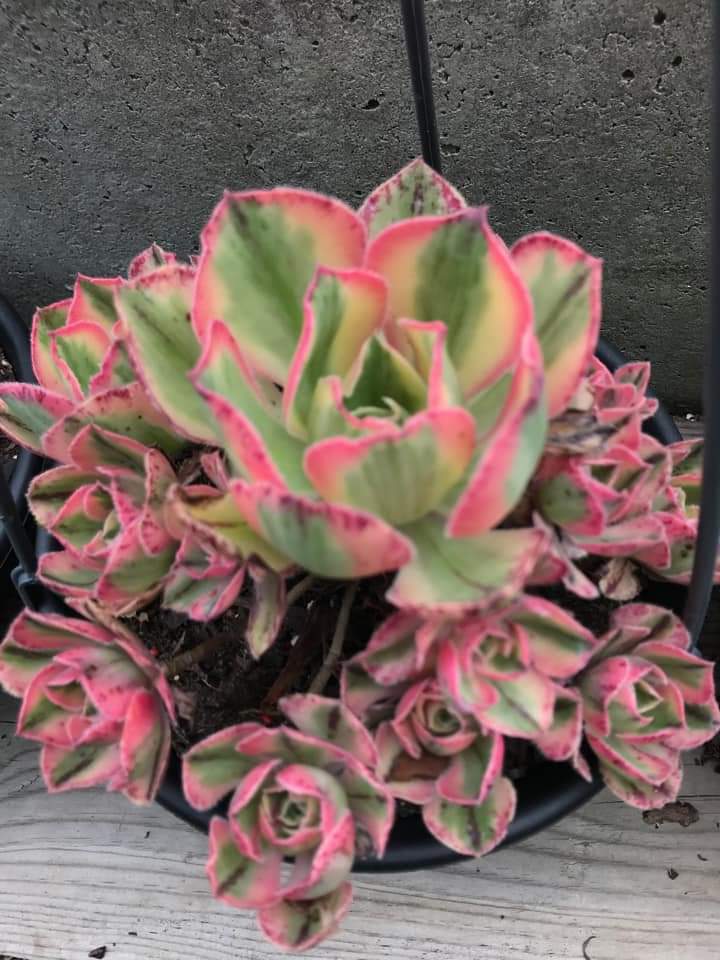
In its small rosettes, ‘Marnier Lapostolle Variegata’ gathers green, ivory and a pink that can become almost fluorescent. Its delicate appeal is matched by a Chinese trade name evoking antique porcelain.
- Reference name
- Aeonium ‘Marnier Lapostolle Variegata’
- Other names
- Blue and White Porcelain, Blue-White Fuji, Marnier Lapostlle variegata, 青花瓷
- Type
- Variegated cultivar
- Date
- Around 2020 — commercial distribution
- Growth habit
- Shrubby
- Branching
- Frequent offsets
- Genus
- Aeonium
- Mutation of
- Marnier-Lapostolle
Family tree
Reserved for Premium members
Origin and history
This cultivar is a variegated mutation of ‘Marnier Lapostolle’, an older Aeonium whose own origin remains unclear. It retains the original plant’s branching habit in a more compact, less vigorous form. Neither its first selector nor its precise emergence date is securely documented.
Trade names include ‘Blue and White Porcelain’, from the Chinese 青花瓷 (Qīnghuācí), a reference to traditional blue-and-white porcelain, and ‘Blue-White Fuji’. The imagery is lovely, even though the plant itself is more green, cream and pink than blue.
Chronological milestones
c. 2020 — The earliest offers of ‘Marnier Lapostolle Variegata’, a mutation of ‘Marnier-Lapostolle’, are reported around 2020.
Botanical description
Small rosettes full of subtle colour
This little shrub usually reaches 20–30 cm, bearing numerous rosettes. Green centres are surrounded by cream-to-pale-yellow sectors, sometimes with delicate marbling and a pink edge. The longitudinal leaf lines inherited from ‘Marnier Lapostolle’ may stand out in purplish red.
From cream to luminous pink
In cooler months, green and ivory predominate. As light strengthens, the edges become pink and then reddish purple, occasionally with an almost fluorescent glow. The arrangement of bands and streaks varies slightly from leaf to leaf.
Slow-growing but freely branching
Growth is relatively slow, noticeably less vigorous than the non-variegated parent, perhaps partly because of the reduced chlorophyll in its pale sectors. Even so, it readily produces branches and gradually becomes a compact cushion of rosettes.
Variegation that appears stable
Available observations record few or no reversions, though that does not make them impossible. Some sensitivity to intense heat and persistent moisture has also been reported; practical precautions belong in the growing conditions below.
Flowering
If you have documented this cultivar in bloom, share your observations or photographs via the Forum bubble beside the Flowering heading.
Photographs
Winter photographs


Summer photographs


Growing conditions
☀️ Light
Pink tones shift throughout the year; protect the plant from sudden intense sun during heatwaves.
💧 Watering
Water during active growth after sufficient drying, then reduce watering during summer rest without leaving the roots continuously damp.
🪨 Substrate
Use an airy, freely draining mix suited to the plant’s habit and root development, with no standing water in the container.
🌡️ Temperatures
Protect from frost and adjust exposure and airflow during intense summer heat.


