
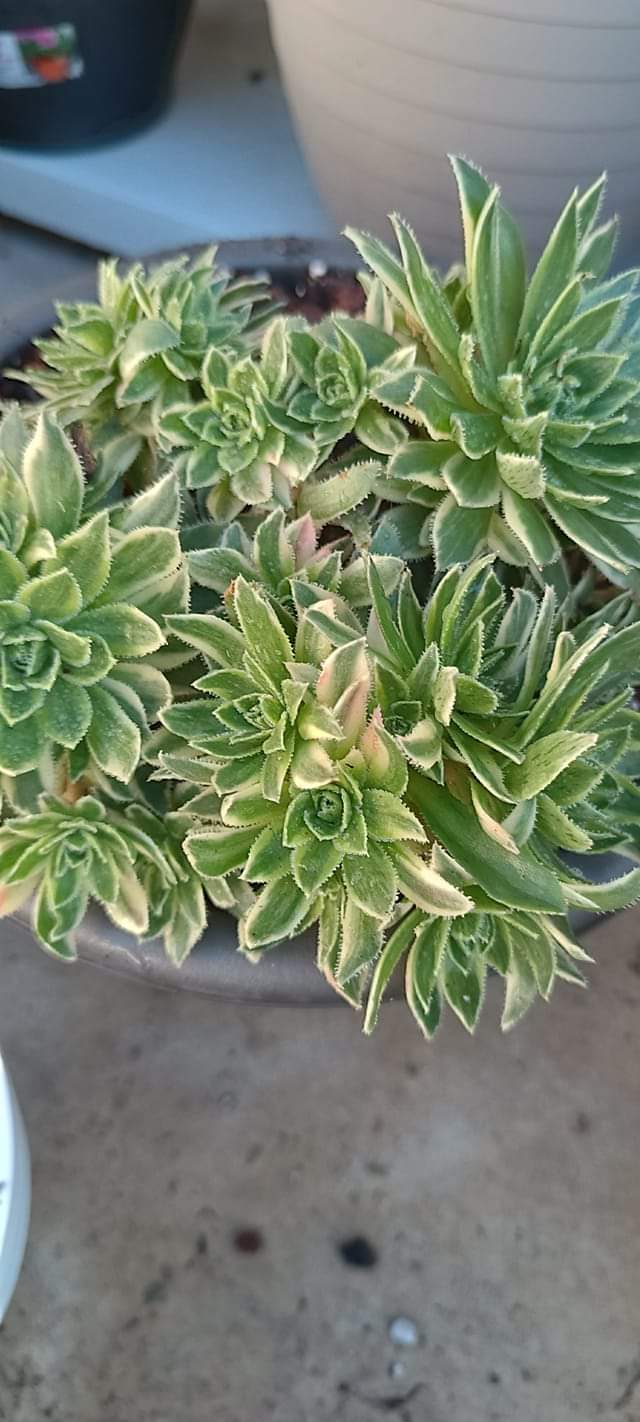
Behind the little cream-and-green rosettes of Aeonium × hybridum variegata lies a much older story than its appearance suggests. The plant has travelled under several names — sometimes even the name of another species — before its identity became clearer.
- Other names
- Bare Metal, Batu, Custard, Heavy Metal, simsii hybrid variegata, simsii variegata, Babetu, Babetu Varigation, 巴贝图锦 · Babetu · Babetu Varigation · Babetu Variegation · 巴贝图锦
- Botanical name
- Aeonium × hybridum variegata
- Type
- Variegated botanical hybrid
- Mutation of
- Aeonium × hybridum
- Date
- 2021 — reported market introduction
- Branching
- Branched
- Reference name
- x hybridum variegata
- Genus
- Aeonium
- Growth habit
- Clump of rosettes
Family tree
Reserved for Premium members
Origin and history
The story begins long before modern variegated cultivars became fashionable. Aeonium × hybridum is the hybrid of Aeonium simsii and Aeonium spathulatum. A related plant was already present in Mr Law’s collection in 1820. Adrian Hardy Haworth described it in 1821 as Sempervivum ciliare var. hybridum; in 1969, Gordon Douglas Rowley placed the name in Aeonium. Two centuries of history behind a tiny plant that is easy to overlook.
The variegated form tells a much more recent story. A mutation of Aeonium × hybridum, it began circulating in Chinese horticultural trade around 2021. ‘Batu’ and ‘Custard’ appeared among its names; on 23 June 2023, Hubbert Debbasch of Kerveat Botanical Farm gave the plant the name ‘Custard’. These dates belong to the variegated sport, not to the original nineteenth-century hybrid.
One name has caused particular confusion: « simsii variegata ». Widely used in trade, it implies that the plant is simply a variegated form of A. simsii. But its identity belongs instead to the hybrid A. × hybridum. It is a lovely example of how an old identification error can travel with a plant — and how understanding the story changes the way we see it.
Chronological milestones
2021 — The earliest offers of ‘x hybridum variegata’, a mutation of Aeonium × hybridum, are reported in 2021.
Botanical description
Forget the towering Aeonium shrubs for a moment: this one seems happiest close to the ground. Short, spreading branches carry many little rosettes, gradually building a living cushion rather than a miniature tree. Its almost creeping silhouette is part of its particular charm.
Narrow leaves have a green central band framed by white or cream. The pattern is simple at first glance, but becomes wonderfully delicate when several rosettes grow together. The original non-variegated hybrid is also known for its slender foliage and tiny translucent structures along the margins, which can give the edges a beaded appearance.
A carpet of little luminous rosettes
The habit stays low, closely branched and graceful. New heads gradually form a small colony, each repeating the contrast of green centre and ivory margins. It is a very different presence from the giant, single-stemmed variegated Aeoniums.
A quiet colour scheme, with the occasional surprise
The green-and-cream design changes relatively little through the year. Sometimes a burgundy line or tiny reddish streaks appear like an unexpected brushstroke on otherwise calm foliage. Such details are worth watching without immediately assuming that a new cultivar has appeared.
A generous maker of new heads
Growth is moderate, but offset production is abundant. Each individual rosette remains small; together they slowly create an attractive, tightly clustered plant. It is easy to see why a modest specimen can become so charming with time.
Flowering
Have you photographed this cultivar in bloom? Share flowering photographs on the Forum.
Photographs
Winter photographs


Summer photographs


Growing conditions
☀️ Light
Provide a bright position and acclimate the plant gradually to direct sunlight. Monitor the pale areas of the foliage when changing its exposure.
💧 Watering
Water according to the plant’s growth activity and how quickly the pot dries, allowing the growing medium to dry sufficiently between waterings. During a summer slowdown, reduce watering rather than following a fixed schedule.
🪨 Substrate
Choose a very free-draining growing medium that allows excess water to escape quickly. In pots, keep the drainage holes clear and avoid leaving standing water in a saucer.
🌡️ Temperatures
Protect the plant from frost. In hot weather, adjust watering to its actual growth activity and choose a well-ventilated position.


