
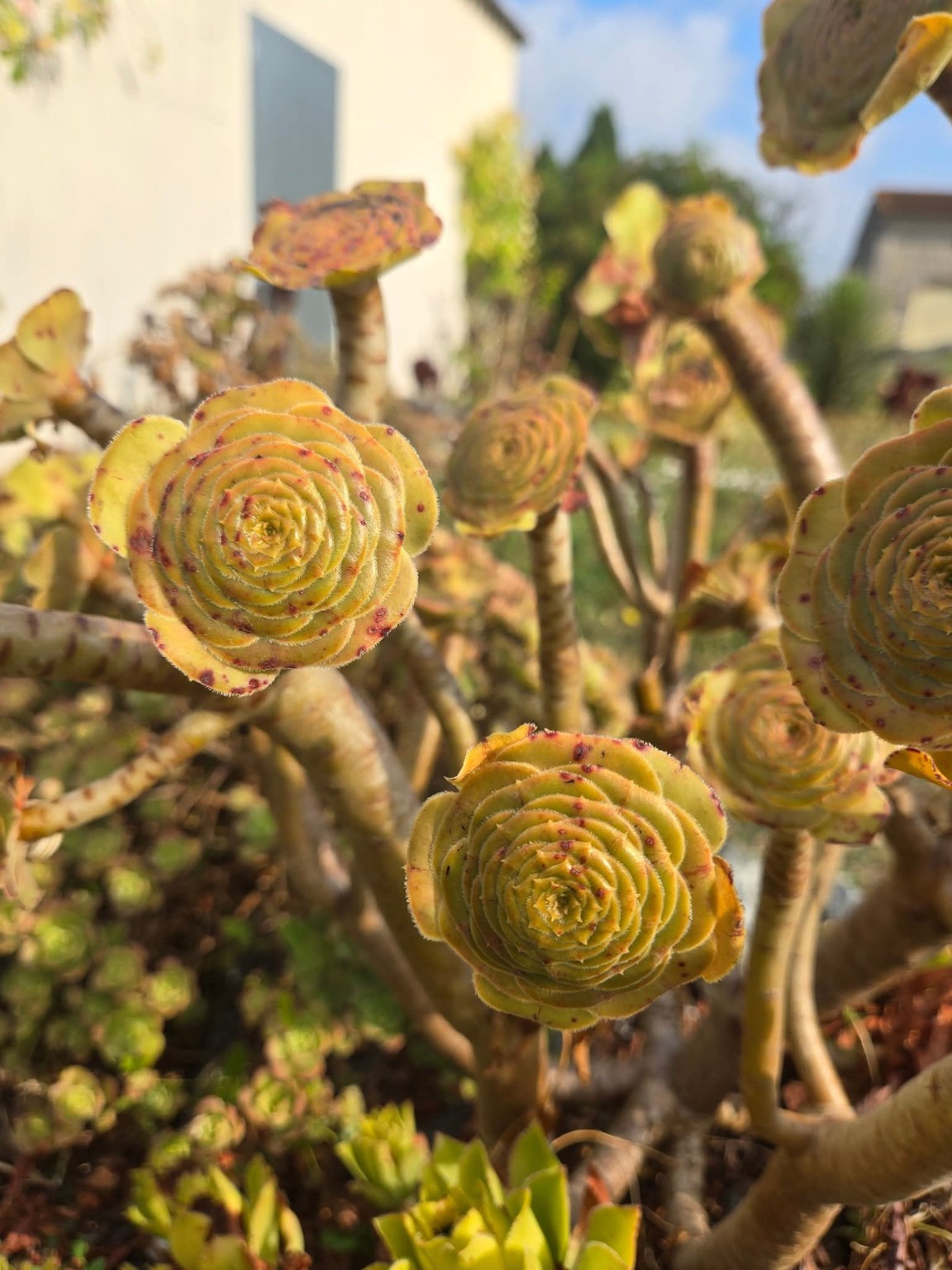
Aeonium arboreum subsp. holochrysum forms a branching succulent shrub with woody stems crowned by green rosettes. Widespread on the rocky slopes of the western Canary Islands, it is distinguished by its profuse golden-yellow flower heads and hairless floral sepals.
- Accepted name
- Aeonium arboreum subsp. holochrysum
- Type
- Botanical subspecies
- Synonyms and other names
- Holochrysum · Aeonium arboreum var. holochrysum · Aeonium holochrysum · Aeonium vestitum
- Natural origin
- Canary Islands (Spain)
- Documented parents
- Aeonium arboreum
- Earliest documented Aeonium name
- 1840
- Habit
- Tree-like
- Branching
- Branching, with basal offsets
- Characteristic flowering
- 7–30 cm inflorescences; yellow flowers
- Botanical section
- Aeonium
- Other names
- Holochrysum · Aeonium arboreum subsp. holochrysum · Aeonium arboreum var. holochrysum · Aeonium holochrysum · Aeonium vestitum
- Genus
- Aeonium
- Country of origin
- Spain
Family tree
Reserved for Premium members
Origin and history
Aeonium arboreum subsp. holochrysum is endemic to the western Canary Islands, occurring on Tenerife, La Palma, El Hierro and, more rarely, La Gomera. It inhabits rocky slopes, cliffs and stony banks, from near sea level to almost 1,600 m on Tenerife. On La Palma it is chiefly recorded up to around 1,000 m, while on El Hierro it is particularly associated with northern slopes. It belongs to botanical section Aeonium.
Its nomenclatural history is unusual. Webb and Berthelot published the name Aeonium holochrysum in the nineteenth century, but examination of historical specimens showed that the original plants, with hairy calyces, did not precisely match those subsequently identified under that name. To stabilise the identity of the hairless-sepalled taxon, Ho-Yih Liu published Aeonium arboreum var. holochrysum in 1989. Ángel Bañares established its present subspecies rank in a botanical revision published in 2008. The name is now accepted by Kew.
The epithet holochrysum comes from Greek and means “entirely golden”, referring to the brilliant flowers. Several historical names, including Aeonium vestitum, appear in its synonymy. Red-striped populations on La Gomera have also been studied under the name rubrolineatum; how these plants are delimited within the wider group is a separate taxonomic question.
Chronological milestones
1835 — An earlier name under Sempervivum is cited, with nomenclatural reservations.
1840 — Publication of Aeonium holochrysum.
1950 — Aeonium rubrolineatum appears in the synonymy of some treatments.
1960 — Aeonium vestitum is also cited.
1989 — Treatments as a subspecies and a variety of Aeonium arboreum.
Botanical description
Habit and rosettes
This subspecies grows as a perennial succulent subshrub with stout, gradually woody stems that may reach about one metre tall. Upright or ascending branches divide to carry several terminal rosettes. As the plant ages, its bark turns grey-brown and retains marks left by fallen leaves, giving it a small, tree-like silhouette.
The rosettes are usually around 10–20 cm across and spread fairly widely during active growth. Their overlapping leaves form concentric layers around a tighter centre, while smaller secondary rosettes fill out the crown. In the dry summer season, the rosettes may become more compact and shed some of their outer leaves.
Foliage and colour
The fleshy leaves are oblanceolate to spoon-shaped, tapering to a wedge-shaped base and widening towards a rounded or shortly pointed tip. They measure approximately 5–15 cm long and 1.5–4.5 cm wide. Their smooth, hairless surfaces are usually fresh green to yellowish green, with fine, curved cilia along the margins.
Leaves may develop bronze tones or a few lengthwise reddish-brown streaks, especially in some populations and in stronger light. These natural pigments are not true variegation. Overall, the rosettes remain predominantly green, unlike the very dark purple cultivars associated with the broader Aeonium arboreum group.
Flowering
Flowering produces a dense, terminal, ovoid to cone-shaped inflorescence about 7–30 cm long. Numerous star-shaped flowers, bright to golden yellow, generally have nine to eleven petals. The flower stalklets become almost hairless, while the sepals are hairless throughout: the latter is an important character for distinguishing this subspecies from related forms of Aeonium arboreum and Aeonium korneliuslemsii.
In the Canary Islands, flowering takes place chiefly during the cooler months and into spring. The rosette that blooms completes its cycle, but other branches survive and keep growing, allowing the shrub to renew itself.
Flowering photographs

Photographs
Do you grow this cultivar? Help document its shapes and seasonal colours. Share your photographs on the Forum.
Documented descendants of ‘arboreum subsp. holochrysum’
Reserved for Premium members
Growing conditions
☀️ Light
Provide abundant light, acclimatising previously sheltered plants gradually.
💧 Watering
Water during active growth, then allow drying between applications. Reduce frequency in the summer slowdown.
🪨 Potting mix
Use a stable pot and free-draining medium to support developing stems.
🌡️ Temperatures
Protect pot-grown plants from frost and prolonged cold rain.


