
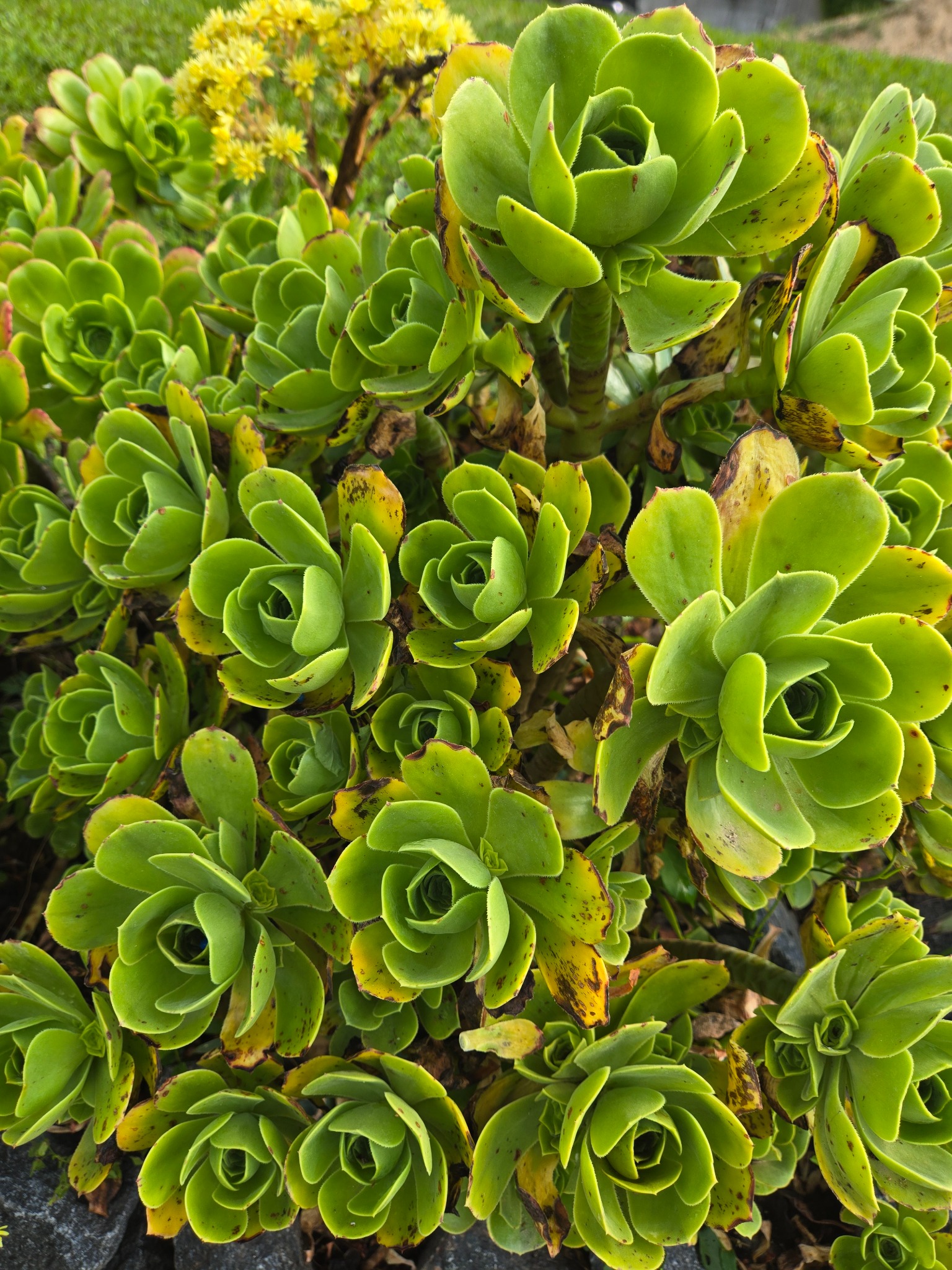
On the volcanic rocks of Lanzarote, Aeonium balsamiferum forms a small shrub with thick branches crowned by grey-green rosettes. Its slightly sticky leaves release a resinous, balsam-like scent, particularly in warm weather, while its yellow flowers are remarkably seldom seen.
- Accepted name
- Aeonium balsamiferum
- Type
- Botanical species
- Natural distribution
- Lanzarote and Fuerteventura (Canary Islands)
- Habit
- Sparsely branching shrub
- Described height
- Up to 1.5 m
- Rosette diameter
- 7–18 cm
- Botanical section
- Aeonium
- Genus
- Aeonium
- Country of origin
- Spain
- Plant height
- Up to 150 cm
- Branching
- Sparsely branching
Origin and history
Aeonium balsamiferum, known in the Canary Islands as “bejeque farrobo” or “farroba”, is native to Lanzarote. Its natural populations are concentrated in the north and centre of the island, including the Famara cliffs, the Haría and Bosquecillo area, and volcanic slopes around Caldera Quemada and Montaña de los Rostros. It grows in rocky crevices and on old lava fields, where a thin layer of accumulated soil and moisture carried by the winds allow it to establish.
Philip Barker Webb and Sabin Berthelot published the name in 1840 in their Histoire naturelle des îles Canaries. The epithet balsamiferum means “bearing balsam” and refers to the plant’s aromatic, resinous substance. Island inhabitants were familiar with this feature. A longstanding local tradition holds that fishermen used the sticky material to coat and strengthen their lines or nets, a practice associated with the vernacular name farroba.
The presence of Aeonium balsamiferum on Fuerteventura has a different history: the species was introduced there long ago and became naturalised, especially near villages, gardens and former cultivated land. Although it now occurs on both eastern Canary Islands, its original native range is Lanzarote. Botanically, it belongs to section Aeonium, among the shrubby members of the genus.
Despite its ability to grow into an attractive shrub, the species has a restricted natural distribution. It is assessed as Vulnerable on the IUCN Red List and is legally protected. Its irregular flowering, fragmented populations and the sensitivity of some habitats make the conservation of wild plants and responsible propagation from cultivated material particularly important.
Chronological milestones
1840 — Webb and Berthelot publish the name Aeonium balsamiferum in their natural history of the Canary Islands.
Botanical description
Habit and branching
Aeonium balsamiferum is an upright to ascending perennial succulent subshrub. It commonly grows to around one metre and may reach 1.5 m in favourable conditions. Its branches are 8–20 mm thick, fleshy at first and gradually woody, smooth, hairless and without the fine reticulated markings seen on some other Aeoniums. Branches may be quite widely spaced, although well-grown specimens can develop a rounded, balanced crown with several rosettes at their tips.
The rosettes, 7–18 cm across, are relatively small compared with the size of the shrub. They form shallow, open cups around a characteristically flattened centre, where the young leaves are tightly overlapping. This creates a neatly arranged central pattern that contrasts with the more widely spread outer foliage.
Foliage and balsam scent
The fleshy leaves are obovate to spoon-shaped, narrowing towards their base and broadening into a rounded tip with a minute point, known as a mucro. They measure about 3–7 cm long, 1.5–3.5 cm wide and 1.5–3 mm thick. Their colour ranges from soft green to grey-green, sometimes with yellowish or brownish tones. A few darker lines may follow parts of the leaf margins.
The blade is generally hairless or very finely pubescent, with a slightly glossy or velvety surface. Small curved cilia, 0.5–1 mm long, line the leaf margins. Leaves and young tissues can feel slightly sticky. This secretion accompanies an aromatic scent reminiscent of balsam or resin, often more noticeable in warm weather; the scent need not be equally strong throughout the year.
Seasonal changes
During active growth, the rosettes open, spreading their green leaves into fairly broad layers. As summer heat and drought arrive, some outer leaves yellow, dry and fall away. The youngest inner leaves then overlap closely, folding together into a compact cluster that protects the developing tissues.
This seasonal change is particularly noticeable on Lanzarote, where it helps distinguish Aeonium balsamiferum from neighbouring species such as Aeonium lancerottense. With the return of cooler weather and sufficient moisture, new growth resumes and the rosettes open again.
Flowering and natural reproduction
Have you photographed this cultivar in bloom? Share flowering photographs on the Forum.
Flowering is one of the species’ most notable features because it happens so infrequently. When a mature rosette flowers, it produces a dense, terminal, ovoid to broadly rounded inflorescence about 15–25 cm high and 14–20 cm wide. It is supported by an 8–15 cm stalk and divides into smooth, slightly sticky branches bearing many flowers on short pedicels.
The star-shaped flowers are bright yellow and generally have seven to nine petals, often nine. The petals are narrow, lance-shaped and pointed, 6–8 mm long. On Lanzarote, flowering takes place mainly in May and June, but is highly irregular: one population may flower while others only a short distance away show no blossoms at all that year.
The rosette that flowers completes its life cycle, while the remaining branches continue growing. Seeds are produced, but relatively few seedlings have been recorded in studied wild populations. Vegetative reproduction also plays an important role: broken shoots may take root, and botanist Marco Cristini even observed small adventitious rosettes developing on old inflorescences at Montaña de los Rostros.
Photographs
Do you grow this cultivar? Help document its shapes and seasonal colours. Share your photographs on the Forum.
Growing conditions
☀️ Light
Bright conditions suit this species of dry habitats; introduce direct sun gradually after winter.
💧 Watering
Water in active growth, allowing the mix to dry before the next application. Reduce watering considerably during rest.
🪨 Potting mix
Use a mineral-rich, freely draining medium in a stable container with drainage holes.
🌡️ Temperatures
Keep sheltered from frost and prolonged cold dampness.


