
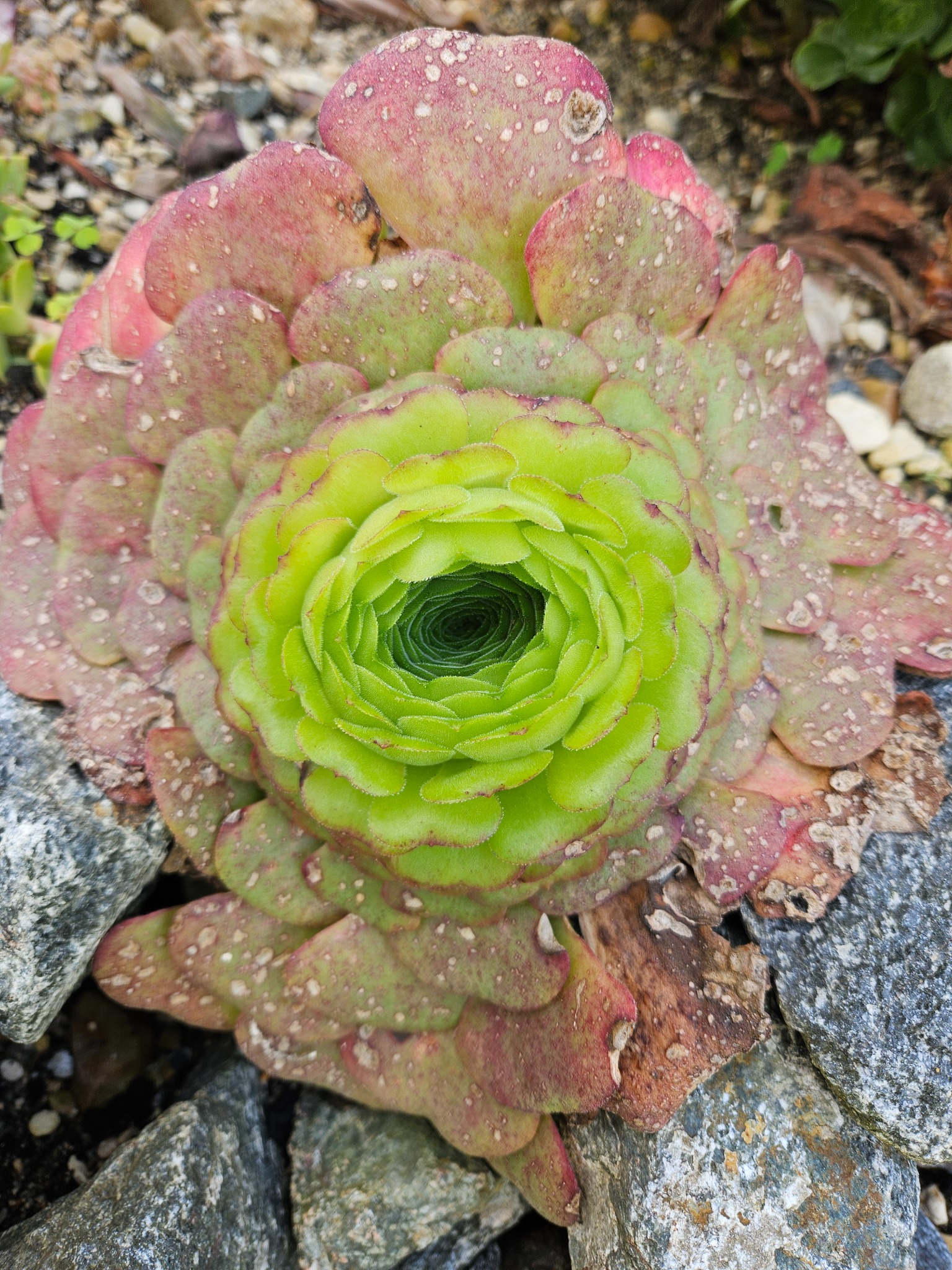
On the cliffs of Madeira, Aeonium glandulosum spreads its broad, almost plate-like rosettes, with outer leaves sometimes turning pink or red. Its finely downy foliage and tiny bead-tipped marginal hairs are distinctive, while the rosette itself can curl into a remarkable tight spiral.
- Accepted name
- Aeonium glandulosum
- Type
- Botanical taxon
- Natural origin
- Madeira (Portugal)
- Habit
- Flattened rosette
- Branching
- Occasional offsets
- Documented height
- 10–20 cm
- Rosette diameter
- 12–40 cm
- Botanical section
- Patinaria
- Genus
- Aeonium
- Country of origin
- Portugal
Origin and history
Aeonium glandulosum, known in Madeira as ensaião or ensaião de pasta, is endemic to the Madeira archipelago. It grows mainly on cliffs, steep rocky slopes and rock faces, often rooted in crevices containing only a small amount of soil. Particularly widespread along northern Madeira, including the Faial, Porto da Cruz and São Vicente areas, it also occurs on Porto Santo, Deserta Grande and Búgio. Its natural range extends from coastal habitats to elevations of approximately 1,500 m.
Large rosettes often grow on almost vertical rock faces, where water can drain readily and the plants benefit from atmospheric moisture. Although northern cliffs are its most characteristic habitat, botanical field observations have also recorded it in more sheltered locations in southern Madeira. This range of conditions helps explain the considerable differences in rosette shape and colour seen among wild plants.
William Aiton first described the species as Sempervivum glandulosum in the Hortus Kewensis in 1789. Philip Barker Webb and Sabin Berthelot transferred it to the genus Aeonium in 1840. Historical names such as Sempervivum patina and Aeonium meyerheimii are now treated as synonyms. Aeonium glandulosum is the sole member of botanical section Patinaria, a distinctive lineage within Madeira’s succulent flora. The name is accepted by Plants of the World Online.
Chronological milestones
1789 — Historical references attribute the name Sempervivum glandulosum to Aiton, the basis of the botanical name used today.
1840 — Webb and Berthelot are reported to have retained Aiton's epithet glandulosum in Aeonium.
Botanical description
Habit, stem and offsets
Aeonium glandulosum is a biennial to perennial succulent, usually consisting of a single large rosette on a very short, stout and smooth stem. The stem is often barely visible, making the rosette appear to grow directly from the rock. Unlike shrubby Aeoniums, it does not normally form a network of long branches. It can, however, produce a few lateral offsets close to the main rosette, sometimes creating a small group of rosettes of different sizes.
The rosette generally measures 12–40 cm across. Depending on age, exposure and moisture, it can spread almost flat like a disc or develop a regular, shallow cup. With its many closely overlapping leaves, this broad, fairly symmetrical rosette gives the species its characteristic outline.
Foliage and distinguishing features
Leaves are fleshy, obovate to oblanceolate, narrowing to a wedge-shaped base and ending in a short, pointed tip, often with a minute mucro. The botanical reference description records leaves 6–11 cm long, 3–8 cm wide and 3–5 mm thick. Their broad shape and concentric overlapping arrangement give the rosette the appearance of a large flower made entirely of foliage.
The leaf blades are finely pubescent, with a covering of very short hairs giving them a softly textured, slightly matte surface. Along the margins are tiny cilia approximately 0.6 mm long, with rounded tips resembling beads or minute droplets. This unusual fringe is a valuable identification feature when examined closely. It also helps distinguish Aeonium glandulosum from other species with exceptionally flat rosettes, such as Aeonium tabuliforme, which can look similar at first glance.
Colour and seasonal transformations
Young leaves are usually pale to fresh green, while older leaves may develop powder-pink, orange, red or purple tones. On some plants the centre remains bright green as the outer leaves turn almost entirely pink; other rosettes stay much more uniformly green. Even plants growing only a few metres apart can show striking differences. These shades reflect leaf age and light conditions rather than true variegation.
Rosette shape also changes over time. In some growth phases, the leaves spread widely to form a shallow plate; when they rise and overlap more closely, they produce a cup, sometimes narrowing into a tight spiral around the centre. This closure is particularly noticeable in young plants and during periods of heat or drought. In the wild, however, flat and cup-shaped rosettes may occur side by side during the same season: these changes do not follow an identical timetable in every plant.
Flowering
Have you photographed this cultivar in bloom? Share flowering photographs on the Forum.
At maturity, the centre of the rosette may produce a strongly branched terminal inflorescence, with a flowering head often much wider than it is tall. It measures approximately 8–25 cm high and 12–40 cm wide, supported by a leafy stalk 2–10 cm long. The flowering branches and their pedicels, 3–18 mm long, are finely glandular-hairy.
The star-shaped flowers form clusters at the ends of the branches. Their petals are a luminous pale yellow, sometimes contrasted by reddish tones on the buds and outer floral parts. There are generally 8–13 pointed, lance-shaped petals, each 7–11 mm long and 3–4 mm wide. The entire inflorescence creates a yellow crown above the green or pink foliage. In Madeira, flowering occurs mainly from late spring through summer, with considerable variation between years and locations.
The flowering rosette is monocarpic: after fruits and seeds mature, it completes its life cycle. If offsets have already formed, these can continue growing; solitary plants are renewed chiefly through seedlings. Thus, in its native habitat, the species may appear either as an isolated disc or as a small group of neighbouring rosettes of different ages.
Photographs
Do you grow this cultivar? Help document its shapes and seasonal colours. Share your photographs on the Forum.
Winter photographs

Documented descendants of ‘glandulosum’
Reserved for Premium members
Growing conditions
☀️ Light
Ample light favours a well-shaped rosette; acclimatise gradually to direct sun after shade.
💧 Watering
Water as growth resumes and allow the mix to dry between applications. Reduce watering during slower growth.
🪨 Potting mix
Use a sufficiently broad pot and a draining mix to accommodate a rosette that can exceed 30 cm.
🌡️ Temperatures
Avoid frost and cold, stagnant moisture within the centre of the rosette.
Help us enrich this profile
An observation, a correction or photographs? Share your knowledge with us.


