
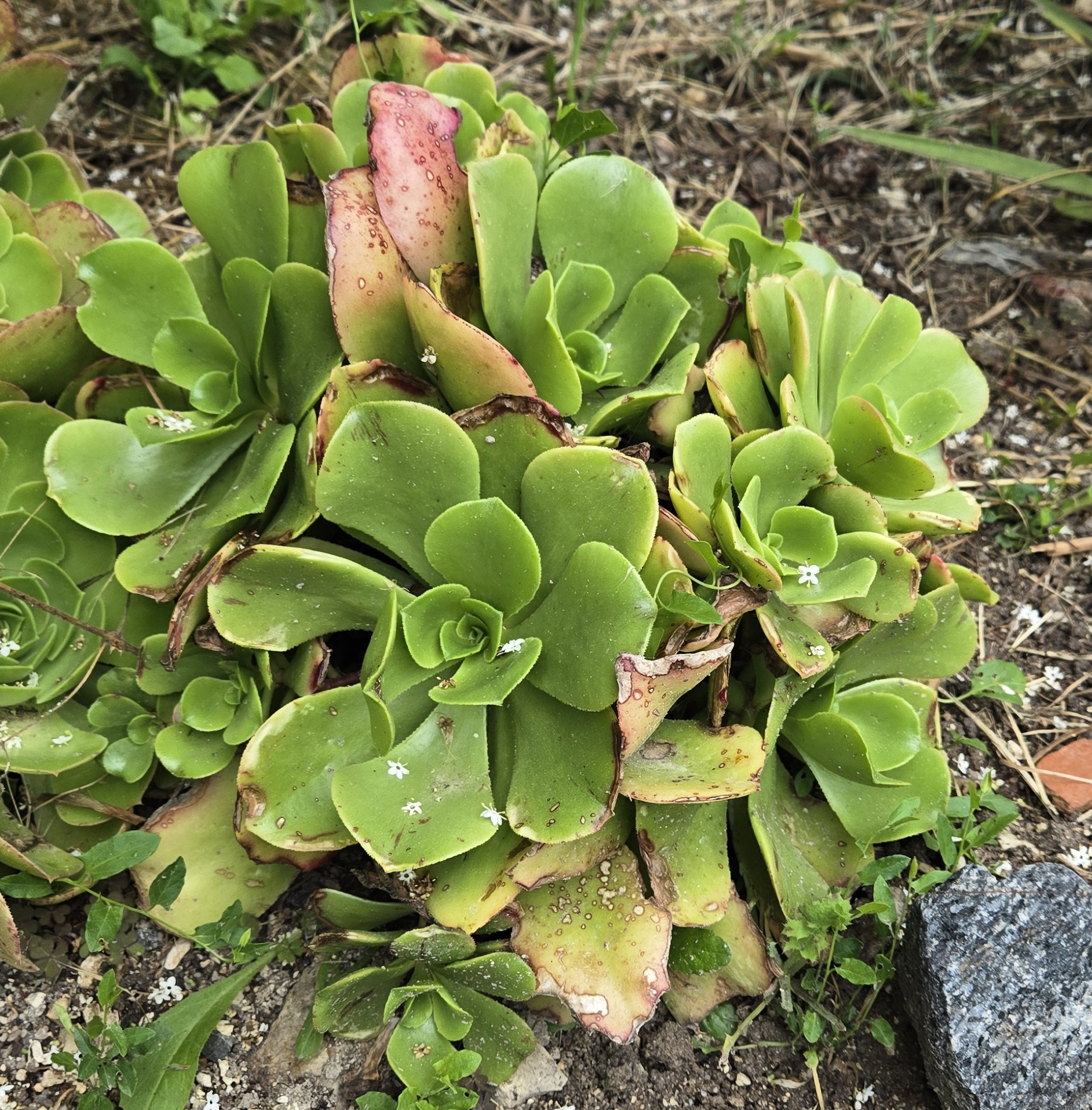
Endemic to Madeira, Aeonium glutinosum forms clusters of green rosettes on remarkably sticky stems. Its growth habit ranges from almost creeping to a small upright shrub, while its finely striped leaves and golden-yellow flowers make it easy to recognise.
- Accepted name
- Aeonium glutinosum
- Type
- Botanical species
- Natural distribution
- Madeira, Portugal
- Habit
- Clump to small branching shrub
- Rosette diameter
- 12–22 cm
- Botanical section
- Pittonium
- Genus
- Aeonium
- Country of origin
- Portugal
- Branching
- Branching
Origin and history
Aeonium glutinosum is endemic to the Madeira archipelago, where it grows on rocky slopes, cliffs, stony banks and sometimes old stone walls. Widespread on the main island, it also occurs more rarely elsewhere in the archipelago. Its stems may spread across rocks or, in other conditions, grow upwards to form a small shrub.
William Aiton first described the species as Sempervivum glutinosum in the Hortus Kewensis in 1789. Webb and Berthelot transferred it to the genus Aeonium in 1840. The Latin epithet glutinosum, meaning “sticky” or “glutinous”, refers directly to the plant’s viscous surfaces, particularly noticeable on its stems and inflorescences.
In Madeira the species is known as farrobo, ensaião or saião. Local fishermen once used its adhesive sap to coat fishing lines and help protect them from water. This traditional use links the plant to Madeiran history as well as to the islands’ distinctive succulent flora.
Chronological milestones
1789 — Aiton publishes the name Sempervivum glutinosum in Hortus Kewensis, more than fifty years before its transfer to Aeonium.
1840 — Webb and Berthelot retain Aiton's epithet glutinosum when they transfer the plant to Aeonium.
Botanical description
Habit and branching
Aeonium glutinosum is a perennial, generally well-branched succulent subshrub. It most often forms a clump around 30–60 cm high, although plants in sheltered locations can grow taller. The stems, approximately 7–20 mm thick, may be erect, ascending or spreading along the ground. On cliffs, some plants remain almost stemless, while those on more open ground can resemble a small shrub with several terminal rosettes.
The stem surface is smooth, shiny and strongly sticky. Dust, soil particles and fragments of plant debris readily adhere to it, sometimes making the older branches appear very dark or almost black. This unusual feature is one of the most distinctive ways to recognise the species.
Rosettes and foliage
Branch tips carry relatively open rosettes, usually 12–22 cm across. The leaves form a loose cup around the growing point. They are fleshy, obovate to spoon-shaped, narrowed towards the base and pointed at the tip. They typically measure 7–12 cm long and 3–5.5 cm wide, with a thickness of about 2–4.5 mm. Their slightly wavy margins bear fine, straight or curved cilia.
The foliage ranges from light to deep green, sometimes with yellowish tones, and has a smooth, glossy surface. Fine darker-green or brownish stripes often run along the central part of the leaf and towards the tip. The leaves are slightly sticky, especially when young. Together, the delicate markings, glossy surface and open rosettes allow Aeonium glutinosum to be recognised even when it is not in flower.
Flowering
Have you photographed this cultivar in bloom? Share flowering photographs on the Forum.
Flowering produces a large, loosely branched and spreading panicle on a distinctly sticky flowering stem. Depending on the size of the plant, the inflorescence can rise 15–60 cm above the rosette. Its star-shaped flowers are carried in clusters on the side branches and are bright golden yellow. They usually have 8–11 petals, often with delicate reddish veins on their undersides, especially noticeable when viewed from the side.
On Madeira, flowering takes place mainly from spring into summer and can sometimes continue into early autumn. As in other branched Aeoniums, the rosette that has flowered completes its life cycle, while the remaining rosettes on the same plant continue growing. The shrub therefore survives and may flower again from other branches in later years.
Photographs
Do you grow this cultivar? Help document its shapes and seasonal colours. Share your photographs on the Forum.
Documented descendants of ‘glutinosum’
Reserved for Premium members
Growing conditions
☀️ Light
Provide bright light, acclimatising leaves gradually to very strong direct sun.
💧 Watering
Water during active growth and allow the mix to dry adequately before watering again.
🪨 Potting mix
Use an airy, freely draining medium and allow airflow around the glandular stems.
🌡️ Temperatures
Protect from frost and persistent cold rain, especially in containers.


