
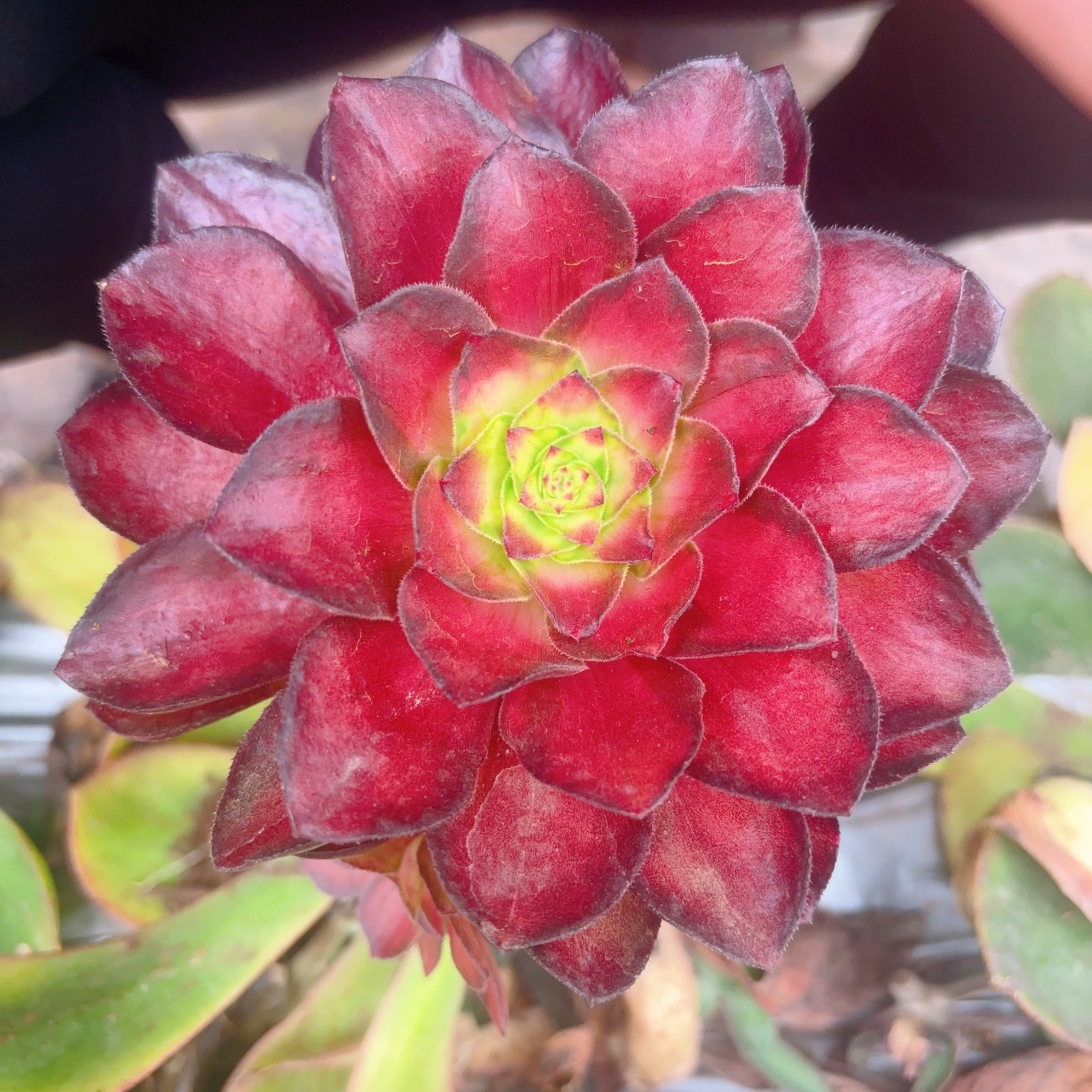
‘Koi’, or 锦鲤 (Jǐnlǐ), stands out for its luminous yellow-green rosette centre surrounded by rich burgundy-red foliage. This Chinese mutation of ‘Qingcheng’ displays broad central variegation, known as 宽中斑锦 (Kuān zhōngbān jǐn).
- Accepted name
- Aeonium ‘Koi’
- Type
- Variegated cultivar
- Other names
- Koi Fish · 锦鲤
- Horticultural origin
- China
- Probable mutation of
- Aeonium ‘Qingcheng’
- Genus
- Aeonium
- Origin type
- Mutation
- Country of origin
- China
Family tree
Reserved for Premium members
Origin and history
Also distributed as ‘Koi Fish’, the cultivar bears the Chinese name 锦鲤 (Jǐnlǐ), meaning koi carp. Its history belongs to the broader ‘Madeira Rose’ horticultural lineage: ‘Koi’ is a mutation of ‘Qingcheng’ (倾城), a relationship reported by the Chinese growers who introduced the selection.
‘Qingcheng’ already represented a variegated form in this family. ‘Koi’ illustrates a further transformation of the leaf pattern, with the lighter tissue spreading across a broad area down the middle of the leaves. It is an example of how an already variegated Aeonium can produce another mutation with a strikingly different appearance.
Introduced among new Chinese selections circulating in 2026, ‘Koi’ is distinctive both for its central variegation and for the rich red tones of its rosettes.
Chronological milestones
2026 — The commercial release of ‘Koi’ is tentatively dated to 2026; it is likely to have arisen as a mutation of ‘Qingcheng’.
Botanical description
Habit and foliage
‘Koi’ forms compact rosettes of fleshy, spoon-shaped leaves that broaden towards their tips and end in a small point. The overlapping leaves form a dense, neatly arranged rosette. Mature foliage can develop rich carmine, garnet and burgundy-red shades, sometimes with purplish undertones.
At the heart of the rosette, younger leaves contrast with these darker tones through a bright yellow-green central area. This meeting of a luminous centre and darker outer foliage gives ‘Koi’ its distinctive appearance.
Broad central variegation: 宽中斑锦
The variegation pattern of ‘Koi’ belongs to the Chinese category 宽中斑锦 — Kuān zhōngbān jǐn, meaning “broad central variegation”. The lighter zone extends along the middle of the leaf blade, while more strongly pigmented tissue remains towards its sides. Unlike marginally variegated forms, the lighter area here occupies much of the leaf’s width.
This same pattern can be seen in ‘Shao Hua’, ‘Tong Yan’ and ‘Chiyan’. Each has its own colours and horticultural history, but all exemplify the broad central variegation that has become especially prominent among modern Chinese Aeonium selections.
Colour and seasonal changes
The strength of the red pigmentation changes with light, temperature and growth conditions. In bright light, older leaves may deepen to dark burgundy, while younger leaves retain a clear yellow to tender-green centre. When the rosette is intensely coloured, red pigments can make the central pattern less apparent on the outer leaves, although it remains conspicuous in the growing centre.
The contrast between dark mature foliage and luminous young leaves gives ‘Koi’ its changing, particularly dramatic appearance when the rosette is compact and richly coloured.
Flowering
Have you photographed this cultivar in bloom? Share flowering photographs on the Forum.
Flowering has not yet been documented.
Photographs
Do you grow this cultivar? Help document its shapes and seasonal colours. Share your photographs on the Forum.
Growing conditions
☀️ Light
Provide ample light while gradually acclimatising pale leaf sections to direct sun.
💧 Watering
Water as growth resumes, then let the mix dry sufficiently; reduce watering in the summer resting period.
🪨 Potting mix
Use a porous, well-drained medium and check that variegated cuttings establish a healthy root system.
🌡️ Temperatures
Keep frost-free. Watch for completely green branches before selecting shoots for propagation.


