
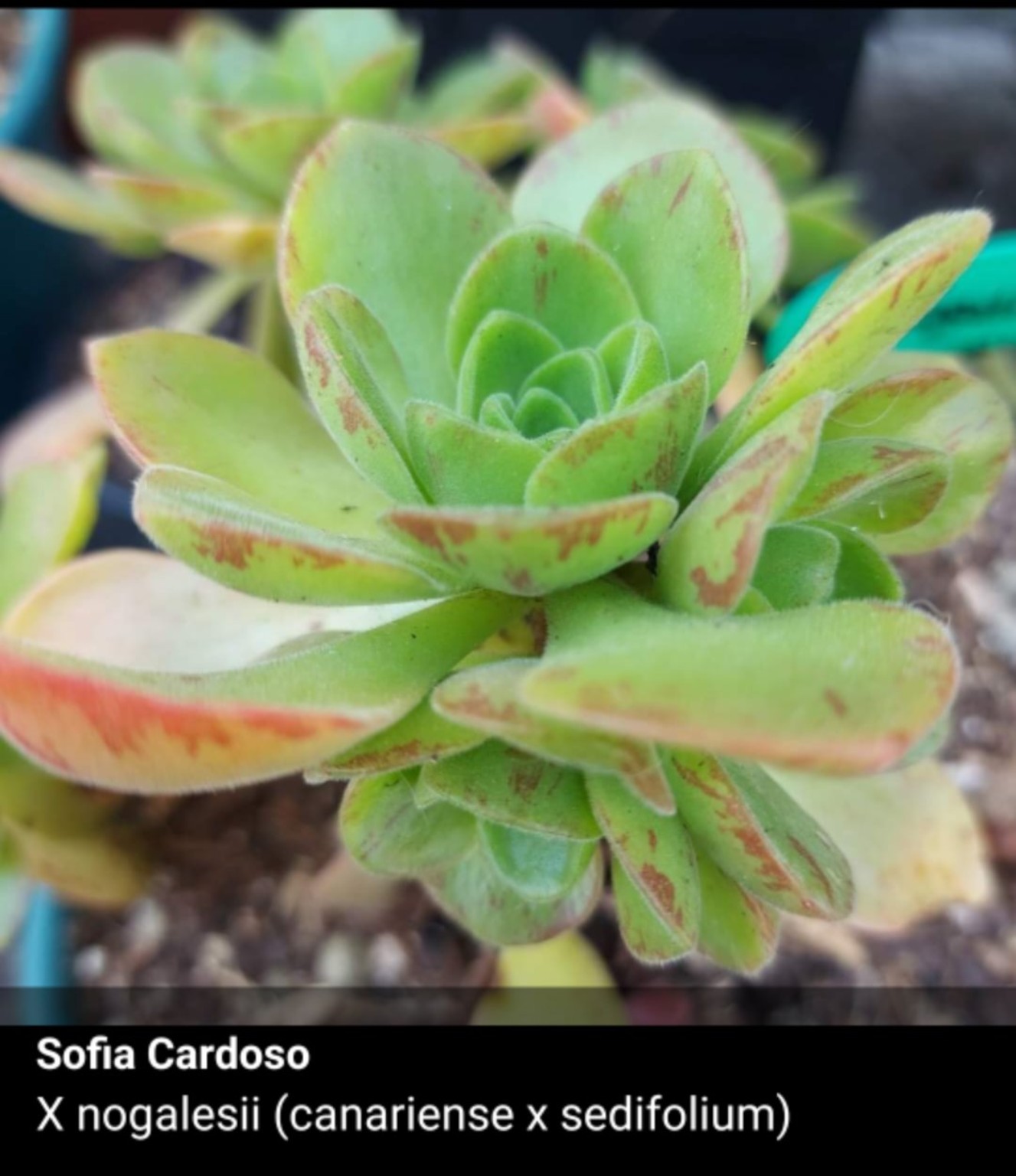
Aeonium × nogalesii is a natural hybrid discovered on La Palma, notable for its densely branched, compact habit and thick, finely hairy, sticky leaves with delicate reddish markings. It combines the glandular foliage of Aeonium sedifolium with features inherited from the La Palma form of Aeonium canariense.
- Accepted name
- Aeonium × nogalesii
- Type
- Botanical hybrid
- Natural origin
- La Palma, Canary Islands (Spain)
- Reported botanical parents
- Aeonium canariense subsp. christii × Aeonium sedifolium
- Habit
- Small, densely branched shrub
- Foliage
- Glandular hairs, sticky stems
- Genus
- Aeonium
Family tree
Reserved for Premium members
Origin and history
Botanist Ángel Bañares described Aeonium × nogalesii in 1986 in the journal Vieraea, based on plants discovered at El Time in western La Palma. The type material had been collected in July 1980 by Ángel Bañares and Manuel Nogales; the holotype is preserved in the TFC herbarium as specimen 19938. The hybrid was named in honour of Manuel Nogales Hidalgo, who took part in its discovery.
This natural hybrid originated from Aeonium sedifolium and the plant then known to Bañares as Aeonium palmense, now included within Aeonium canariense subsp. christii. It was observed growing alongside both parent species. Its appearance strongly recalls Aeonium sedifolium, but the rosettes are larger and the leaves are densely pubescent.
A second form was described on Tenerife by Bañares and Macarrón as Aeonium × nogalesii nothovar. dasyphyllum (effectively published in 1997). Found in the Barranco de Masca, it originates from Aeonium canariense subsp. canariense and Aeonium sedifolium. This densely glandular-leaved form belongs to the same hybrid complex but differs from the nominal La Palma form in its locality and canariense parent.
Chronological milestones
1986 — Mottram records Bañares's 1986 publication of Aeonium × nogalesii in Crassulacea.
Botanical description
Habit and branching
In the original description, Aeonium × nogalesii forms a small, rounded subshrub about 20–25 cm tall. It develops numerous slender, often twisting and closely spaced branches, creating a compact, bushy silhouette. Secondary branches are generally 3–5 mm across. Older stems are very dark, almost black, and tomentose, while younger growth is lighter brown, sticky, and marked with the scars of fallen leaves.
The branch tips carry deep-green rosettes noticeably larger than those of Aeonium sedifolium. Their close arrangement and glandular texture give the plant a distinctive appearance, between the small, bushy habit of sedifolium and the more developed foliage of its other parent.
Foliage and colour
The leaves are sessile, linear to spoon-shaped, slightly broader towards the tip and ending in a small point. Bañares described them as 2.5–3 cm long, sometimes reaching 4 cm, by 1–1.5 cm wide and 4–6 mm thick. Their fleshy substance contrasts with the slender branches carrying the rosettes.
The leaf surface is densely covered with tiny glandular hairs, giving it a sticky feel and a subtly velvety appearance. The bright to deep-green blades bear fine reddish marks and short streaks, particularly towards their tips. Pink to reddish-brown tones may also highlight the margins, increasing the contrast with the green centre of the rosettes. This colour pattern and the leaf pubescence are among the hybrid’s most recognisable features.
Flowering
Have you photographed this cultivar in bloom? Share flowering photographs on the Forum.
In the original account, Ángel Bañares noted that no flowers had been observed during five years of monitoring. Floral characters were therefore not established in the 1986 protologue. The botanical identification rests primarily on the plant’s habit, branching, rosettes and distinctive glandular, streaked foliage.
Photographs
Do you grow this cultivar? Help document its shapes and seasonal colours. Share your photographs on the Forum.
Growing conditions
☀️ Light
Give bright light and acclimatise the small rosettes gradually to direct sun.
💧 Watering
Water during growth, allowing the medium to dry between applications; reduce watering during summer rest.
🪨 Potting mix
A porous, free-draining mix prevents persistent moisture around crowded branches.
🌡️ Temperatures
Shelter from frost and prolonged cold dampness, with good airflow through the foliage.


