
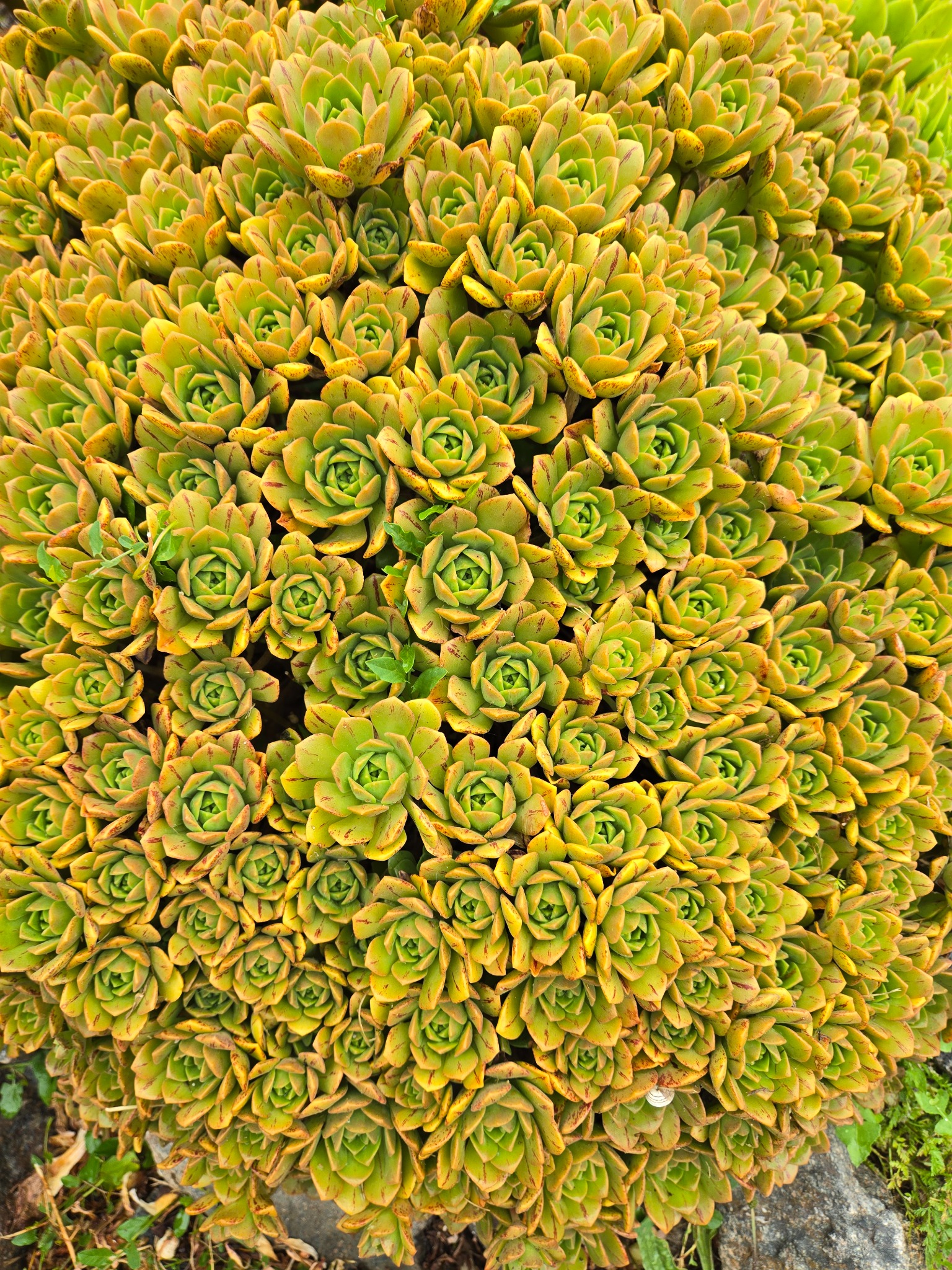
With its tiny fleshy rosettes, sticky leaves marked by reddish-brown streaks and naturally compact habit, Aeonium × occidentale resembles a more robust Aeonium sedifolium. This natural hybrid from La Palma comes from Aeonium goochiae and Aeonium sedifolium.
- Accepted name
- Aeonium × occidentale
- Type
- Botanical hybrid
- Natural occurrence
- La Palma, Canary Islands (observed in the wild)
- Botanical parents
- Aeonium goochiae × Aeonium sedifolium
- Habit
- Small branching shrub
- Cultivated height
- 10–20 cm
- Rosette diameter
- Up to 4 cm
- Genus
- Aeonium
- Branching
- Branching
Family tree
Reserved for Premium members
Origin and history
Aeonium × occidentale is a natural hybrid from La Palma in the Canary Islands, arising from Aeonium goochiae and Aeonium sedifolium. It has been recorded in the western part of the island, notably at El Time, where Ángel Bañares and Manuel Nogales collected the specimen that would become its botanical type in March 1980. The holotype is preserved at the TFC herbarium under number 19.936.
The cross was reported in 1983 by Arnoldo Santos-Guerra in his study of the vegetation and flora of La Palma, together with illustrations of the plant. Ángel Bañares subsequently used the name Aeonium × occidentalis in 1990, but that publication did not meet the nomenclatural requirements for valid publication. He validly published Aeonium × occidentale in October 2007 in Vieraea. The epithet occidentale refers to the western part of La Palma, where the hybrid was collected.
Both parents leave their mark on the plant’s appearance. From Aeonium sedifolium it inherits a low, compact habit, branches that become woody readily, small rosettes and dark leaf markings. The influence of Aeonium goochiae can be seen in the distinctly broader leaves and much paler flowers. The resulting hybrid has its own distinctive silhouette, also recognised by growers familiar with the plant.
Chronological milestones
2007 — Historical references attribute the name Aeonium × occidentale to Bañares.
Botanical description
Habit and branching
Aeonium × occidentale forms a small, densely branched succulent subshrub. Its stems, approximately 3–5 mm in diameter in the original description, readily become woody and bear numerous terminal rosettes. In cultivation it often reaches around 10–20 cm in height, developing a fairly regular crown of branches that resembles a miniature bonsai. Its compact outline closely recalls Aeonium sedifolium, but the plant is more robust.
The rosettes are small, reaching about 4 cm across. Arranged at the tips of short or slightly spreading branches, they give mature plants a neat, bushy and balanced appearance.
Foliage and colour
The leaves are thick and distinctly succulent, with an oblanceolate shape: narrow at the base and broadening towards a rounded tip. Ángel Bañares described them as 2–3 cm long, around 1 cm wide and 4–5 mm thick. They are therefore larger and broader than the leaves of a typical Aeonium sedifolium, contributing to the hybrid’s sturdier appearance.
The leaf surface is densely covered with very fine glandular hairs, giving it a sticky feel and a slightly downy texture. The green background can turn yellow-green to golden under stronger light, with reddish spots and sometimes conspicuous reddish-brown streaks. These dark markings recall those of Aeonium sedifolium, but are especially noticeable on the broader leaves, often highlighted by spring sunshine.
Flowering
Have you photographed this cultivar in bloom? Share flowering photographs on the Forum.
The inflorescence is relatively loose and almost flat-topped, with small flowers arranged along several branches. In the original description, Bañares recorded an inflorescence with approximately 45 flowers, its branches and calyces covered in fine glandular hairs.
The flowers usually have seven or eight creamy-white to yellowish-white petals, much paler than the yellow flowers of Aeonium sedifolium. This colour reflects the influence of Aeonium goochiae. Flowering is uncommon in cultivated plants, so the plant’s compact branching habit and sticky, red-marked foliage remain its most useful everyday identification characters.
Photographs
Do you grow this cultivar? Help document its shapes and seasonal colours. Share your photographs on the Forum.
Growing conditions
☀️ Light
Provide bright light, introducing direct sun gradually while monitoring the small rosettes.
💧 Watering
Water during active growth, allowing sufficient drying between applications; reduce watering in summer.
🪨 Potting mix
Use a light, sharply draining medium with airflow around the glandular foliage.
🌡️ Temperatures
Shelter from frost and prolonged cold, wet conditions.


