
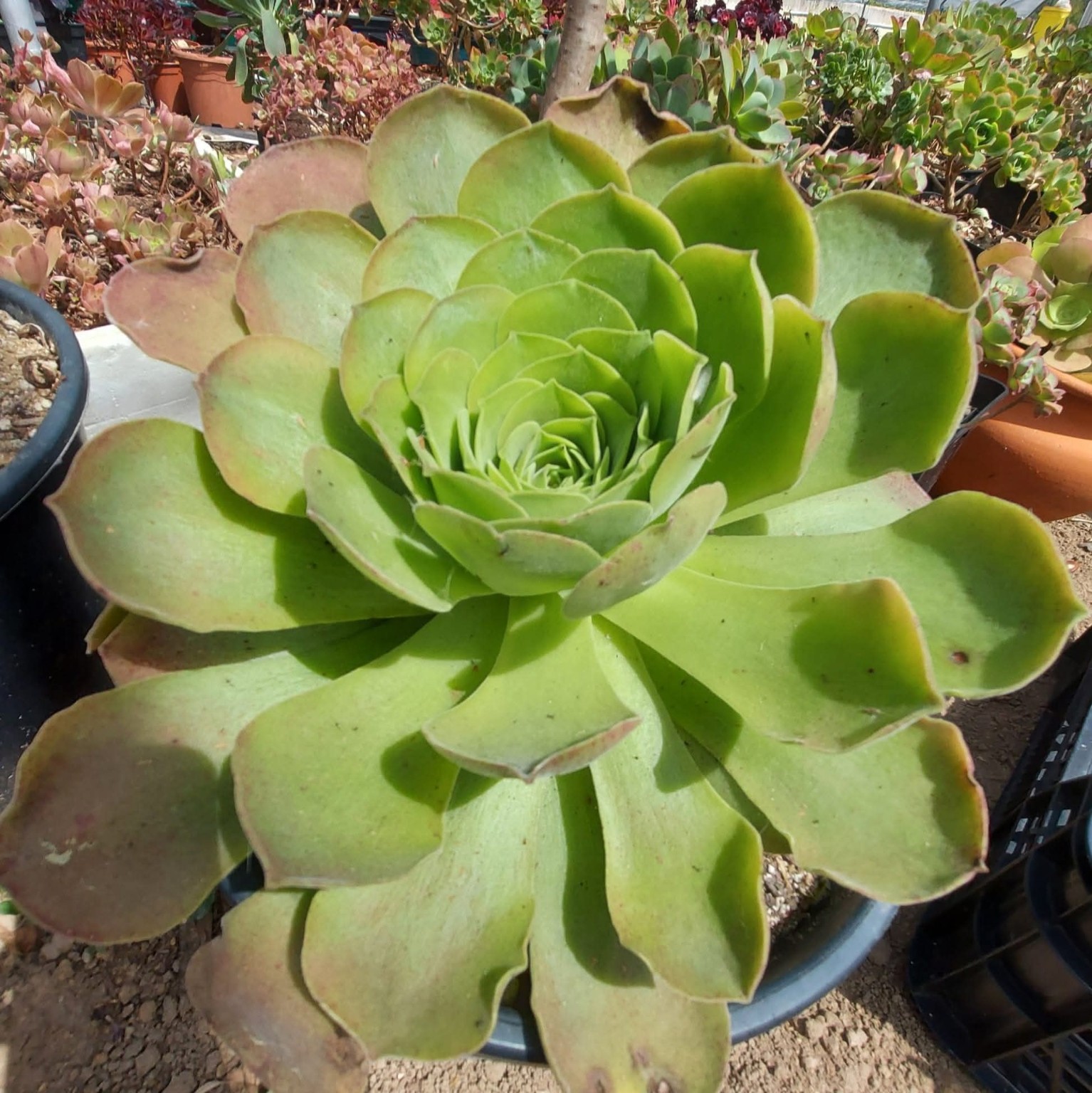
Aeonium canariense subsp. longithyrsum is the northern El Hierro form of this large Canarian Aeonium. Its broad, cup-shaped rosettes bear thick, velvety and notably glandular leaves, often with wavy margins, followed by tall yellowish-green flower heads.
- Accepted name
- Aeonium canariense subsp. longithyrsum (Burchard) Cristini
- Type
- Botanical subspecies
- Synonyms and other names
- Canariense ssp. Christii var. longithyrsum
- Natural origin
- El Hierro, Canary Islands (Spain)
- First named in print
- 1929
- Habit
- Open cup-shaped rosette
- Branching
- Few offsets
- Rosette diameter
- 30–70 cm
- Other names
- Aeonium canariense subsp. longithyrsum · Canariense ssp. Christii var. longithyrsum
- Genus
- Aeonium
- Country of origin
- Spain
- Native range
- Canary Islands
Origin and history
Endemic to El Hierro, this subspecies occurs chiefly on the island’s northern slopes, particularly around Frontera, the El Golfo valley and the cliffs near Jinama and Sabinosa. It grows in rock crevices, on moist walls, drier rocky outcrops and sometimes near northern woodland, from low elevations to around 1,000 m. Its confinement to one island also distinguishes it geographically from the closely related plants of La Palma.
Otto Burchard named it Sempervivum canariense subsp. longithyrsum in 1929. The epithet means “long-thyrsed”, referring to its tall inflorescence. In the 1960s, Eric R. Sventenius used the name Aeonium longithyrsum, effectively published in 1969. Ho-Yih Liu later grouped plants from El Hierro and La Palma within a broader concept close to Aeonium palmense.
The boundaries of this group have changed over time. In 2008, Ángel Bañares and colleagues included the El Hierro populations in Aeonium canariense subsp. christii. Marco Cristini restored their separate status as Aeonium canariense subsp. longithyrsum in 2022, a treatment now accepted by Kew. The two subspecies nevertheless share many characters, so their geographical origins remain important when identifying them.
Chronological milestones
1929 — Burchard publishes Sempervivum canariense subsp. longithyrsum.
1969 — Sventenius uses Aeonium longithyrsum; its nomenclatural standing requires qualification.
2022 — Cristini publishes the subspecies combination used in Kew’s current treatment.
Botanical description
Habit and rosettes
This perennial succulent has a short, thick stem generally concealed by its older leaves. It forms a large, cup-shaped basal rosette, ranging considerably with age and conditions, from about 10 to 60 cm across in descriptions of the group. Inner leaves remain upright, while the outer foliage spreads into a broad, deep crown. During dry spells, the rosette may partly close.
Although one main rosette often dominates, the plant is not invariably solitary. Offsets can develop near the base on short creeping shoots or stolons and gradually form additional rosettes beside the parent. The overall plant remains low-growing but may spread as these offsets establish.
Foliage, texture and colour
The leaves are broad and very fleshy, obovate to oblanceolate, narrowing to a wedge-shaped base and ending in a rounded tip, sometimes with a small mucro. The margins may be strongly undulating along part of their length and are edged with very fine cilia. Both surfaces bear a dense covering of glandular hairs, usually 0.3–0.5 mm long and occasionally reaching 1 mm. Botanical descriptions of this complex report approximately 30–60 hairs per square millimetre.
This covering makes the leaves velvety but also noticeably sticky, sometimes trapping dust or small debris. The underlying colour is green to yellowish green, with bronze, copper or orange tinges developing in stronger light. The foliage can also release a pronounced balsamic scent, particularly during hot, dry weather. These seasonal pigments are natural and do not represent variegation.
Flowering and renewal
Have you photographed this cultivar in bloom? Share flowering photographs on the Forum.
In spring, a mature rosette may produce a large, conical terminal inflorescence approximately 40–60 cm long and 15–30 cm wide. Its stalk, leafy towards the base, branches into numerous short flower-bearing shoots. Flowers are pale yellow to yellowish green, generally with eight to ten lance-shaped petals measuring 7–10 mm long. The sepals and flower stalklets are glandular-hairy.
As in other forms of Aeonium canariense, the flowering rosette is monocarpic and dies after seed production. Previously formed offsets can survive and continue growing, allowing the plant to persist after its main rosette has flowered.
Photographs
Do you grow this cultivar? Help document its shapes and seasonal colours. Share your photographs on the Forum.
Documented descendants of ‘canariense subsp. longithyrsum (Burchard) Cristini’
Reserved for Premium members
Growing conditions
☀️ Light
Provide strong light while introducing intense direct sun gradually, particularly where a large rosette is exposed.
💧 Watering
Water during active growth and let the medium aerate between applications. Avoid keeping the centre of a dense rosette constantly wet.
🪨 Potting mix
Use a stable, well-drained potting mix and a container with free drainage to support the large rosette.
🌡️ Temperatures
Shelter from frost and prolonged cold, wet conditions, adjusting protection to local climate.


