
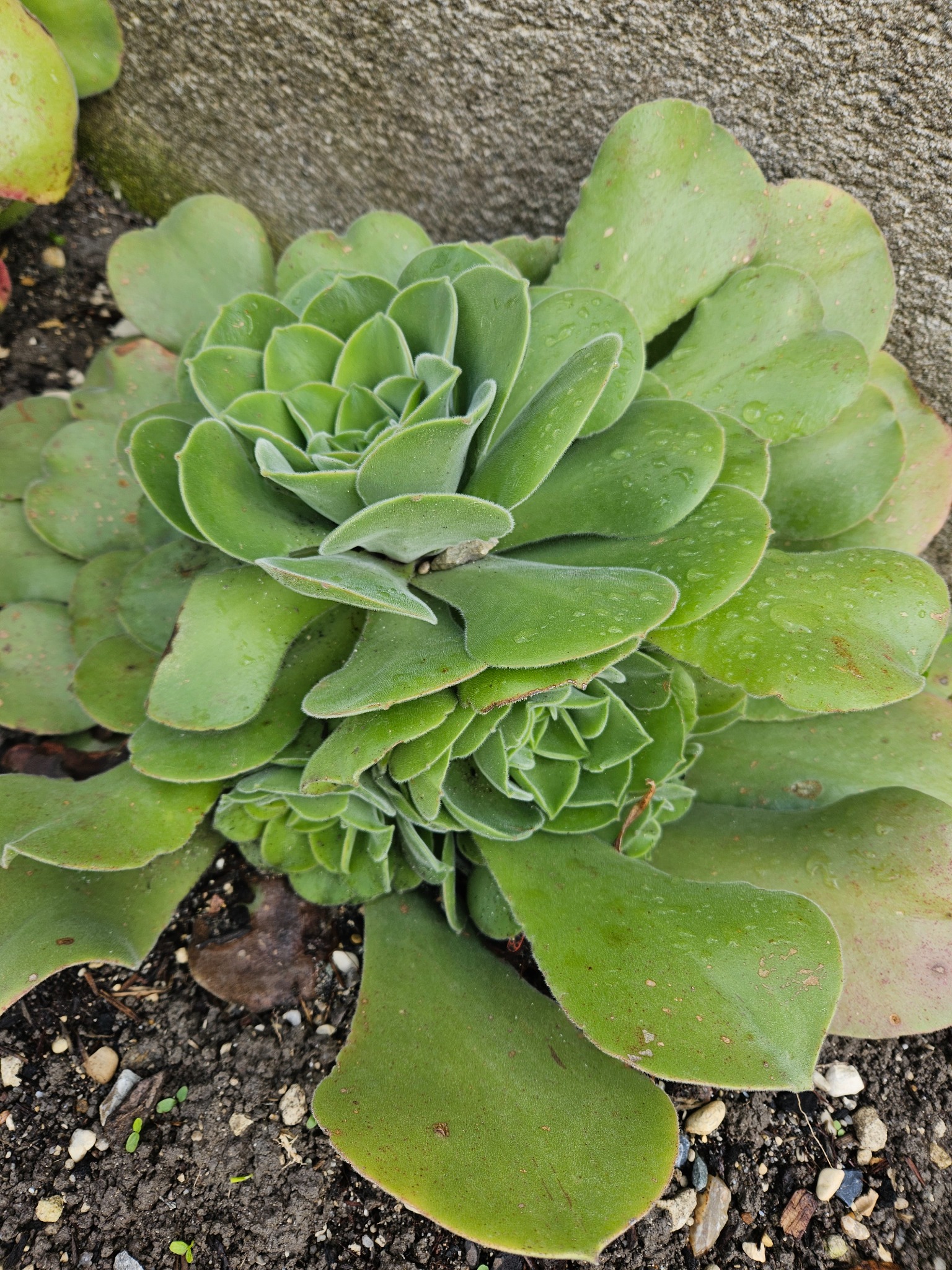
Aeonium canariense subsp. virgineum is distinguished by its cup-shaped rosettes and velvety, almond-green leaves. Endemic to northern and northwestern Gran Canaria, it combines a low-growing habit, finely glandular foliage and yellowish-green flowers.
- Accepted name
- Aeonium canariense subsp. virgineum (Webb ex Christ) Bañares
- Type
- Botanical subspecies
- Synonyms and other names
- canariense ssp. virgineum
- Natural origin
- Gran Canaria, Canary Islands (Spain)
- Historical name published
- 1888
- Habit
- Open cup-shaped rosette
- Branching
- Frequent offsets
- Distinctive leaves
- Velvety, glandular; sometimes wavy margins
- Botanical section
- Canariensia
- Other names
- Aeonium canariense subsp. virgineum · canariense ssp. virgineum
- Genus
- Aeonium
- Country of origin
- Spain
- Native range
- Canary Islands
Origin and history
Aeonium canariense subsp. virgineum is endemic to northern and northwestern Gran Canaria. It grows on rocky slopes, banks and ravine walls from low elevations up to about 1,000 m. Localities include Moya, Guía, Azuaje and the Barranco de la Virgen, in habitats ranging from open rocky sites to cooler places near lightly wooded slopes.
The epithet virgineum refers to the Barranco de la Virgen, where botanist Eugène Bourgeau collected the plant in March 1846 as specimen 356. This collection was subsequently designated as the nomenclatural reference. Published as Aeonium virgineum in 1887, the taxon was later treated as a variety of Aeonium canariense by Ho-Yih Liu in 1989.
Ángel Bañares, María Victoria Marrero and Stephan Scholz recognised it at subspecies rank in their 2008 revision because of its distinctive morphology and geographical distribution. The name Aeonium canariense subsp. virgineum is now accepted by Kew, although the older name Aeonium virgineum remains common in horticulture.
Chronological milestones
1888 — Early publication of Aeonium virgineum and related nomenclatural treatments.
1929 — Burchard treats it as a subspecies of Sempervivum canariense.
1989 — Publication of the combination Aeonium canariense var. virgineum.
2008 — Bañares publishes Aeonium canariense subsp. virgineum.
Botanical description
Habit and rosettes
This perennial succulent has a very short, stout stem, usually hidden beneath its leaves. Rather than developing a tall branching trunk, it forms a large, cup-shaped basal rosette. In wild populations, rosettes are frequently less than 25 cm across, although vigorous plants can grow larger. A few offsets may emerge at the base, gradually forming a small cluster.
The inner leaves remain partly upright while outer leaves spread more widely, producing a deep cup. Older foliage may dry and persist around the base. In summer, as growth slows, the centre becomes more compact and protects the youngest leaves from excessive exposure.
Foliage and colour
The leaves are notably fleshy, broadly obovate to spoon-shaped, narrowing towards the base and ending in a rounded tip, sometimes with a minute mucro. Their slightly concave blades are pale to almond green, with finely ciliate, occasionally undulating margins. Their relatively firm texture contributes to the compact rosette structure.
The most distinctive feature is the dense glandular hair covering on both leaf surfaces. The tiny hairs measure about 0.6–0.9 mm long, with 10–20 hairs per square millimetre in the botanical reference description. This creates a soft, matte, almost powdered texture. Stronger light can bring out pink or reddish tones along leaf margins and tips; these are natural pigments, not variegation.
Flowering
Have you photographed this cultivar in bloom? Share flowering photographs on the Forum.
The branched terminal inflorescence is ovoid to pyramidal, about 15–45 cm high and 12–30 cm across. Numerous small flowers are yellowish-green to pale yellow, generally with six to nine lance-shaped petals measuring 7–8.5 mm long and 1.5–2 mm wide. Flowering takes place mainly from March to June.
The flowering rosette is monocarpic and dies after producing seed. Where offsets have already formed, they continue growing; solitary plants are renewed from seedlings.
Photographs
Do you grow this cultivar? Help document its shapes and seasonal colours. Share your photographs on the Forum.
Documented descendants of ‘canariense subsp. virgineum (Webb ex Christ) Bañares’
Reserved for Premium members
Growing conditions
☀️ Light
Provide bright conditions, but acclimatise shade-grown plants gradually to stronger sun.
💧 Watering
Water during growth without leaving the medium waterlogged; reduce frequency as growth slows.
🪨 Potting mix
Choose a porous, free-draining medium. Avoid fine, persistently wet soil around the roots.
🌡️ Temperatures
Protect from frost and prolonged cold rain, allowing good airflow around the rosettes.


