
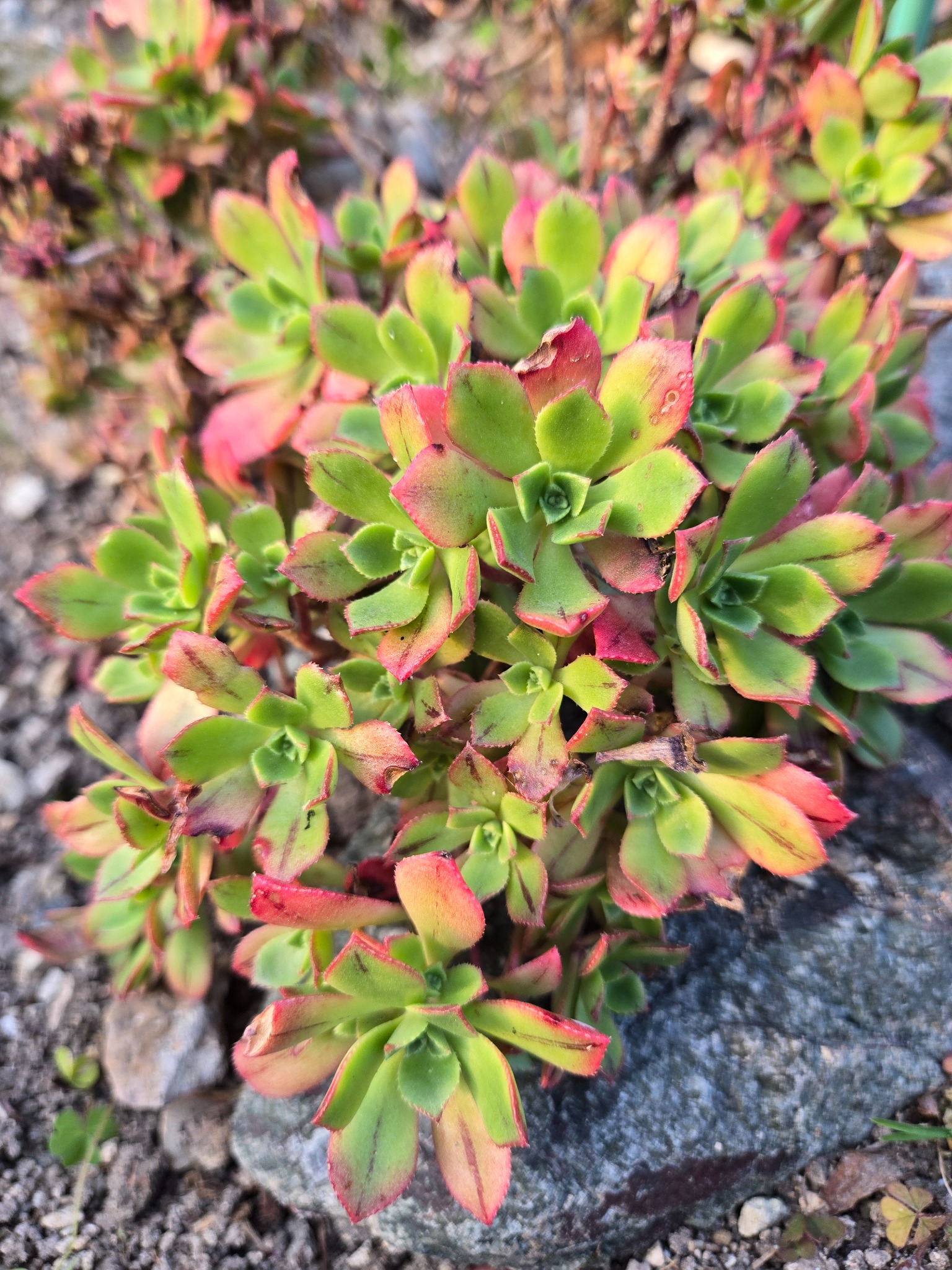
Aeonium decorum var. alucense is a dwarf, freely branching form from the arid cliffs of northeastern La Gomera. Its slender stems bear small green rosettes edged in red, which can close into delicate cups during dry periods.
- Accepted name
- Aeonium decorum var. alucense Bañares & Marrero
- Type
- Botanical variety
- Synonyms and other names
- alucense
- Natural origin
- Between Ávalo and Aluce, La Gomera (Spain)
- Date
- May 2002 — Type specimen collected
- Habit
- Low, almost creeping clump
- Branching
- Freely branching
- Height in described population
- Usually under 20–25 cm
- Rosettes
- Roughly 2.5–5 cm in the description
- Other names
- alucense
- Genus
- Aeonium
- Country of origin
- Spain
- Plant height
- Under 25 cm
- Rosette diameter
- 3–3.5 cm
Origin and history
Aeonium decorum var. alucense was described by Ángel Bañares and María Victoria Marrero in 2008 in the journal Willdenowia. The name refers to Aluce in northeastern La Gomera. The type specimen was collected in May 2002 between Aluce and Ávalo at an elevation of 300 m and is preserved in the TFC herbarium as specimen 46850.
This population occupies a very small area between Ávalo and Aluce, at approximately 200–330 m above sea level. It grows in crevices and on exceptionally dry rock faces, often on phonolite, surrounded by xerophytic vegetation. The isolation of these habitats and the plants’ unusually small size led the authors to distinguish them from typical Aeonium decorum, which is larger and much more widespread on La Gomera. Their compact habit also persists when both forms are grown under the same conditions.
Although var. alucense was validly published, Kew now treats it as a synonym of Aeonium decorum rather than recognising a separate botanical variety. The name remains useful for identifying this distinctive local form.
Chronological milestones
2002 — In May, Bañares and Marrero collect the reference specimen at Aluce–Ávalo on La Gomera.
2008 — Bañares and Marrero describe a botanical variety of Aeonium decorum in Willdenowia under the name alucense.
Botanical description
Habit and branching
This form grows as a small perennial succulent subshrub, reaching about 20 cm in height. Its numerous branches, roughly 3 mm thick, are slender and twisting, either upright or hanging down. The bark becomes rough and scaly with age, while adventitious roots may develop along the stems. Together they form a dense, bushy, sometimes almost creeping plant.
Each branch ends in a rosette just 2.5–5 cm across. Leaves spread during active growth but can rise and close into a small, tight cup when conditions become dry. These miniature rosettes are markedly smaller than those of typical Aeonium decorum.
Foliage and distinguishing features
The fleshy leaves are obovate to oblanceolate, measuring 1.5–2.5 cm long, occasionally 3 cm, and 0.6–1.3 cm wide. They narrow towards the base and taper to a small, often mucronate point. Their colour ranges from pale to deeper green, with red tones along the margins and sometimes across parts of the blade.
The leaf surface is finely hairy, bearing small multicellular hairs. The margins have single-celled cilia reaching up to 0.8 mm long. This pubescence, together with the reduced leaf size, distinguishes the form from the usually hairless leaves of typical Aeonium decorum.
Flowering
Have you photographed this cultivar in bloom? Share flowering photographs on the Forum.
Between March and May, flowering produces a short, dense inflorescence approximately 7–11 cm high and 5–7 cm wide. It may be simple or divide into two branches, supported by a hairy stalk 2–4 cm long, occasionally 5 cm, with small lance-shaped bracts.
Flowers usually have seven or eight lance-shaped petals, white with a pinkish tint, measuring 8–9 mm long. The outer petal surfaces and calyces are finely hairy, while the anthers are whitish to pale yellow. This compact flowering head, much shorter than that of the typical form, is another valuable identifying feature of alucense.
Photographs
Do you grow this cultivar? Help document its shapes and seasonal colours. Share your photographs on the Forum.
Documented descendants of ‘decorum var. alucense Bañares & Marrero’
Reserved for Premium members
Growing conditions
☀️ Light
Choose bright conditions, but avoid moving a shade-grown plant abruptly into scorching sun.
💧 Watering
Adjust watering to growth, allowing more drying time while the plant is dormant or slow.
🪨 Potting mix
A mineral-rich, freely draining medium is suitable for a plant from dry rocky habitats, without trying to copy their geology exactly.
🌡️ Temperatures
Protect from frost and cold dampness, especially around stems close to the potting mix.


