
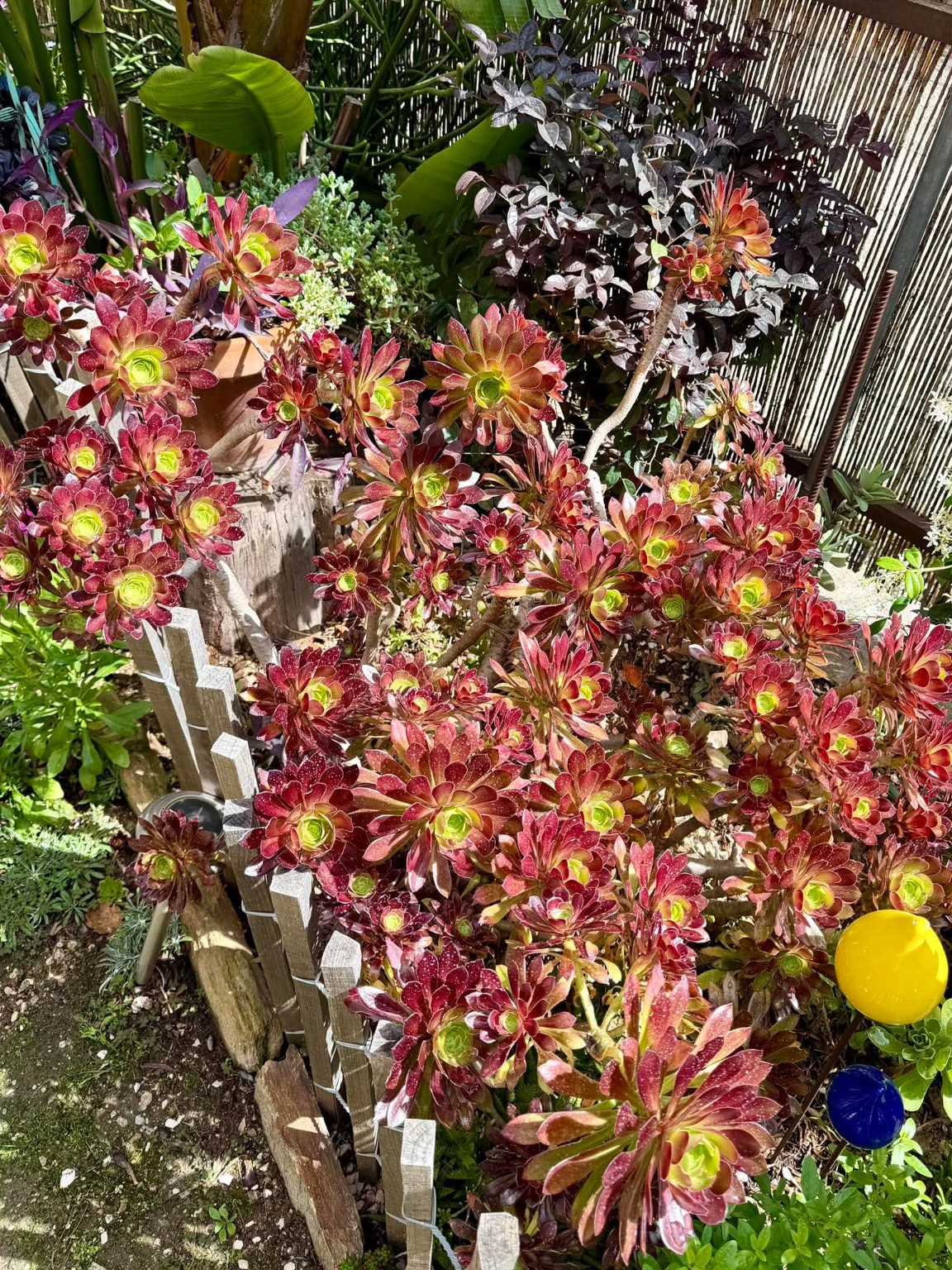
From tender green to deep purple, ‘Atropurpureum’ changes its colours with the seasons. This old favourite, with tree-like stems, has a quiet elegance that explains its enduring popularity.
- Reference name
- Atropurpureum
- Other names
- Aeonium arboreum atropurpureum · arboreum atropurpureum · Sempervivum arboreum atropurpureum · Aeonium arboreum var. atropurpureum
- Genus
- Aeonium
- Type
- Cultivar
- Growth habit
- Tree-like
- Plant height
- Over 50 cm
- Rosette diameter
- 10.16–15.24 cm
- Branching
- Highly branching
- Name publication
- 1959
Family tree
Reserved for Premium members
Origin and history
Associated with Aeonium arboreum, ‘Atropurpureum’ has travelled through horticultural history under several names. The International Crassulaceae Network lists names including Sempervivum mutabile (1817), Sempervivum arboreum atropurpureum (1887) and Aeonium arboreum var. atropurpureum (1930). These early references do not all establish the identity of a single clone.
In 1959 B. K. Boom established the cultivar in Succulenta, volume 38, no. 6, page 85. It is now commonly written Aeonium arboreum ‘Atropurpureum’. Its original raiser and the exact circumstances of its appearance are unknown; 1959 is not a proven date of creation.
In its 2022–2024 trial, the Royal Horticultural Society gave ‘Atropurpureum’ an award in 2024, praising its well-branched silhouette, changing colours and ease of growing and propagation.
Chronological milestones
1887 — Sempervivum arboreum atropurpureum, a historical name cited by ICN.
1930 — Aeonium arboreum var. atropurpureum, a historical name cited by ICN.
1959 — Established as a cultivar in 1959 by Boom (Succulenta 38(6): 85).
1999 — An Award of Garden Merit in 1999 is reported, pending confirmation from the RHS.
2024 — RHS Award of Garden Merit, following the 2022–2024 trial.
Botanical description
A little tree dressed in burgundy
It forms a shrub of upright stems that develop bare bases with age. It branches generously and can send up new shoots near the base. Adult plants often exceed 60 cm and may approach one metre; plants in the RHS trial averaged 1.5 m.
Glossy, spatulate, finely ciliate leaves form rosettes roughly 10–15 cm across in some horticultural descriptions. The crowns often retain a green centre while older leaves become burgundy and purple.
During winter growth, particularly under weaker light, green returns. Increasing sunlight deepens the purple. ‘Atropurpureum’ generally retains more red and green tones than ‘Zwartkop’, which may appear almost black. This is pigmentation, not variegation. Vigour and tolerance of dry periods make it a rewarding collection plant.
Flowering
Have you photographed this cultivar in bloom? Share flowering photographs on the Forum.
Mature rosettes send up large branched inflorescences carrying small yellow stars. Flowering was recorded in late spring during the RHS trial. The flowering rosette completes its life cycle, while other branches can continue growing.
Photographs
Do you grow this cultivar? Help document its shapes and seasonal colours. Share your photographs on the Forum.
Summer photographs

Mutations of ‘Atropurpureum’
Direct mutations

Documented descendants of ‘Atropurpureum’
Reserved for Premium members
Growing conditions
☀️ Light
A bright position reveals the colours; increase direct sun gradually after winter shelter.
💧 Watering
Water in active growth after the mix has dried. Reduce watering as the crowns tighten in summer.
🪨 Substrate
A free-draining mix and a stable container suit this cultivar as it gains height.
🌡️ Temperatures
Protect from frost and cold, wet winters; acclimatise to outdoor conditions in spring.


